


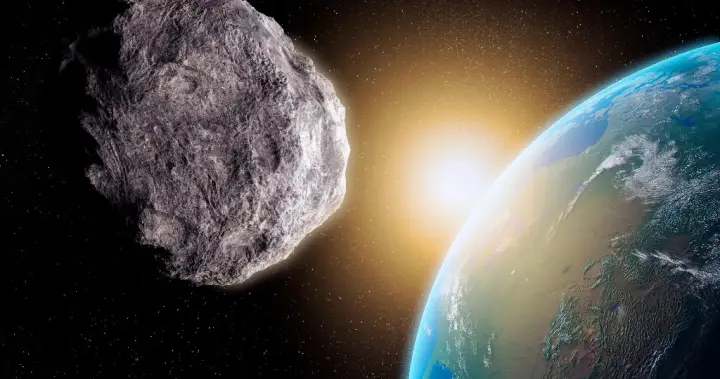
Experts believe a large asteroid the size of three CN towers stacked on top of each other is about to fly past Earth this weekend at its closest point since the 17th century and will be visible from parts of Canada.
The asteroid, dubbed 1997 NC1, “will pass relatively close to Earth on June 27,” according to a statement from the Canadian Space Agency (CSA).
The CSA says “there is no risk involved.”
According to the CSA, asteroids are small rocky or metallic bodies that orbit the sun. They are considered a kind of “minor planets”, meaning they contain many of the same elements that make up many of the planets in the solar system, but are not otherwise classified as planets.
Most of the asteroids, according to the agency, are in the asteroid belt between the orbits of Mars and Jupiter, and their sizes can range from less than 10 meters wide to the largest ever discovered, called Vesta, which is more than 500 kilometers wide.
Story continues below advertisement
Large asteroids impacting Earth are “quite rare,” the CSA says, adding: “When they do occur, these cosmic events can not only change the planet’s landscape – they can even cause mass extinctions.”
According to a National Aeronautics and Space Administration (NASA) document updated Thursday, the 1997 NC1 passage will be the closest “since it occurred before 1600, which is the furthest back when its motion is currently calculated.”
NASA also says 1997 NC1 has been determined to be a “potentially hazardous asteroid.”
Related videos

1:19
Meteor streak spotted in several US states
Previous video
Next video
How big is the asteroid and how close will it come?
A spokesman for the Dunlap Institute for Astronomy and Astrophysics at the University of Toronto said the asteroid is believed to have a diameter of up to 1,650 meters.
Story continues below advertisement
By comparison, the CN Tower is about 550 meters tall, meaning the 1997 NC1 could be three times its measured height.

Get the latest national news
Get the latest Canadian news delivered to your inbox as it happens, so you don’t miss the top stories.
But how close will it get to Earth?
“The term ‘close’ is relative here,” says astrophysicist Heidi White of the Trottier Institute for Exoplanet Research at the University of Montreal in a note.
White and CSA say 1997 asteroid NC1 will pass Earth at a distance of 2.5 to 2.6 million kilometers, which is 6.5 to 7 times farther than the Moon is from Earth.
“To put things into perspective, if the Earth were to shrink to the size of an orange, the asteroid would still pass 20 meters away,” White says.
More about science More videos
White also says events like this are “rare,” occurring roughly every five years.
NASA also says 1997 asteroid NC1 won’t get this close to Earth until 2133.

2:42
Artemis II astronaut Jeremy Hansen explains what drew him to space
White says 1997 asteroid NC1 will be visible from parts of Canada on June 27 when the sky goes completely dark, but Canadians will likely need a small telescope to see it.
Story continues below advertisement
If Canadians want to find an asteroid in the night sky, White says, they can use their telescope to look for the constellation Ophiuchus, which can usually be seen in the summer from across southern Canada.
The asteroid can then be found within the constellation.
“In a telescope, it will appear as a very faint point of light moving slowly against a background of stars,” White says.
White says past events such as 1997’s NC1 provide “valuable scientific opportunities.”
“Astronomers can use them to make detailed observations that will help determine the size, shape and composition of the asteroid, as well as refine its orbit,” White says.
“In many ways, these passing events are like a free reconnaissance mission, allowing us to study this lone traveler in much more detail!”
© 2026 Global News, a division of Corus Entertainment Inc.