


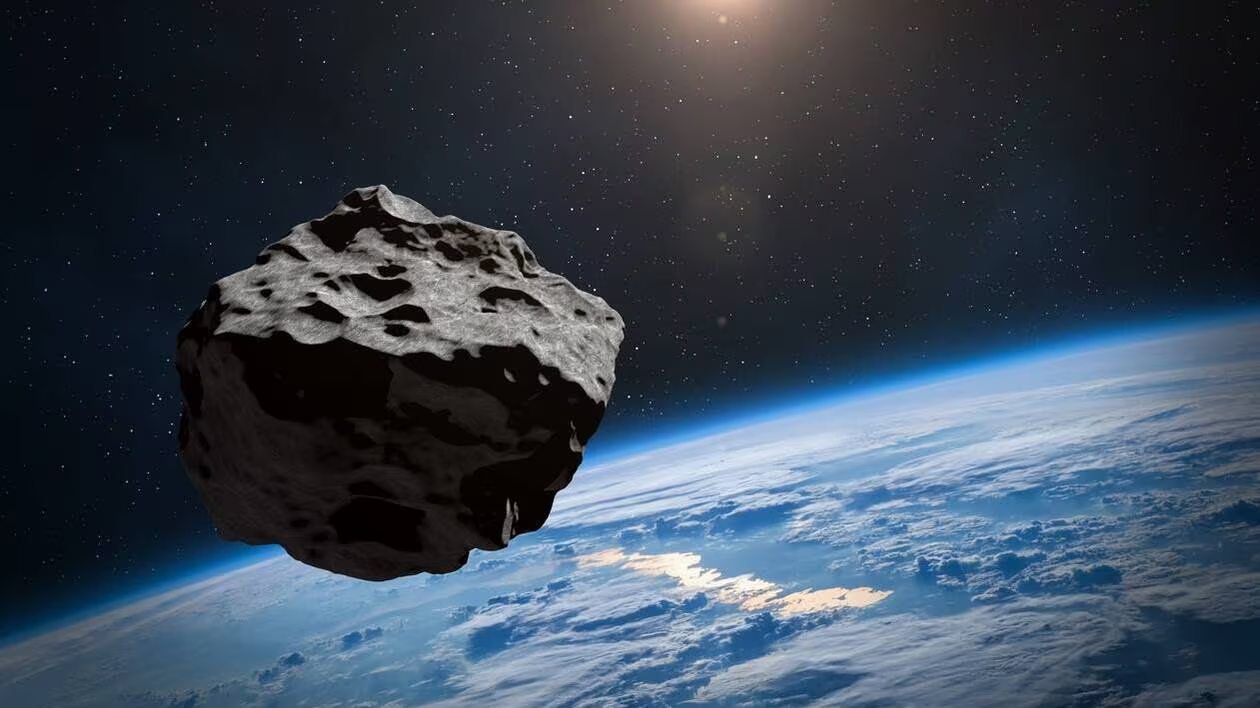
An asteroid ranging in size from 750 to 1650 meters, dubbed 1997 NC1, will pass very close to Earth this Saturday, June 27, at exactly 1:14 pm ET. Paris time. We’ll explain it to you.
Where did this asteroid come from?
As the National Center for Space Research (Cnes) reminds us, there are millions of asteroids orbiting the Sun. These are rocky or metal bodies. 1997NC1 is a rocky body: its dimensions are approximately 750-1650 meters, according to calculations based on an estimate of its albedo (the amount of sunlight it reflects), reportsAFP.
Such an event is rare. “A close passage of an object of this size by Earth occurs only once every few years,” explains Juan Luis Cano from Esa’s planetary defense office, quoted in the press release.
The object was first discovered on July 5, 1997 by one of the U.S. Army’s Ground-Based Electro-Optical Deep Space Observatories (GEODSS) located at Haleakala on the island of Maui in the Hawaiian archipelago. This discovery occurred as part of NASA’s NEAT (Near-Earth Asteroid Tracking) program aimed at cataloging near-Earth objects, which we can read about on the Cité de l’Espace website.
Read also: “It’s particularly bright”: This Breton man keeps a close eye on the 440-meter asteroid that will hit the Earth
Is this dangerous for the Earth?
The risk of collision is zero. It will pass closest to Earth on Saturday at 1:14 p.m. Paris time, speed 8.9 km/s. It would then be 2,559,461 km from our planet, or 6.66 times the Earth-Moon distance, making the probability of a collision zero. The next close flyby of 1997 NC1 will be on June 23, 2030, at a distance of 19.7 million kilometers.
Read also: How likely is it that a destructive asteroid will hit Earth?
The asteroid will be visible from regions of the Northern Hemisphere during the approach stage, almost everywhere during its closest flyby, and only from the Southern Hemisphere as it moves away from the Earth.
It can only be observed at night and has the appearance of a luminous point. “The object may reach 10th magnitude during its close passage (in Europe this will be at least daylight), making it possible to observe it with good binoculars or even modest amateur telescopes in the nights around the event,” points to Knes. It is possible that the Moon, almost full at this time, will likely interfere with its observation. “It won’t look spectacular. The asteroid will be a faint point of light in the star field,” he said. – Knes warns. Therefore, it will be impossible to see it without a tool.