

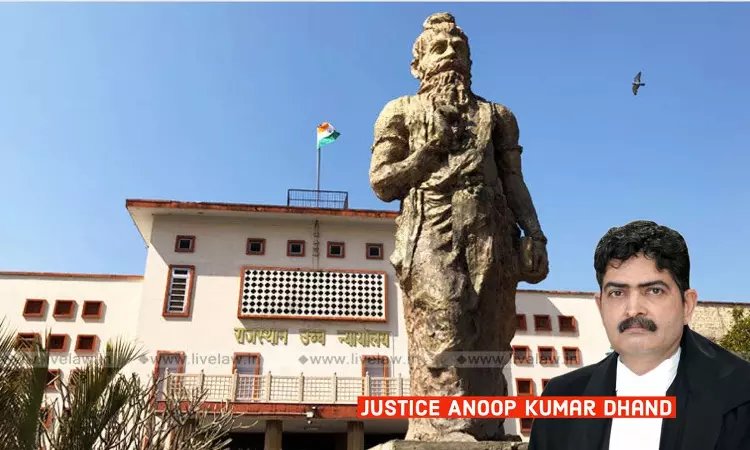
The Rajasthan High Court is set to consider whether the judicial magistrate has jurisdiction to hear and decide bail applications for these offenses despite the creation of special courts under Sections 36 and 36A to try the offenses under the NDPS Act.
At the same time, the court turned to members of the bar with a request to assist the court in this matter.
Section 36A of the Act prescribed that only special courts could try offenses punishable under the NDPS Act. Section 36 of the Act provides that there will be only one Judge in the Special Court, who will be appointed by the Government with the consent of the Chief Justice of the High Court.
Let me tell you Bench of Justice Anup Kumar Dhanda He was hearing an application for bail of the accused under the NDPS Act, which stated that the Magistrate Court had already granted him bail.
The court said:
“Taking into account all the facts and circumstances of the case, this Court deems it appropriate to frame the question to be answered: “Whether the judicial magistrate has jurisdiction to entertain and decide a bail application filed by an accused for an offense punishable under the NDPS Act, especially when special courts have been constituted to try such offenses under Sections 36 and 36A of the NDPS Act?” Respected members of the Bar are requested to assist the Court in this matter.”
In this regard, besides asking the above-mentioned question to the members of the Bar, the Court also asked the concerned Judicial Magistrate to provide clarification in this regard.
The court noted that the quantity of drugs allegedly seized from the accused was less than the commercial quantity but more than the petty quantity, which can carry a prison sentence of up to 10 years.
Referring to Sections 36 and 36A of the Act, the court stated:
“A perusal of these sections shows that the Legislative Assembly has deemed it proper to limit the powers of the Magistrate in matters of granting bail in connection with any offense under the NDPS Act. If the Magistrate is of the opinion that there is no need to remand the accused for an offense under the NDPS Act, then he cannot grant bail and will order him to be committed to a special court having jurisdiction.”
In this context, the Court framed the above question and asked the members of the Bar to assist in this matter.
The Secretary was directed to publish a notice in the list of reasons inviting members of the Bar to express their views on the matter. Meanwhile, clarification has also been sought from the Judicial Magistrate concerned.
This case was registered on July 9, 2026.
Title: Kaluram v. State of Rajasthan