


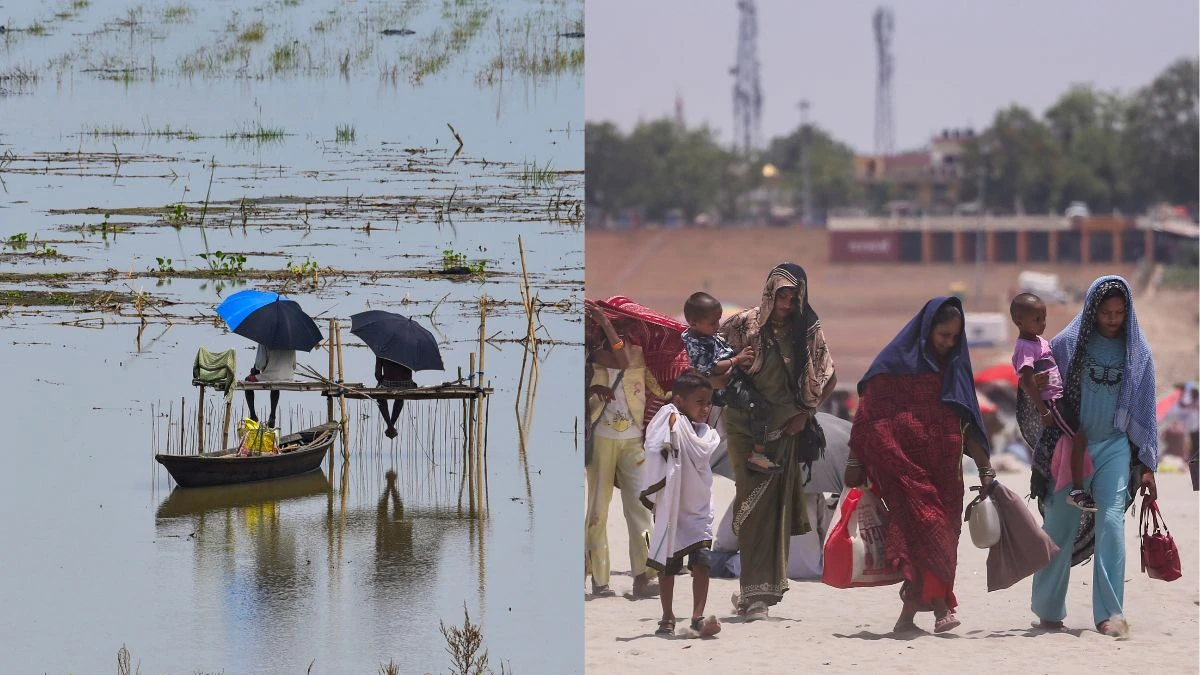
Look at the Indian sky on Sunday, June 28, and you will see two countries at once. In the Far East, the states of Assam and Meghalaya are bracing for such heavy rain that the weather service has received a rare sign.
A thousand kilometers away, Uttar Pradesh is suffocating from a heat wave. Same nation, same day, opposite skies. The reason is not chaos. This is physics.
WHY ARE ASSAM AND MEGHALAYA READY FOR EXTREMELY HEAVY RAIN?
The India Meteorological Department (IMD) expects extremely heavy rainfall in Assam and Meghalaya on June 28. Extremely heavy rain is the top of the IMD scale with over 204.4mm of rain in one day.
The reason is in the earth itself. Moist winds blowing from the Bay of Bengal hit the hills of Meghalaya and rise sharply. Flooded fields in Assam, where humid winds from the Bay of Bengal are pushed upward and squeezed dry. (Photo: PTI)
As the air rises, it cools, and the moisture it carries condenses into clouds and rain. Scientists call this orographic uplift, the simple action of a mountain squeezing water from the sky.
Sub-Himalayan West Bengal and Sikkim face the same punishment from June 27 to 29.
WHY IS IT STILL HOT IN UTTAR PRADESH?
While the east is sinking, the plains of Uttar Pradesh are heating up. The IMD has warned of extreme heat.
A heat wave is declared when the daily maximum reaches at least 40 degrees Celsius and is significantly higher than normal for that date. The sun beats down on the plains of Uttar Pradesh, still awaiting the arrival of the monsoon. (Photo: PTI)
The monsoon, the seasonal wind system that brings most of India’s rain, has not yet reached these northern plains. Until the rainy winds arrive, dry, sun-heated air lingers over the region, with nothing to cool it.
Help is on the way, but not on Sunday.
WHAT IS THE MONSOON THAT RULES ALL THIS WEATHER?
A monsoon trough, a long belt of low air pressure stretching from Punjab to Bihar on June 28, is spreading across the country.
Imagine a trench in the atmosphere into which moist sea winds flow and along which rain collects. The monsoon trench, running from Punjab to Bihar, acts as a trough for the moist sea winds and the rain they carry, resulting in heavy rainfall in the northeast. (Photo: PTI)
This belt is home to several cyclonic gyres, vortexes of rotating air that attract moisture and cause storms over Telangana, Gujarat, Chhattisgarh and the Bay of Bengal.
Western Disturbance, a rain system coming from the Mediterranean Sea, has loomed over Haryana. Together, these systems decide who gets wet and who stays dry.
WILL IT RAIN IN DELHI ON SUNDAY?
Delhi is located on the border between the humid east and the hot northwest.
The IMD expects partly cloudy skies, thunderstorms in the afternoon, gusty winds reaching 40 kmph and mercury temperatures of 39 to 41 degrees Celsius. Monsoon low and El Niño are causing a strange climate gap in India. (Photo: Windy)
Behind the entire season is El Niño, a periodic warming of the Pacific Ocean that tends to weaken the Indian monsoon, so rainfall in 2026 is forecast to fall below normal.
On Sunday, India is simply in a tug of war: one half is waiting for the rain, the other is watching it pour.
– Ends
Published:
Radifa Kabir
Published:
June 27, 2026 8:30 PM EST