


Topline
The Full Strawberry Moon will become full on Monday, June 29, 2026. Named after the traditional strawberry harvest in parts of North America in June, this full moon is notable for three reasons: it is the first full moon of summer in the Northern Hemisphere, it will hang lower in the sky than any other full moon of 2026, and it will be the second-largest full moon of the year. As is the case with every full moon, the moment of peak light is not the best time to see it. The most beautiful views will be at moonrise, when the strawberry moon appears low on the southeastern horizon at dusk.
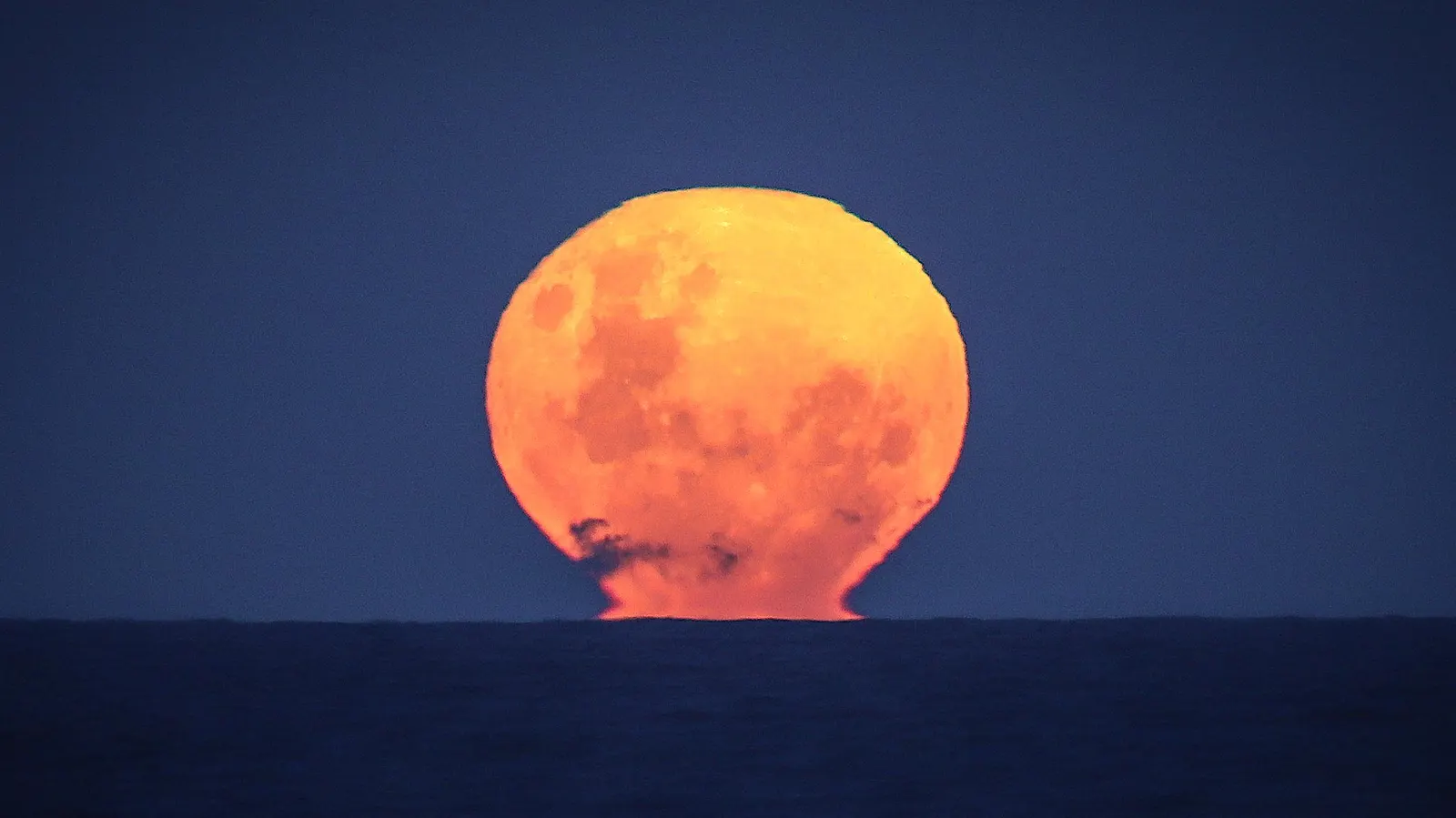
The Strawberry Moon rises over the Pacific Ocean at Narrawalle Beach near Mollymook on the south coast of New South Wales in Australia on June 6, 2020. (Photo by David Gray/Getty Images)
Getty Images
Key facts
The Strawberry Moon will reach its exact full phase at 7:58 pm ET on Monday, June 29, 2026, although it is still below the horizon as seen from North America.
This full moon occurs just one day after apogee, the point in the moon’s 29-day orbit when it is furthest from Earth. Full moons that coincide with apogee are known as micromoons—the opposite of a supermoon—and appear about 12 to 14% smaller and dimmer than average.
The June full moon is traditionally known as the Strawberry Moon, a name associated with the season’s harvest rather than the color of the moon. Other names include “Berry Ripening Moon,” “Green Corn Moon” and “Hot Moon,” according to TimeAndDate.com.
Best time to see the full strawberry moon rise
The best evening to watch the Strawberry Moon rise will be Monday, June 29, 2026 – the night of the full moon – at the same moonrise time where you are. To see the full moon at its best, find an elevated location, open field, or shoreline with a clear view of the southeastern horizon.
Moonrise will occur across North America during the blue hour, when the sky darkens but still retains color—ideal timing.
- New York City: Sunset at 8:31 pm ET, moonrise at 8:48 pm ET.
- Los Angeles: Sunset at 8:08 pm PT, moonrise at 8:26 pm PT.
The night before, the moon rises before sunset and the sky is still very bright. The next night it rises much later, when the sky has already darkened.
Low hanging full moon
June’s Strawberry Moon is the lowest hanging full moon of 2026 in the Northern Hemisphere due to the way the full moon reflects the Sun’s position in the sky. The full moon is always opposite the sun by definition. Since the summer solstice will occur just a few days earlier, on June 21, the sun is almost at its highest and longest daytime arc across the sky. As a result, the full Moon moves in the lowest possible arc, rising and setting far to the southeast and southwest and never rising very high.
In practice, this means that the Strawberry Moon remains close to the horizon most of the night. When viewed through the thicker layer of Earth’s atmosphere, it often takes on warm yellow or orange tones—and this geometry creates the basis for one of the most famous visual tricks in astronomy.
Background
The Strawberry Moon is the seventh of 13 full moons in 2026, a year that includes an additional full moon because the lunar year is about 11 days shorter than the solar year. Of these full moons, three are supermoons—January 3, November 24, and December 24—when the Moon is near perigee and appears larger than average. In contrast, June’s Strawberry Moon represents the opposite extreme: the last micromoon of 2026. The next full moon after this will be the Buck Moon on July 29, 2026, which begins a series of taller, brighter summer full moons.