


The industry’s concerns go beyond the immediate impact on liquidity, spanning over ₹50,000 crore. | Photo credit: FRANCIS MASCARENAS
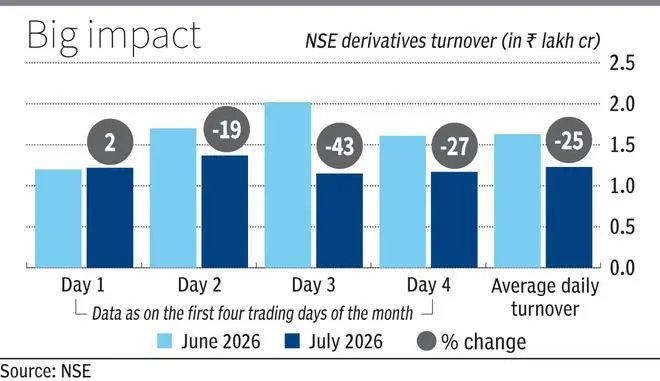
The negative impact of the Reserve Bank of India’s decision to tighten bank lending for proprietary trading in the equity derivatives market since July has been evident in the sharp decline in trading volume over the last four trading sessions.
The average daily turnover (ADT) in the derivatives segment on the NSE during the last four trading sessions fell 25 percent to ₹1,22,677 crore as against ₹1,63,328 crore recorded in the corresponding period last month.
ADT of equity and index futures on NSE fell 4 percent and 49 percent respectively to ₹69,524 crore and ₹11,420 crore as against ₹72,223 crore and ₹22,506 crore recorded during the same period in June.
Similarly, ADT’s premium on index and stock options during the last four trading sessions fell 45 percent and 17 percent to ₹34,038 crore and ₹7,694 crore respectively, from ₹62,017 crore and ₹6,581 crore in the corresponding period, according to exchange data.
Futures and options
A similar trend was observed on the BSE, where ADT on futures and options fell 30 percent to ₹27,255 crore from ₹38,881 crore in the last four trading sessions.
Ketan Marwadi, member of the Capital Markets Association of India, said that since the revised norms came into force, industry concerns go beyond the immediate impact on liquidity, covering over ₹50,000 crore.
“If a distinction is not made between speculative and directed property trading, domestic intermediaries may be forced to create space for foreign private firms to capture a larger share of market volumes and profitability. This may ultimately lead to a gradual shift of value creation, tax revenue and employment opportunities outside India,” Marwadi said.
Anand James, chief market strategist at Geojit Investments, said derivatives trading volumes, especially futures where capital requirements are higher, are likely to remain under pressure in the near term and could see a further slowdown as firms adjust to the new regulatory framework.
“Exposure costs will also be affected as bid-ask spreads widen. While this may not significantly impact investor profitability, high-frequency traders who rely on thin margins and high liquidity may face challenges,” he added.
Margin financing
Sachin Gupta, vice-president (research) at Choice Equity Broking, said futures trading inherently relies on margin funding and as funding costs rise, many traders are likely to scale back their activities and larger institutional participants become more cautious.
“While traders can gradually adapt and become more disciplined in their use of capital, the immediate impact is likely to be lower profitability,” Gupta said.
Feroz Aziz, co-CEO of Anand Rathi Wealth, noted that proprietary firms account for a significant share of liquidity in the derivatives market, especially in options and arbitrage strategies. As companies adjust their financing structures and use a greater proportion of equity capital, participation is expected to become more selective.
However, he added that markets generally adapt to regulatory changes over time. While trading volumes may initially stabilize at lower levels, liquidity is likely to gradually recover as participants adjust to the new system.
Amid lower derivatives trading activity, shares of exchange operators BSE and MCX came under pressure, falling 3 per cent each to ₹3,679 and ₹2,643 respectively on Tuesday.
Published July 7, 2026