

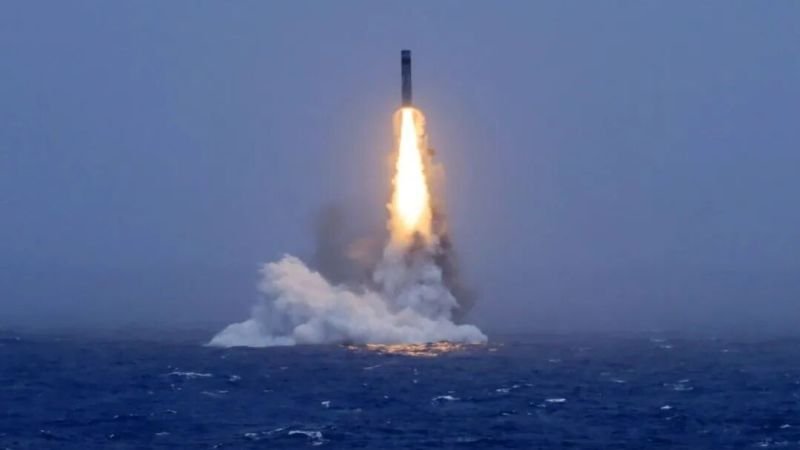
China conducted a rare test of a submarine-launched ballistic missile in the Pacific on Monday, drawing criticism from New Zealand and Australia for actions they say threaten peace and stability in the region.
The People’s Liberation Army Navy submarine “launched a strategic missile with a dummy warhead towards the corresponding high seas of the Pacific Ocean, which landed exactly within the designated waters,” Senior Captain Wang Xuemeng, a PLA Navy spokesman, said in a statement.
“This test launch was a routine part of China’s annual military training schedule,” Wang said, adding that “relevant countries” were informed about the test in advance.
“The operation was carried out in accordance with international law and practice and did not target any specific country or target,” Wang said.
The missile flew over the exclusive economic zones (EEZs) of the Federated States of Micronesia, Nauru, Kiribati and Tuvalu and landed around the edge of the Kiribati or Tuvalu EEZ, a regional source familiar with the matter told CNN.
The US State Department said it was monitoring the launch of an unarmed but nuclear-capable “long-range intercontinental ballistic missile”, in a statement attributed to its spokesman.
“Beijing’s rapid and opaque nuclear buildup is of great concern to the region and the world,” it said, adding that it called on China to “engage in meaningful discussions on arms control.”
Beijing did not specify what type of missile was tested. CNN asked China’s Ministry of Defense to comment on the test.
The PLA Navy operates two types of submarine-launched ballistic missiles: JL-2 and JL-3. The latter has enough range to reach the continental United States from waters off China, including the South China Sea, according to missile experts.
China’s main ballistic missile submarine is the Type 094, also known as the Jin class, and it has six vessels.
Beijing rarely reports its missile tests, but the JL-3 was first tested in 2018 and again a year later, according to the Center for Strategic and International Studies (CSIS) Missile Defense Project.
“Unwanted and disturbing”
New Zealand Foreign Minister Winston Peters said on Monday that China fired a missile into the waters of the South Pacific nuclear-weapon-free zone established in 1986 under the Treaty of Rarotonga. China signed Protocols II and III to the pact in 1987.
Protocol II calls on signatories not to use or threaten to use nuclear weapons against other countries or their territories within the zone; Protocol III prohibits nuclear testing in the zone.
“Earlier today, China informed us of its plans to launch a long-range ballistic missile into the South Pacific,” Peters said.
“New Zealand considers this an unwelcome and worrying development. We, like our neighbors in other Pacific countries, have no interest in China using the South Pacific as a testing ground for missile capabilities,” Peters said.
Australian Foreign Minister Penny Wong on Monday called the test “destabilizing for the region.”
The test should be seen “in the context of China’s rapid military buildup, which lacks transparency and certainty about the intentions the region expects,” Wong said, adding that she would leave it up to China to “say what its intentions are.”
The Japanese government statement expressed “serious concerns about China’s increasingly active military activities” and called on Beijing to reconsider ballistic missile testing.
The self-ruling island of Taiwan, with which Beijing has vowed to “reunite”, by force if necessary, also criticized the launch. Presidential spokeswoman Karen Guo said Beijing’s actions had “caused concern” in the region and reiterated China’s “increasingly obvious expansion ambitions in the Western Pacific.”
New Zealand’s Peters said the Chinese test brought back memories of 2024, when the PLA test-fired an intercontinental ballistic missile in the region.
“We as a region should not sit back and allow testing like this to become the norm or routine,” Peters said.
But missile tests are commonplace for nuclear powers.
For example, the U.S. Navy conducted four tests of its Trident submarine-launched ballistic missile off the coast of Florida last September, according to a press release.
India tested a submarine-launched ballistic missile in December, and Russia test-fired an SLBM in October last year.
China is building up its nuclear submarine fleet as part of its overall buildup of its nuclear forces.
China last tested an ICBM launched into the Pacific in September 2024, firing a nuclear-capable DF-31B missile from Hainan Island in the South China Sea into the open Pacific Ocean near French Polynesia. This was the first open ocean test of a Chinese intercontinental ballistic missile in 44 years.
The US Department of Defense report said China routinely conducts missile tests within its borders, noting that in December 2024 it launched multiple ICBMs in succession from a training base in the country’s west, “indicating the ability to rapidly launch multiple silo-based ICBMs.”
The US Department of Defense’s December 2025 report on China’s military power said the PLA viewed such tests as “an option for medium- and high-intensity nuclear deterrence operations.”
CNN’s Steven Jiang, Todd Simons, Hilary Whiteman, Yumi Asada, Wayne Chang and Sylvie Zhuang contributed to this report.