

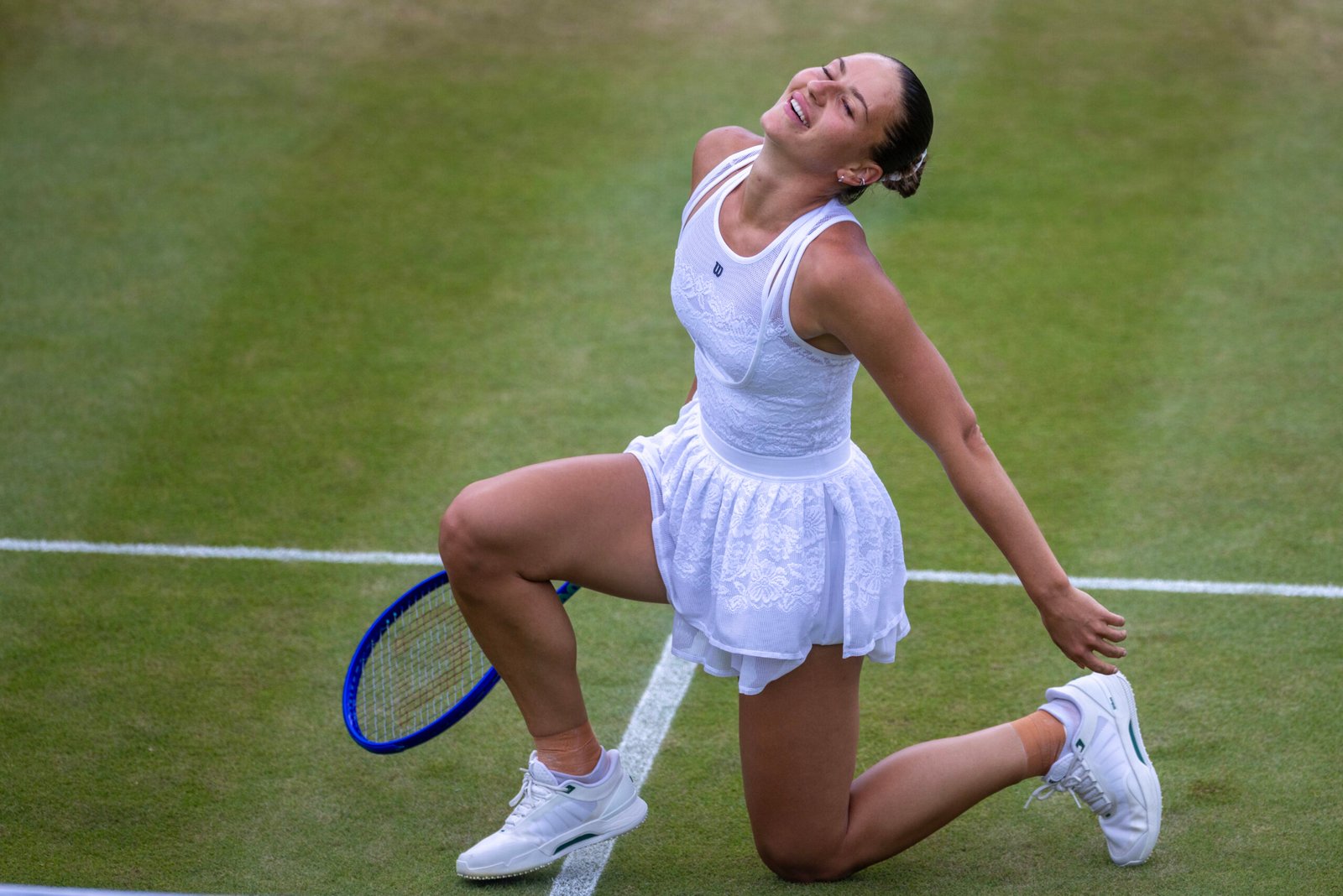
LONDON — For the first time in her career, Marta Kostyuk spent a second week in a row at a Grand Slam tournament. The No. 12 seed secured her place in the Wimbledon fourth round for the first time on Saturday with a 6-2, 4-6, 6-1 demolition of No. 23 seed Emma Navarro – her first win over an American in five meetings, including two defeats on grass last year.
But Kostyuk’s passage through the Wimbledon draw seems different to her than at this stage of Roland Garros. In Paris, she entered the tournament on a 12-match winning streak after titles in Rouen and Madrid; She was considered a title contender from the start and then one of the favorites when she upset four-time champion Iga Swiatek in the fourth round. Kostyuk did reach her first Grand Slam semi-final, but lost to eventual winner Mirra Andreeva 6–1, 6–3.
In contrast, she went three rounds in SW19 without the same level of external attention or internal expectations. After a grueling two weeks at Roland Garros, Kostyuk disappeared from view for three weeks before Wimbledon. She left Queen’s with an ankle injury and then fled to the Greek island of Hydra – notably not one of the country’s most glamorous destinations, but a quiet refuge where cars are banned and islanders transport goods on donkeys.
“I was looking for where to go, and then I had a completely random meeting with my stylist, and I told her that I wanted to go to Greece,” Kostyuk said. “And she visited many of them. She said, “Oh, you should go to Hydra. You’ll love it there.”
“I was in Mykonos once and I didn’t like it at all. Very noisy, not what I really needed at the time. I didn’t want to go to all these famous islands because I think they’re overpriced and just don’t have that aura, you know? So I went there and it was incredible. That was great”.
Kostyuk arrived in London rested and recharged, but with no real hope of going deeper in a tournament where she never advanced beyond the third round, and on a surface where she never felt comfortable.
“A For many years that I played here, I played terrible,” she said. “I couldn’t find my tennis on this surface, not at any tournament.”
A week of training didn’t help. Kostyuk lost all her sets, including to Jessica Pegula and Serena Williams.
“I turned to (coach) Sandra (Zanevska) and said, “Can you please tell me, honestly, right now, do you think grass is right for my game?” – Kostyuk recalls. “She said, ‘100%.’
From the outside, most fans and experts would instinctively agree with Zanevskaya, with whom Kostyuk has worked for the past three years. The Ukrainian is one of the most athletic athletes on tour, and her phenomenal quick-reaction skills have helped her achieve some impressive shots over the years on the grass. Her willingness to support herself at the net and her strength when she straightens her forehand are also a natural fit for the surface game.
But this year, Kostyuk has often spoken of becoming “a different player and a different person,” crediting Zanevskaya for helping her rethink her approach to tennis. She focuses less on the results of any given match and more on how she feels during it – but more importantly, she switches to a broader view of a career that she knows is, in a broader sense, transitory.
“Winning and losing are always close,” she said. “You can win everything, and in one month people forget about you. You can’t tie yourself and your self-worth to how you perform on the court, because over time it all goes away. When your career is over – I thought about this, that about the greatest players of all time, even now, people talk about them less and less. That’s normal. That’s how life should be. But that’s my point – even when you’re a legendary player, everyone still forgets about you. And you have to move on and live your life without all this success, attention and everything that tennis gave you.”
With this in mind, Kostyuk put the tribulations of the training week behind her. She says she feels “100% better” than she did at the same stage of Roland Garros – so much so that she has even started looking forward to next year before this year’s campaign ends. Just a few days after Zanevskaya was asked if she was even capable of playing on grass, Kostyuk changed her mind.
“I told Sandra (Saturday) morning that I’m really excited to be back on this surface next year,” she said. “Because I kind of know what to do. It doesn’t mean I’m going to be great next year or anything like that, but at least I have some excitement about coming back here.”
Her current focus is on the second week of Wimbledon, where she will face qualifier Ashlyn Kruger for a place in her third Grand Slam quarter-final.