

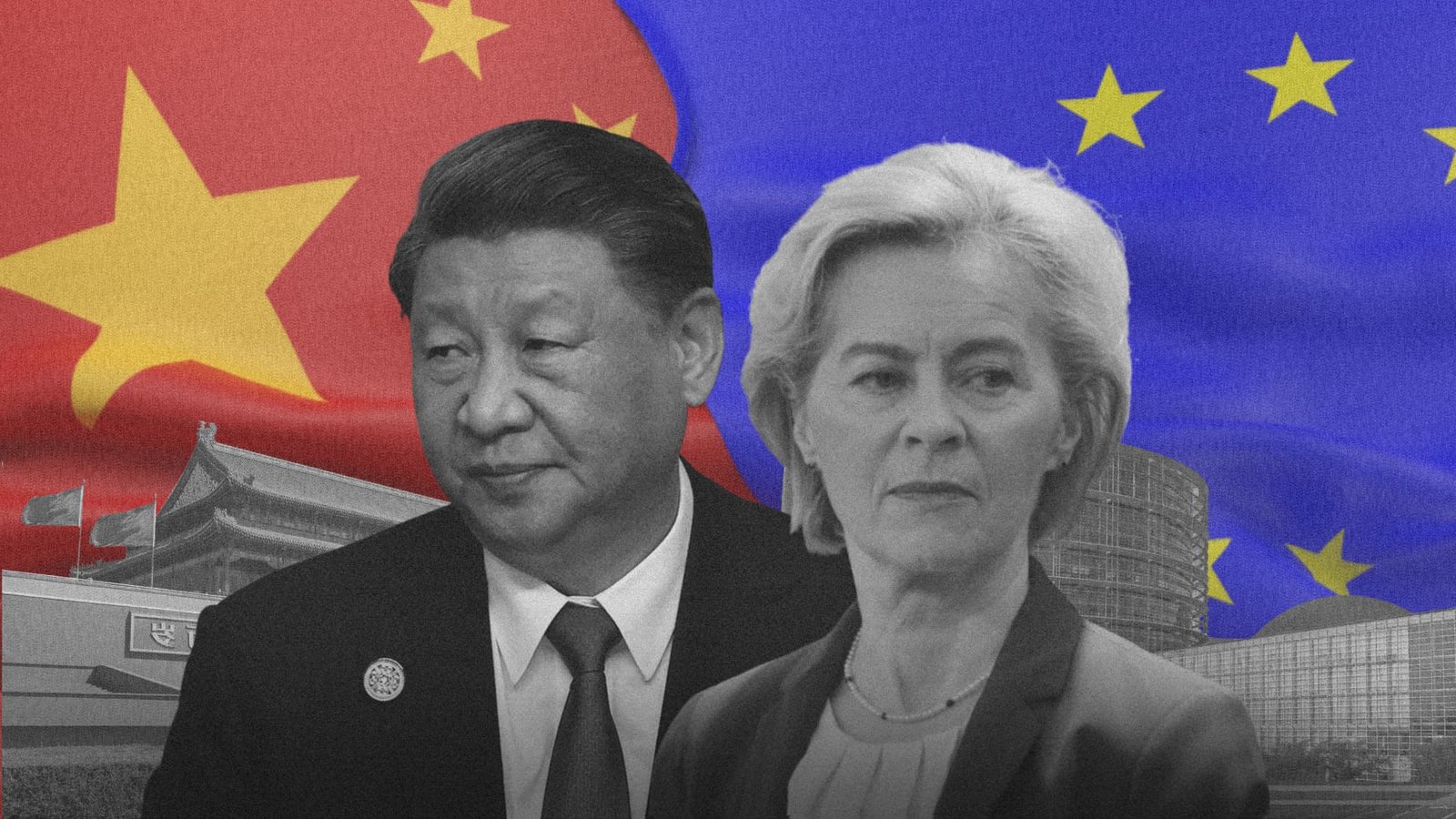
The European Union and China have agreed to negotiate until October to try to defuse deep tensions, particularly those revolving around the huge trade deficit recorded by the Twenty-Seven.
The EU and China have given themselves three months to avoid a trade war. In Brussels on Monday, June 29, the two sides agreed to hold talks until at least October to try to resolve deep tensions.
“Not everything will be resolved, not everything will be fixed, but we believe that until October our teams will have enough time to achieve concrete results,” responded European Trade Commissioner Maros Šefčović after a meeting with Chinese Minister Wang Wentao.
The EU says it no longer wants to maintain the whopping 360 billion euro trade deficit it has registered with Beijing, which it accuses of distorting competition through subsidies and an undervalued currency. The old continent fears its already fragile industries will be swept away by Chinese rivals in what some economists call a “second China shock,” twenty years after the first wave hit particularly the United States, where it triggered particularly painful deindustrialization.
However, this trade deficit is not new. In fact, since the early 2000s, the European Union has been buying more goods from China than it has sold. However, in recent years the gap has widened to more than a billion euros per day. This has become especially troubling for economic leaders as Chinese manufacturers began producing high-quality products in sectors previously dominated by Europeans, such as cars.
China argues
Faced with this situation, which is considered “unsustainable”, “the status quo is not an option”, insisted Maros Šefčović, assuring that Europe must “protect its industrial base and fight for a level playing field at the global level”. Rumors of massive job cuts at Volkswagen – with 100,000 jobs possibly affected by 2030 – have made the topic even more explosive in recent days.
But the discussions promise to be complex. China partly disputes the picture painted by Brussels and refuses to take responsibility for the economic difficulties facing Europe.
“The root causes of the problems facing the EU do not lie in China,” Chinese diplomacy responded on Tuesday.
Last week, Prime Minister Li Qiang also denied the existence of a “China shock” and vowed that China is “not rich enough yet” to massively subsidize its industries.

Separately, through an account linked to CCTV, a Chinese public media outlet, Beijing warned this weekend that it was prepared for a trade conflict. “If the EU continues to treat the negotiations as a mere formality, China could face a further deterioration in trade relations between the EU and China, or even a freeze. China does not want to come to this, but it is not afraid of it either,” the message says.
“The EU is turning into a rule-breaking organization, and the foundations of its “normative power” are being shaken,” he added, believing that “the EU’s influence is largely overestimated.”
Rebalancing Economic Models
Essentially, the solution most often proposed by Western economists would be for China to agree to rebalance its economic model, focusing it less on exports and more on consumption, as is the case in Western countries (in France, household consumption accounts for more than half of the wealth produced annually, compared with only 40% in China).
Specifically, this will require strengthening China’s social safety net. Currently, the latter is poorly developed, which encourages the vast majority of households to save a lot, and therefore consume less. This feature of the Chinese economy is perfectly identified by Beijing, which for years promised to correct the situation, but in fact did not do so.
For their part, most European leaders note that the EU is investing too little. “The way the world economy has been developing for a good decade now is clearly unsustainable, and there are three large regions, each with their own problems: China, which is not consuming enough, the United States, which, as I was going to say, is consuming too much, and Europe, which is underinvesting,” Roland Lescure, France’s economy minister, said ahead of the G7 meeting in Evian.
This is precisely the problem that Mario Draghi set out to address in a report presented at the end of 2024, proposing to invest an additional 800 billion euros per year and preparing a critical assessment of the economic policies pursued in Europe, and in particular in Germany, over the past twenty years. At this stage, only a third of his recommendations have been implemented.