

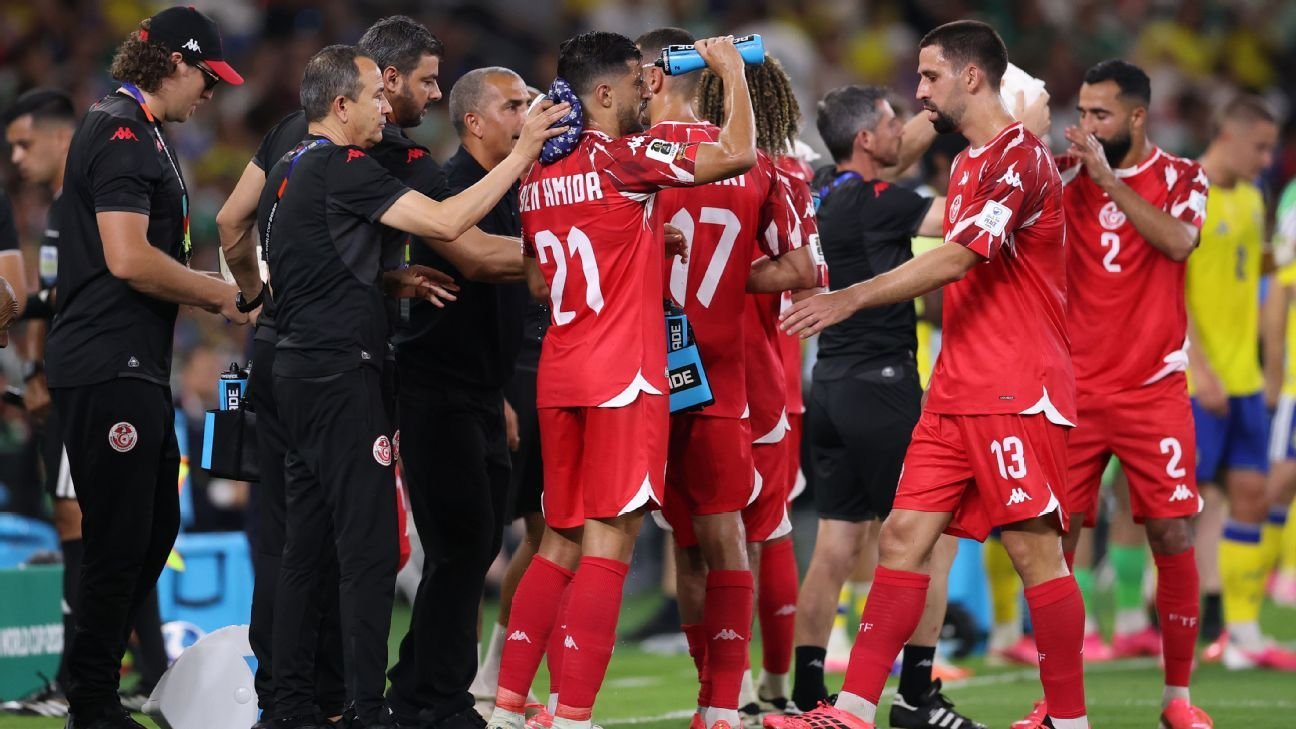
There will be a host of new initiatives at this summer’s World Cup to improve the spectator experience and the quality of match refereeing, but the mandatory hydration break in each half appears to be having the biggest impact on the game itself.
In December, FIFA announced that all 104 World Cup matches would be suspended for three-minute “drink breaks” in the middle of each half amid expectations of high temperatures during the expanded 48-team tournament to be played in the United States, Canada and Mexico.
Recent World Cups and major competitions have also included drink breaks, but these were either at the discretion of the match referee or when a certain temperature threshold was reached.
The decision to extend drinks breaks for every World Cup match, which FIFA said was made in consultation with coaches and broadcasters, has been presented as necessary for the welfare of players, but some argue there are financial motives behind their introduction.
Why do they take hydration breaks at the World Championships?
Argentina’s Enzo Fernandez said he felt “dizzy” while playing in “very dangerous” temperatures during last summer’s Club World Cup in the United States. Elsa – FIFA/FIFA via Getty Images
One of the most important takeaways from the revamped FIFA Club World Cup, held last summer in the United States, was the intense heat in which many matches were played.
Coaches and players were sharply critical of the conditions, with Chelsea and Argentina midfielder Enzo Fernandez saying he was “really dizzy” playing in temperatures he described as “very dangerous”.
Chelsea’s three games during the tournament, which was played in June and July last year on almost the same dates as this summer’s World Cup, were played under local weather warnings urging people to avoid strenuous outdoor exercise.
Then-Chelsea head coach Enzo Maresca said he had to stop training due to a red heat warning in Philadelphia last June. Spaniard Marcos Llorente said he felt “terribly hot” and added: “My toes hurt, my nails hurt – it’s unbelievable” after playing in Atletico Madrid’s 4-0 demolition of Paris Saint-Germain in Pasadena, California.
Chelsea won the Club World Cup, beating PSG 3-0 in the final at the MetLife Stadium.
In a statement announcing the mandatory introduction of drinking breaks at the World Cup, FIFA said the measure “is part of a deliberate attempt to provide the best possible conditions for players, building on the experience of previous tournaments, including the recent FIFA Club World Cup.”
– 2026 FIFA World Cup: squad list and players announced
– Injuries at the 2026 World Cup: which stars are missing?
Why are mandatory hydration breaks criticized?
The advertising is prominently displayed on stadium screens during drinks breaks at the World Cup. Visionhaus/Getty Images
FIFA’s December announcement was notable for requiring a drinking break in every half of all World Cup matches, including those played under closed roofs and in colder climates such as Seattle.
While the need to prioritize player health in high temperatures is not disputed, some argue that football games are being split from two-half competitions to a four-quarter format more closely associated with the American sport.
Those concerns were followed three months later by confirmation that FIFA had given commercial broadcasters the green light to run advertising during World Cup drinking breaks.
This development led many observers to conclude that, in addition to player welfare concerns, there were commercial motives behind FIFA’s decision to unilaterally introduce drink breaks at their showpiece event.
FIFA says its decision to implement drink breaks in all 104 matches, regardless of the local temperature during each match, was made to ensure uniformity and consistency throughout the tournament.
Broadcaster DAZN used split-screen advertising during drinks breaks at the Club World Cup last summer. Several international television companies, including American Fox, refused to participate in broadcasting the advertisement.
Advertising for spectators at elite football matches is ubiquitous on stadium signage, player kit and pitchside stands, and television audiences have regular commercial breaks before, during half-time and after games, but completely breaking away from a live football match to show advertising is a new phenomenon in several countries.
– Ogden: What is Infantino’s legacy as FIFA president: reformer or ringleader?
What did players, coaches and experts say about hydration breaks?
Virgil van Dijk has been critical of the hydration breaks introduced at this summer’s World Cup. Ulrik Pedersen/NurPhoto via Getty Images
While crowd booing during drinking breaks is a growing trend, those on the field were divided in their early weeks of the tournament.
Virgil van Dijk criticized their debut after a 2-2 draw with Japan was broken into four quarters at air-conditioned AT&T Stadium in Arlington, Texas, on June 14.
The 34-year-old laughed before saying: “The hydration breaks are a bit interesting because I’ve obviously watched almost every game to date and it’s a bit of a stretch to watch an advert every time… Not that I enjoy it.
“I think it’s not very good for neutral viewers on TV either. If it’s really hot, it would obviously be a good idea to put them in. But I think you need to look at it on a game-by-game basis, in my opinion. But I think I’ve said enough about this already.”
The impact of the breaks on the flow of play also came under scrutiny following Germany’s 7-1 win over Curucao, with Julian Nagelsmann noting that the first three-minute stoppage came at the right time for his side to sort things out tactically after conceding a first-half equalizer.
“Curacao played a diamond today and we adjusted our attack before the hydration break,” Nagelsmann said.
“But even then, there were two or three moments where it took a while because, at the end of the day, it’s very rare to play against a diamond-shaped team these days. This is almost unheard of.”
“Very few teams do this anymore and we needed some time. The water break was actually good to just go over what we had already adjusted on the board.”
Uruguay coach Marcelo Bielsa criticized the hydration breaks in his press release ahead of Uruguay’s match with Cape Verde on June 21.
“The new rules set many goals – so be it,” he said. “The general consensus is that playing four periods instead of two changes the cultural way football is interpreted.
“In my opinion, this adds nothing and takes away a lot. “When (the match) was split into four periods, there was no thought about what impact it might have on what makes football such a fun sport, but other consequences that I am not discussing or analyzing.”
Carlo Ancelotti was grateful for the chance to talk to his players as Brazil trailed Morocco by a goal in the first half of the World Cup. MB Media/Getty Images
Nagelsmann’s comments came after Brazil coach Carlo Ancelotti subsequently admitted after his side drew with Morocco that the first-half drinks break allowed him to give his players new instructions. Vinicius Junior equalized six minutes after the restart.
When asked about the benefits of breaks, Ancelotti said: “You can explain the problem to the players and make tactical adjustments, which can be very good.”
France head coach Didier Deschamps said he was rooting for them ahead of his team’s first match against Senegal.
“Those three-minute hydration breaks allow you to get the players closer and it gives you an opportunity to adjust a couple of things about the 22-23 minutes of play that just happened,” he said at a news conference.
“When the temperatures are high, it’s important to be able to give that extra opportunity, two opportunities, to the head coach. That’s a good thing, that’s a fact, but it causes us to split the game up, and if you’re in a strong position, after that break you’ll have to start playing again. But we are adapting to this, even in the preparatory work we foresaw this.
“It’s not two halves, it’s four quarters, that’s what we have, that’s been decided, so the players and coaches are adapting to this new reality, but you can say two extra times.”
U.S. women’s national team head coach Emma Hayes, who works as a pundit for British broadcaster ITV during the tournament, said the timing of hydration breaks can be either positive or negative, depending on the state of the match at the time.
“It benefits the team to lose momentum—that’s why I call them breaks in momentum,” she said.
“When you’re at the top, you don’t want it; when you lose, you want it.
“Sometimes it’s not even a workout (during a hydration break). It’s about getting fluids and calming the players down. Sometimes you can do nothing, but this can also be considered training.”
“It’s a shame. I can understand it in really warm parts of the country, but it feels like it could be something that could stay here forever.”
What do hydration breaks look like?
Hydration breaks give coaches the opportunity to gather players and adjust tactics. Lars Baron/Getty Images
The referee’s whistle stops play at the 22nd minute of each half to allow the players to recover. Three minutes later, the referee’s second whistle ends the drinks break and play resumes.
2026 World Cup chief tournament director Manolo Zubiri said that if there is an injury or other ongoing stoppage “in the 20th or 21st minute”, the referee may take the opportunity to call a short hydration break.
Coaches take the opportunity to give their players further tactical instructions during three-minute breaks, with USMNT boss Mauricio Pochettino raising eyebrows for the first time during a pre-tournament friendly against Senegal when he gathered his players around a laptop on the bench.
For viewers watching from home, commercial broadcasters have been given the option to switch to split screen or full cutout, where they can show any advert as normal.
Broadcasters have been advised that advertising should not start within 20 seconds of the referee’s signal for the drink break to begin, and they should return to action more than 30 seconds before play restarts.
Information from Ed Dove of PA and ESPN contributed to this story.