

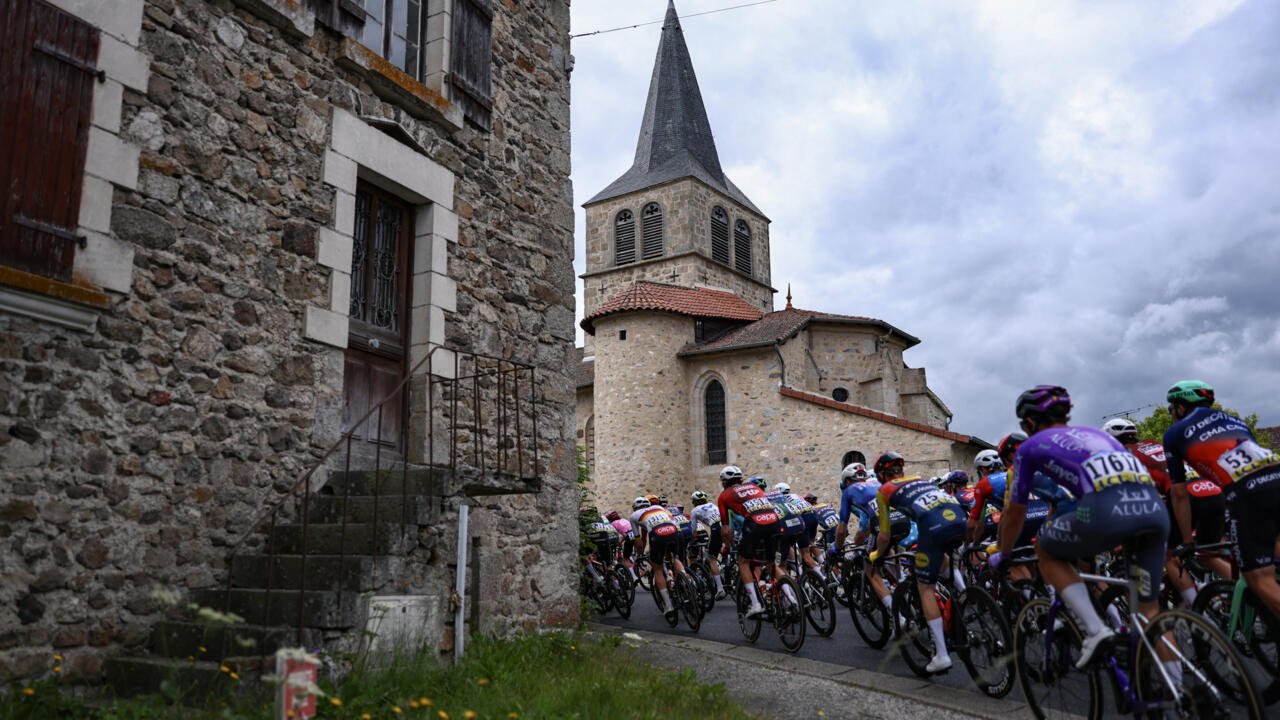
Barcelona (AFP) – “My bedside book is the Michelin Guide”: Christian Prudhomme, director of the Tour de France, and Thierry Gouvinou, its architect, tell AFP how the Grande Boucle route is created, a complex mechanism that must avoid many obstacles.
First modification: 07/02/2026 – 18:30
3 min. Reading time
When the world’s biggest race starts on Saturday in Barcelona, those responsible for ASO – the organizing company – will already have the next editions in mind, which they have been working on for a long time.
Because the construction of the route is a work that is not improvised and begins three years before Christian Prudhomme decides where the Grand Départ (tour starts) will take place.” He then determines the direction of the rotation and begins to imagine stopping cities, choosing from among the 300 candidates – 250 in France and 50 abroad – that are usually at his disposal.
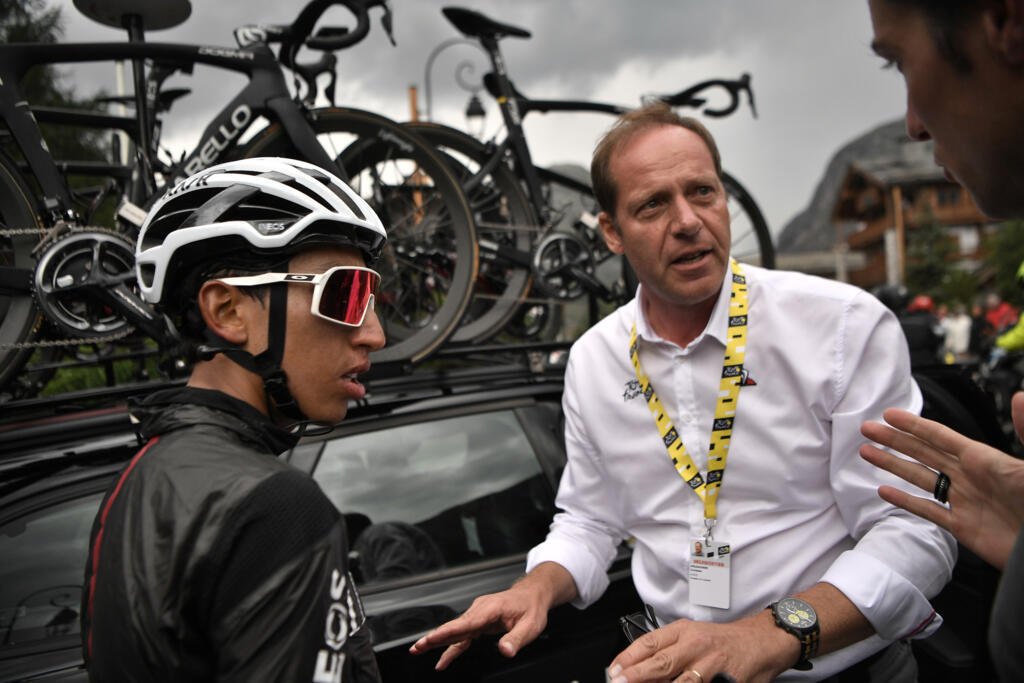
Tour de France director Christian Prudhomme (right) announces Colombian rider Egan Bernal’s new yellow jersey after a stage stoppage due to bad weather on stage 19 of the 106th Tour de France, between Saint-Jean-de-Maurienne and Tignes, July 26, 2019. © Marco Bertorello / AFP
The decision must be made by the Tour Director, who multiplies the number of meetings with local political leaders, and then writes everything down in a Word file, assessing many sporting, political, logistical factors…
“If we only thought in sporting terms, we’d be there every year,” he says, running his hand over the southern half of a map of France pinned to his office wall. “Because there you can do whatever you want: flat, medium mountains, very difficult stages. Only there is also Brittany, the land of cyclists; The North, which gave us an exceptional welcome last year; Normandy, where there are always incredible numbers of people.”
The beauty of the locations is another important element because “people also see the Tour for the beauty of the scenery,” knowing that there are “a lot of places we’ll never go” because a huge barn simply “won’t have room to set up.”
Particular attention is paid to weekend scenes when more people gather, as well as July 14th, the French national holiday.
There are also the most necessary ones. “You can name fifty ports; if there is no Tourmalet, Galibier, Ventoux or Alpe d’Huez, they will tell you there is no mountain.”
Winks at history
Prudhomme is especially fond of references to history, such as the seven stages on the front lines of the First World War in 2014.
City elections for the following year are confirmed in the spring. The Tour director is leaving only a “small margin” until early August to “adjust it a little depending on what happened in the Tour that just ended, for example, a more or less good result.”
Once the seats are chosen, it is Guven’s turn.
“At the end of August, Christian gives me a list of stopping cities. From there I dedicate all my time to it. In short, I’m building the route in a month because it needs to be completed by September 25.”
From his office, he ran his first Tour de France using mapping or sports apps. He also receives many letters from locals who recommend this or that little-known climb.
He then gets into the car and goes to “sensitive areas.” In particular, coming to the city center, which has given him “more work” for several years due to urban renewal.
Last minute changes
Once the route has been decided, as announced in Paris at the end of October, all that remains is to fix the inevitable problems, such as the collapsed cornice.
However, sometimes the only solution is to urgently change the route, as will happen in the second stage on Sunday due to the swine fever epidemic in the Collserola massif in the Barcelona agglomeration.
For this former cyclist, experience matters. “This is my 30th tour. There aren’t many regions I don’t know.”
And the work continues even on vacation, when he continues to always monitor the roads. “My bedside book,” he says, “is a Michelin map.”
© 2026 AFP