
The Enduring Mystery of Shergar: Ireland’s Greatest Racehorse Kidnapping After Four Decades
The telephone rang at 2 a.m. in London. On the other end, a voice delivered news that would launch one of the most baffling criminal investigations in sporting history: Shergar, the most valuable racehorse in the world, had been snatched at gunpoint from his stable in County Kildare, Ireland. The date was February 8, 1983. More than forty years later, despite exhaustive police investigations, documentary exposés, and countless theories, the fate of the champion thoroughbred remains one of the most enduring mysteries in the annals of both sport and the Troubles.
A Champion Without Peer
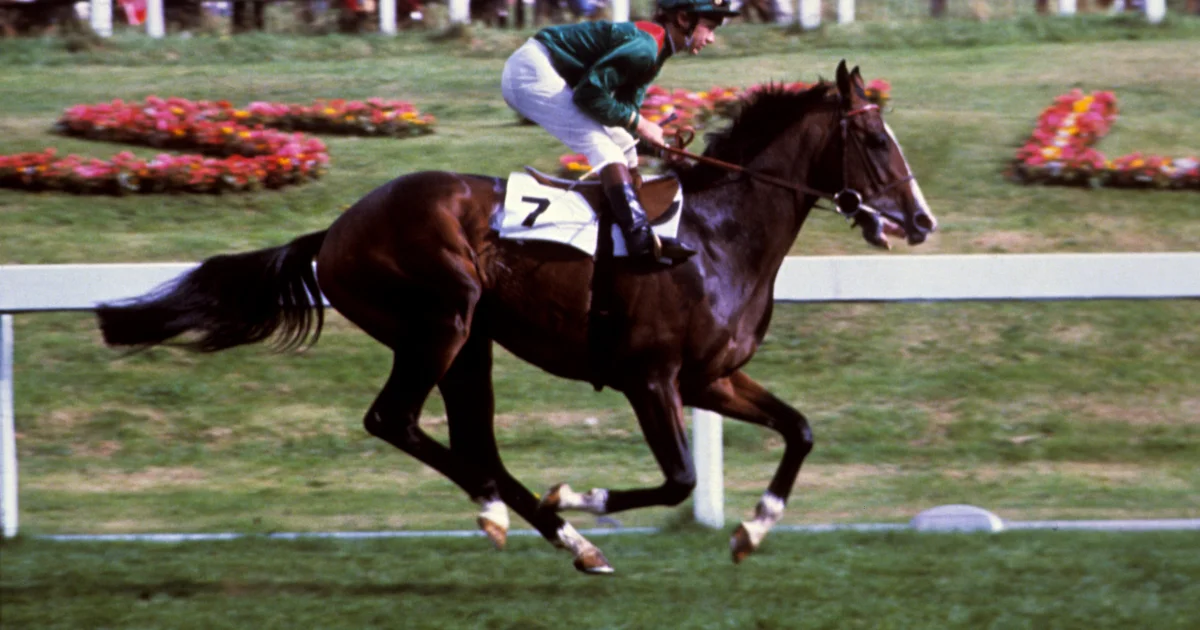
To understand the magnitude of the crime, one must first understand the horse. Shergar was not merely a winner; he was a phenomenon. Owned by the Aga Khan IV, the spiritual leader of the Ismaili Muslims and one of the world’s most prominent racehorse owners, the bay colt with a distinctive white blaze and four white socks dominated the 1981 flat racing season.
He won the Epsom Derby by a staggering ten lengths—a margin of victory so vast that the jockey aboard the runner-up, unable to wear his glasses while riding, genuinely believed he had won the race as he crossed the line. Weeks later, Shergar repeated the feat in the Irish Derby. Sports commentator Derek Thompson, who stood in the winner’s circle that day, ranks him “probably the best of all time.”
“The guy who rode the second horse, he was long-sighted and he couldn’t wear his glasses, obviously, when he was riding. So when he passed the post, he thought he’d won.” — Derek Thompson, recalling Shergar’s 10-length Epsom Derby demolition.
Syndicated at a valuation exceeding £10 million (equivalent to well over $50 million today), Shergar was retired to Ballymany Stud Farm near Newbridge, County Kildare, to begin a lucrative career as a stallion. He was, quite literally, a national treasure and a global asset.
The Night of the Gunmen
The kidnapping read like a thriller screenplay. Jim Fitzgerald, Shergar’s head groom, recounted the terror in Alison Millar’s documentary Searching for Shergar before his death. Millar described Fitzgerald as a man “absolutely haunted, traumatized by the whole experience” who likely never recovered.
On that February evening, Fitzgerald, his wife, and their children were in the farmhouse sitting room. A knock at the door revealed armed men—later identified by investigators as likely members of the Provisional Irish Republican Army (IRA). The gunmen forced the family to the floor at gunpoint, marched Fitzgerald to the stable, and loaded the stallion into a waiting horsebox. Fitzgerald was driven 30 miles away and dumped on a roadside with a gun to his head and a warning: “Shut up. Don’t talk about this.”
The operation was military in its precision. There were no witnesses, no forensic trail, and no immediate ransom note. The horse had vanished into the night.
Negotiating with Ghosts: The Thompson Channel
Enter Derek Thompson. Because of his high-profile connection to the horse and the Aga Khan, the kidnappers chose him as an intermediary. Thompson flew from London to Belfast, then to a remote farmhouse 30 miles out, where he spent 12 hours fielding calls from the abductors.
The demands fluctuated wildly—from £40,000 to £2 million. The Aga Khan, adhering to a principled stance against paying ransoms that might fund further violence, refused to engage financially. Then came the final, chilling call Thompson recalled decades later: “‘The horse has had an accident. He’s dead.’ And the phone went dead. That’s the last we heard.”
Context: The Troubles and the Economics of Terror
The kidnapping did not occur in a vacuum. It unfolded at the height of the Troubles, the ethno-nationalist conflict that gripped Northern Ireland from the late 1960s until the Good Friday Agreement in 1998. The IRA, the primary Catholic paramilitary group, relied on bank robberies, protection rackets, and donations to fund its armed campaign against British rule.
As filmmaker Alison Millar noted, “The bank robberies weren’t paying off.” Shergar represented a potential windfall—a single asset worth millions that could purchase vast quantities of weaponry, notably Libyan-supplied arms funneled through sympathetic channels. The logic was cold and utilitarian: the “most expensive horse in the world” was a convertible asset for a war economy.
The Search: Psychics, False Leads, and Folk Songs
The investigation that followed was unprecedented in scale. The Garda Síochána (Irish police) and the Royal Ulster Constabulary (RUC) poured resources into the case. The public fascination was intense; a folk song charted, and crime-solving clairvoyants flooded tip lines.
“The help lines were getting bonkers [with] people saying, ‘Hey, we found the horse.’ And it wasn’t. It was, like, a dead sheep,” Millar recalled. Theories proliferated: the horse had been shipped to Libya for Muammar Gaddafi; he was stolen to settle U.S. Mafia debts; he was hidden in a secret stable awaiting a ransom drop that never came.
| Prominent Theories on Shergar’s Fate | Key Proponent / Source | Plausibility Assessment |
|---|---|---|
| Killed shortly after kidnapping due to handling difficulties; buried in County Leitrim bogland. | Sean O’Callaghan (ex-IRA informant), Tommy Conlon (journalist) | High. Supported by geography, IRA operational capacity, and O’Callaghan’s 1998 memoir. |
| Smuggled abroad (Libya/Europe) for breeding. | Contemporary press speculation, some intelligence reports | Low. Logistically near-impossible for a high-profile stallion requiring specialized care. |
| Stolen for U.S. Mafia debt repayment. | Tabloid theories, unverified intelligence | Very Low. No evidentiary link; IRA funding streams were distinct from organized crime syndicates. |
| Accidental death during transport; body disposed of secretly. | Richard Brabazon (trainer), Tommy Conlon | Moderate-High. Aligns with “accident” call to Thompson; Brabazon notes difficulty hiding a large animal carcass. |
The Informant’s Account: Sean O’Callaghan and Kevin Mallon
The most detailed narrative comes from Sean O’Callaghan, a former IRA volunteer turned supergrass (informer), whose 1998 memoir The Informer named Kevin Mallon—a notorious IRA operative famous for a 1973 helicopter prison escape—as the ringleader. O’Callaghan wrote that the kidnappers transported Shergar to County Leitrim, near the Northern Ireland border, an area of sparsely populated, boggy terrain ideal for concealing a large carcass.
Journalist Tommy Conlon, who chronicled the IRA kidnapping of supermarket executive Don Tidey, corroborated the geography: “If the local leader here got a phone call saying, ‘We need to dispose of this horse,’ there would’ve been people here to do it… so remote that it would be an ideal place to bury a body that you never wanted found.”
Local lore pins the disposal site near Aughnasheelin. 60 Minutes attempted to contact Mallon without success. O’Callaghan died in 2017; Mallon’s current whereabouts and status remain opaque.
Why the Case Went Cold: Structural Impediments
Several factors conspired to ensure the case would never be solved:
- Jurisdictional fragmentation: The kidnapping straddled the Republic of Ireland and Northern Ireland, complicating police coordination during a period of minimal cross-border cooperation.
- IRA discipline: The organization’s cell structure and culture of silence (omertà) meant few participants ever broke ranks, even decades later.
- Lack of forensic evidence: In 1983, DNA profiling was in its infancy; the crime scene was contaminated by necessity (the groom’s presence), and the horsebox was never recovered.
- Political sensitivity: As the peace process advanced in the 1990s, there was institutional reluctance to reopen wounds or prosecute aging volunteers for “legacy crimes” that might destabilize the fragile peace.
Legacy: A Symbol of Ireland, Stolen by Its Own Conflict
Alison Millar captures the cultural wound: “The horse is such a symbol of Ireland and, you know, freedom, and its beauty, its wildness, its magic. And there’s a shame that they shot the most famous and killed the most famous horse in the world at that time.”
Shergar’s name endures in Irish consciousness not merely as a sporting legend but as a metaphor for the wanton destruction wrought by the Troubles. The Aga Khan, who died in February 2024 at age 88, never learned the truth. His breeding empire, Godolphin (founded later by his relative Sheikh Mohammed), and the wider bloodstock industry tightened security protocols permanently in the kidnapping’s wake.
Today, Ballymany Stud operates under surveillance unimaginable in 1983. The Shergar Cup, an annual jockeys’ competition at Ascot, bears his name. But the horse himself—his bones, his final resting place—remains lost to the bogs of Leitrim or the silence of men who took their secrets to the grave.
Current Status: Cold Case, Open Memory
As of 2025, the Garda Cold Case Unit lists the Shergar kidnapping as an active investigation, though detectives privately acknowledge the probability of a resolution is negligible. No human remains linked to the horse have been found; no weapon recovered; no definitive confession corroborated by physical evidence.
The most recent development came not from police but from cultural reckoning: Millar’s 2023 documentary Searching for Shergar reintroduced the story to a generation born after the Good Friday Agreement, framing it as a microcosm of a conflict that consumed the innocent alongside the combatants.
Derek Thompson, now in his eighties, still receives occasional letters from amateur sleuths. He remains convinced the final call was genuine. “They couldn’t handle him,” he says. “A stallion like that… you don’t just tie him to a tree.”
And so the mystery persists—a champion stolen by history, buried in the borderlands, galloping forever in the gap between what is known and what will never be proven.
Arts, Autos, Beauty, Books, Business, Communities, Computers, Drink, Education, Electronics, Entertainment, Finance, Fitness, Food, Games, Garden, Government, Health, Hobbies, Home, Industrial, Internet, Jobs, Law, Leisure, Literature, News, Online, Pets, People, Real Estate, Reference, Science, Shopping, Society, Sports, Telecom, Transportation, Travel, Vehicles, Ireland, Northern Ireland, United Kingdom, County Kildare, County Leitrim, The Troubles, Irish Republican Army, IRA, Kidnapping, Cold Case, Horse Racing, Thoroughbred, Shergar, Aga Khan, Aga Khan IV, Derek Thompson, Jim Fitzgerald, Alison Millar, Sean O’Callaghan, Kevin Mallon, Tommy Conlon, Richard Brabazon, Ballymany Stud Farm, Epsom Derby, Irish Derby, Godolphin, Bloodstock, Ransom, Unsolved Mystery, Historical Crime, 1980s, 1983, Documentary, Investigative Journalism, Sports History, Cultural Heritage, Negative, Controversial, Critical, Neutral

