


photo source, DAY
narration
Before photography became the visual language of imperial power, the Englishwoman drew portraits of people she met in India with extraordinary interest and accuracy.
This is Emily Eden.
Emily is a very talented artist and writer. She is a woman from Britain’s most powerful political family.
In the 1830s, she toured northern India with her brother George Eden (1st Earl of Auckland), then Governor-General of India.
Read more
During this journey, she painted portraits of princes, officers and court dignitaries, as well as servants, travelers, fakirs, Afghan and Sikh leaders, Akali warriors, hill tribes and animals who traveled with the royal retinue.
It was this broad perspective that set Emily apart from many of her contemporaries.
 photo caption, Click here to join BBC News Telugu WhatsApp channel
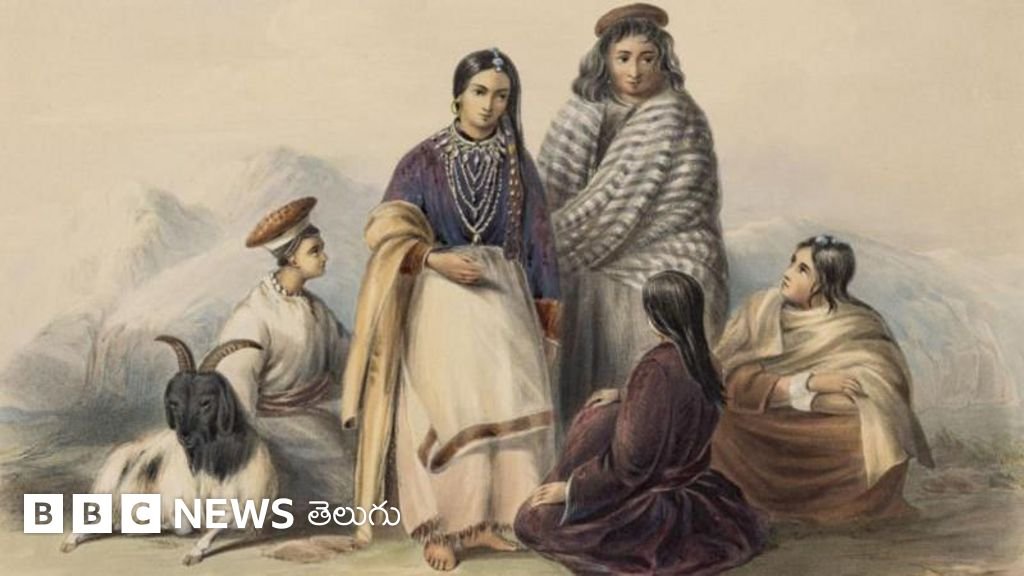
More than two dozen of her paintings were published in 1844 under the title Portraits of Princesses and People of India.
Now these paintings have become a special attraction of the exhibition “The Princess and the People” organized by DAG (Delhi Art Gallery) in Delhi.
The exhibition, curated by historian Mary Ann Pryor, brings together a complete series of lithographs (hand-colored) based on Eden’s drawings.

photo source, DAY
Emily Eden arrived in Calcutta in March 1836. There a new world opened up for her.
She did not paint a single painting for three weeks due to homesickness and the need to adapt to her new environment. For two months not a single picture was painted.
However, it was the people she was with that filled her with excitement.
These include Emily’s nephew William, sister Fanny, servants, nanny, cook, servants, doctors and pets.
She is a versatile person, not only as an artist, but also as a writer.
Historian and writer Mary Ann Pryor notes that exposure to new people, cultures and ways of life began to broaden her horizons even before arriving in India.
“The diversity of people and places inspired and enriched Emily’s art, and her natural curiosity always sought out what was new and different. Her observations were carefully recorded in her sketches and paintings,” Mary said.

photo source, DAY
Instead of castles, churches and English landscapes, Eden focused his attention on strangers, different costumes, architecture and new landscapes.
Between 1836 and mid-1842, she willingly traveled to regions on the verge of major political change. Her paintings provide a rare glimpse into the court of Maharaja Ranjit Singh.
The kingdom of the then Maharaja of Punjab was one of the most powerful kingdoms in the Indian subcontinent. These images reflect the final stage of his reign, the beginning of the Victorian era.

photo source, DAY
Her diaries are full of humor and observations. She often wrote the names of people and places exactly as they sounded.
Having reached Benares (modern Varanasi), Eden’s group descended the Ganges to nearby Ramnagar. The king had his residence here.
Emily was not impressed by the scene and wrote: “We are going to leave our ship here and go paint.”
However, Emily was not immediately inspired. Initially, cultural differences between England and India made her yearn to return home.

photo source, DAY
The fact that women could not enter the church without a special hat called a “bonnet”, the infestation of mosquitoes, the unbearable heat, the sounds of dogs, crows, foxes and hawks, and the need to stay at home for long periods of time made Emily uncomfortable.
But months passed and she starred in several films. Her films gradually gained popularity. They quickly sold out at charity fairs in Shimla.
The British in India also appreciated these films. Indian artists also began to imitate them.
Emily Eden’s paintings are among the best Indian paintings produced by British women artists during the Regency and Victorian eras, Pryor said.
Her stature was rivaled only by Charlotte Canning, famous for her plant portraits, and then by Marion North.
In 1842, the Eden family returned to England. Even after this, Emily continued to draw.

photo source, DAY
Visiting the Sikh court in 1838, Eden painted sketches of the servants of Maharaja Ranjit Singh’s eldest son, Khadak Singh.
Their elegant dresses, turbans and embroidered shoes show how much she was attracted to this outfit.
In letters written that same year, she repeatedly described Sikhs as “attractive to look at” and praised their fine physiques.

photo source, DAY
photo caption, Dhullo, Dedar Khan
The person on the left in the photos above is Dhullo and the person on the right is Dedar Khan. Both were senior officials at Government House in Calcutta. Eden drew them in winter uniform.
Lord Auckland’s chief servants carried swords on their belts. But at home they were barefoot.

photo source, DAY
photo caption, Pashtun men
Eden also painted these Pashtuns wearing traditional white salwar kameez and turbans from Afghanistan.
They came to Shimla from Kabul with a British officer. She described the meeting as “meeting two Arabs.”

photo source, DAY
photo caption, HMS Jupiter – ship
While aboard the ship Jupiter on a voyage to India, Eden filled a sketchbook with photographs of the sailors who helped on the arduous voyage.

photo source, DAY
photo caption, Akali Nihang militants
Eden’s depiction of the Akali Nihang warriors reflects the importance of these particular warriors in the Sikh army, known for their high turbans, blue robes and throwing steel weapons.
photo source, DAY
photo caption, Photo of a wealthy Muslim student (left)
Eden also painted a portrait of a wealthy Muslim student from Calcutta. She recorded that the student clearly stated that her pearls, emeralds and jewelry belonged to her and not her father.
The one on the right is the daughter of a government official. She is dressed in a salwar kameez, which was rare at that time, with jewelry, an embroidered cap, and holds a toy wheel in her hand.
photo source, DAY
photo caption, Emily Eden died in 1869.
Emily Eden is also a humor writer.
However, her initial strong impulse to paint the landscapes and people of India gradually faded away. There were very few of her films after that. Most of them feature familiar scenes from England.
Emily Eden died in 1869.
(BBC Newsroom Collective publication)