

Do you like our content?
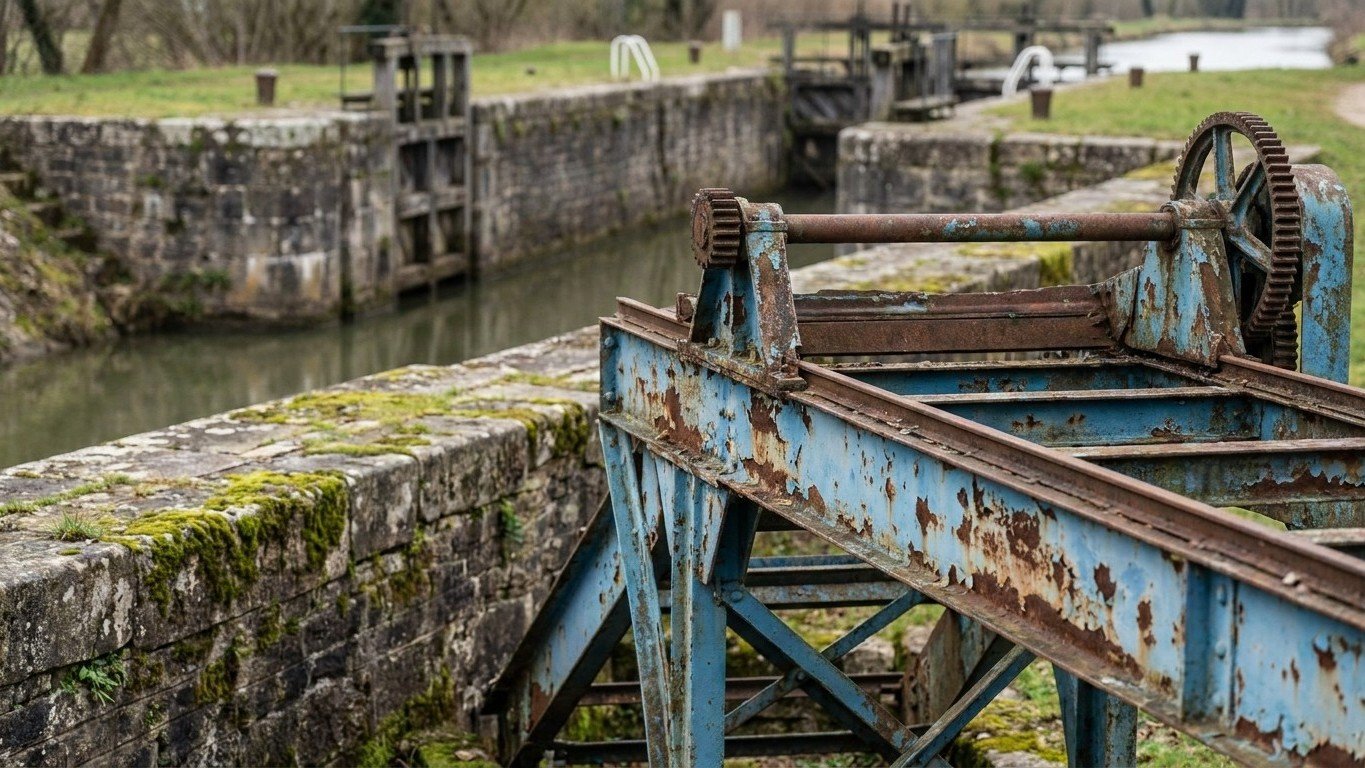
Six minutes. This is the time it took on the watery slope of Foncerand to raise or lower a barge, compared to 45 minutes on the historic lock staircase built by Pierre-Paul Riquet. A technical feat intended to revolutionize river traffic along the Canal du Midi. Today this blue metal frame stands, motionless and rusty, next to the famous Nine Castles of Béziers, the most photographed monument on the canal after Carcassonne and the Pont du Gard.
To remember
- Technological innovation promises to solve a three-century-old problem
- Repeated breakdowns and chronically insufficient maintenance turn the car into a gas plant.
- How poor budgeting and engineering decisions doomed the project before it even opened.
Summary
- An engineering solution to a three-century-old problem
- Construction site that gets stuck even before opening
- Declining river freight traffic is an obvious culprit, but not the only one
- Ruins that are now part of the decor
An engineering solution to a three-century-old problem
The problem dates back to the 17th century. At Foncerand, the canal must suddenly lose 25 meters of height to join the Orbe, a necessary passage for boats going to Agde. Riquet solved this topographical limitation by introducing a staircase of successive basins, an engineering feat for the time. But three centuries later, this heritage masterpiece has become a bottleneck for cargo transportation.
In the 1970s, the state launched an extensive program to modernize the southern canal network. These works began on the Garonne Canal between 1970 and 1974 and then continued at both ends of the Canal du Midi. In Beziers it is impossible to modernize the historical staircase without completely distorting the architectural monument. The chosen solution is inspired by an innovation already tried in other places: the construction of a water slope, similar to the one that already existed in Montague, in the Tarn-et-Garonne.
Ingenious on paper, the principle resembles precision mechanics. The boat entered a water-filled and slightly inclined channel, a raised machine occupied above it and closed this corridor with a waterproof shield, then this elevator moved the water wedge and pushed the boat to the upper level. A literal wedge of water pushed like a cork into an inclined pipe transporting the barge without the need to sequentially fill and empty the basins.
Construction site that gets stuck even before opening
Work began in 1979. Everything did not go as planned: in 1984, construction was suspended at full speed. The Parisian engineer Jean Aubert, already the author of the Montague water slope, signed this second version, presented as technologically advanced. But as soon as it was adopted, problems arose. A few months after its opening, in 1984, there was an accident caused by loss of traction when the car was driven uncontrollably and at too high a speed on a slope.
It will take three years of repairs to get the machine working again. In 1987, after modifications, the machine was put into operation for the second time, five days a week. Chaotic work, far from the promised smoothness. The necessary maintenance required numerous periods of downtime, and these periods of downtime increased over time to the point that Bitterre residents remember the machine stopping more often than it was running.
However, the initial ambitions were not limited to simply reloading boats. The feature, originally intended to produce power when boats hit the water to sell power to EDF, never saw the light of day. A project within a project, which also remained a dead letter.
Declining river freight traffic is an obvious culprit, but not the only one
The most common explanation points to the decline of freight river transport, replaced by road and rail. An attractive argument, but according to channel historians, it doesn’t entirely stand up to scrutiny. The oft-heard argument about the collapse of the trade movement is completely implausible, since it had already been greatly reduced when the Montech water slope was put into operation fourteen years earlier. The drop in freight traffic was not a last-minute surprise. The engineers already knew this when they started the Bézier project.
The real reason is more likely due to poor budgeting. The Water Slope, commissioned in 1988, was built with the aim of doubling the size of the locks and reducing travel times, but the development, lacking a sufficient budget to support operation and maintenance, which was more costly than expected, went largely unused. An infrastructure that was underfunded from the very beginning and was doomed to chronic breakdowns due to a lack of maintenance resources commensurate with its technical complexity.
The service is being developed as much as possible to try to preserve the tool. In 1990, the water slope’s operation was switched to on-demand service for boaters, after which it was finally used in 1999 and finally closed two years later. Twenty-one years after its discovery, the giant machine breathes its last, having failed to fulfill its original mission: to facilitate the commercial traffic of the canal, where, in any case, there was little trade left to facilitate.
Ruins that are now part of the decor
Since then, the car has been quietly rusting in place, a few meters from the Rike Stairs, which continues to receive hundreds of thousands of visitors every year. An almost ironic contrast: on the one hand, the 17th-century work is still functioning and has been classified as a historical monument since 1996; on the other hand, the 1980s machine failed after less than two decades of indiscriminate use.
Between 2016 and 2017, the site was completely renovated, including the construction of a tourist office, a panoramic restaurant and landscaped gardens, with a budget of 13.2 million euros, financed in particular by the Occitania region and the Hérault department. But the water slope itself has not been reconstructed: it remains in plain sight, almost like part of an open-air industrial museum. Some Beziers residents are now proposing to promote it as evidence of the heritage of a time when people still believed they could modernize the three-hundred-and-fifty-year-old canal with technology. Others simply wait for it to eventually disappear, corroded by rust and age.
Sources: bab.viabloga.com | canal-du-midi.com