


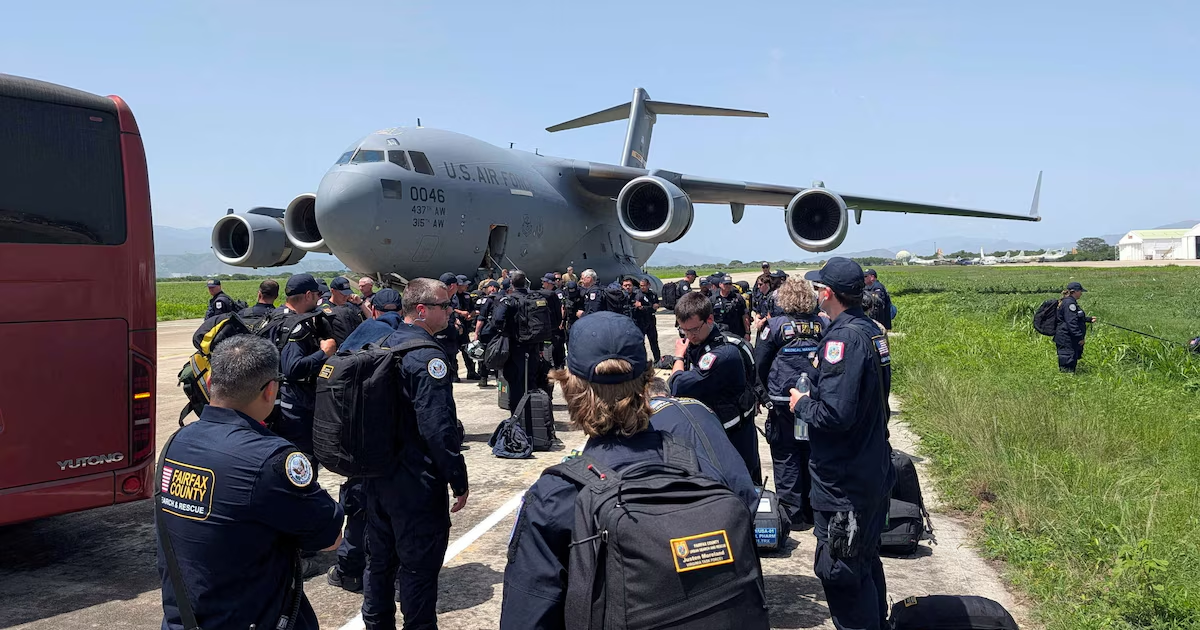
The duty continues to rise. Venezuelan authorities announced Saturday that at least 1,430 people were killed and 3,300 injured after powerful earthquakes of magnitude 7.2 and 7.5 hit the country on Wednesday. 50,000 people are still missing, most of them under rubble, and hundreds of buildings damaged in the states of Caracas, La Guaira, Miranda, Aragua, Carabobo and Falcón.
According to the US Geological Survey (USGS), the death toll could exceed 10,000 people, making the disaster one of the deadliest earthquakes in recent Latin American history. As of Friday, power remained out near the epicenter in Moron and was completely out in the La Guaira region.
While relief operations promise to be particularly difficult in a country with fragile infrastructure weakened by years of sanctions, eyes are turning to the United States, which actually regained economic and political control of the country after seizing President Nicolas Maduro in January 2026.
“Great friends”
“The United States is ready, willing and able to help,” Donald Trump assured on Thursday. The American president announced a $150 million envelope and ordered all federal agencies to “be prepared to intervene.” “We will be close to our new and wonderful friends,” he assured.
Secretary of State Marco Rubio also said that he had spoken with Venezuelan President Delcy Rodriguez and announced the dispatch of assistance teams from Virginia and California. The Pentagon should also organize humanitarian flights and provide aerial imagery to facilitate rescue efforts.
A mobilization that contrasts with the policies pursued so far at the humanitarian level by the Trump administration, which has limited cooperative assistance to the maximum and dissolved the United States Agency for International Development (USAID) last year.
“Avoid a political crisis”
And for good reason, the United States is no longer a mere external player or partner of Venezuela. They, in a sense, “control” the country, to use the words spoken by Donald Trump after the kidnapping of Nicolas Maduro by American special forces. While the country is officially led by the transition government of Delcy Rodriguez, it is under pressure from Washington, which has introduced reforms to ensure a central role in managing Venezuela’s oil and gold revenues while maintaining a regime of tough economic sanctions.
READ ALSO: Venezuela: why the debt restructuring contract won by Mathieu Pigasse is controversial
“The United States is not responsible for the earthquake itself, but given its central role in the post-Maduro transition, it is clearly interested in a quick response to prevent a humanitarian emergency from escalating into a broader political and security crisis,” analyzes Brian Fonseca, a Venezuela specialist, for the Swiss newspaper. Time.
Days before the disaster, Donald Trump was still hailing the operation, which allowed the United States to regain political control of Caracas. “We have won a great victory,” he said on June 20, also mentioning the redirection of oil and gold flows towards the United States. “Venezuela has never experienced such prosperity,” he assured, despite the particular crisis in the economy.
“Trial”
The earthquake may now test Washington’s willingness to accept the consequences of its intervention in the country. “The humanitarian damage from the earthquakes and the upcoming reconstruction will determine whether the US government is prepared to support a putative ally with relief funds and relief policies,” the UN said. New York Times.
Even within the American administration, some are already questioning the scale of the response announced by Washington. The American official thus trusted Interception that the $150 million promised by Donald Trump seems insufficient given the role the United States currently plays in Venezuela. “Aren’t we the ones who run this country? This is a commitment that goes beyond friendship,” he said on condition of anonymity.
Economic supervision
This comes after Trump appeared to suggest earlier this week that the United States has made billions of dollars from Venezuela’s oil wealth over the past six months, the investigative magazine recalls. After the fall of Nicolás Maduro, the U.S. Treasury created a payments system that concentrated some of the management of Venezuela’s export earnings in the hands of the United States, thereby giving it a direct role in the country’s ability to finance its recovery.
READ ALSO: “The road is still long”: hope for economic spring is fragile in Venezuela
At the same time, the Trump administration maintained a broad sanctions regime while granting certain exemptions to foreign companies wishing to do business in Venezuela. “The continued sanctions also continue to complicate the financial operations of the Venezuelan government and local businesses, even as humanitarian needs surge.” New York Timeswhich, however, indicates that financial sanctions relating to humanitarian assistance have been suspended.
The disaster could also challenge American immigration policy. For months, the Trump administration has argued that the situation in Venezuela has stabilized enough to allow Venezuelan migrants to return to their country of origin, unsure whether the current disaster might slow down those deportation plans. The head of American diplomacy, Marco Rubio, himself admitted that the earthquakes represent a “failure” of Washington’s plan to revive the Venezuelan economy and organize future democratic elections.
READ ALSO: In Venezuela, the Helicoid of Caracas: from a shopping mall to a torture center
Despite Donald Trump’s statements, Venezuela’s economic performance is at its lowest level. In the first quarter of this year, Venezuela’s economic growth recorded its weakest rate since 2021. According to Venezuelan economist Francisco Rodriguez, quoted InterceptionU.S. sanctions have sapped oil revenues that fund imports and much of the country’s economic activity, contributing to a prolonged weakening of infrastructure and government services. A fragility that risks complicating disaster response today.