

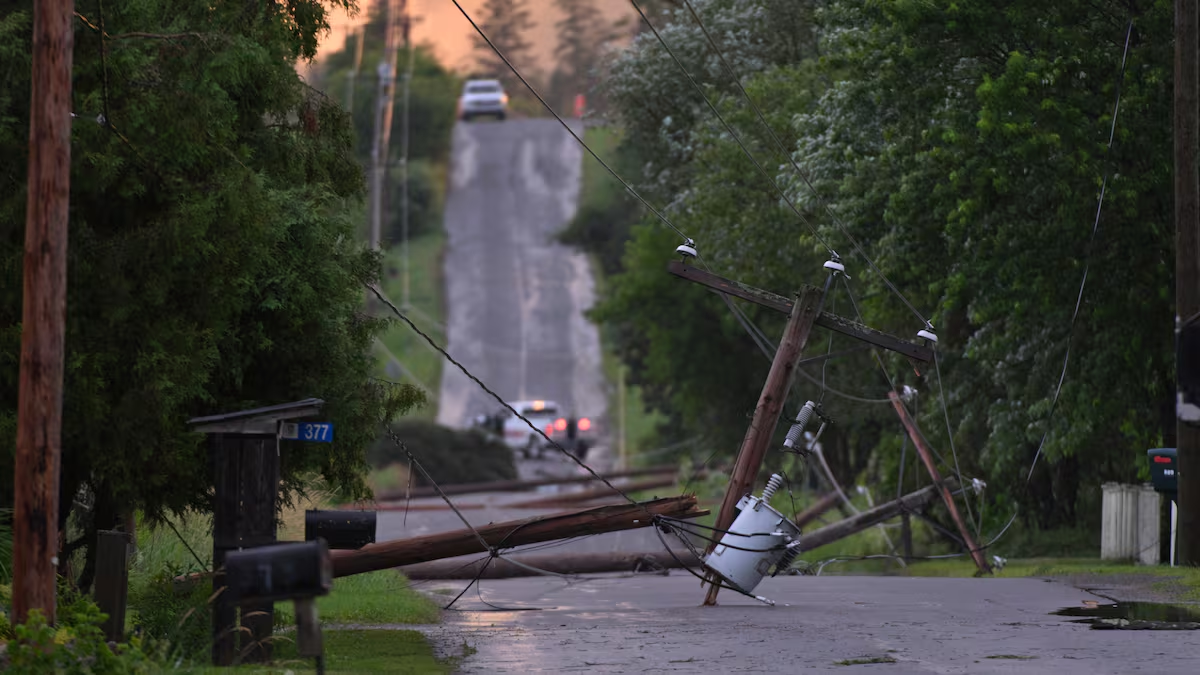
All signs point to a tornado hitting the Laurentians Tuesday night, leaving behind a devastated landscape, the latest sign of a summer marked by violent storms.
“The roof of the barn was damaged, good diameter trees were cut in half and even the Hydro-Québec poles were broken. This requires strong winds,” they explained. Magazine Dominique Martel is a meteorologist at Environment Canada.
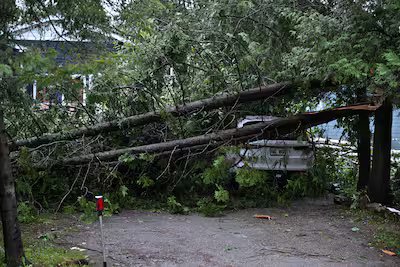
A tree fell on a car on Highway 327 in Harrington, Quebec, Canada on Tuesday, July 21, 2026.
Photo Martin Alarie
He said it was “highly likely” that the tornado touched down from Bell Falls to Harrington in the Laurentian Mountains between 5:24 p.m. PT. and 5:42 p.m., as all elements point in that direction, such as power outages and damage at that location.
However, the Northern Tornado Project will require more formal testing to confirm this phenomenon.
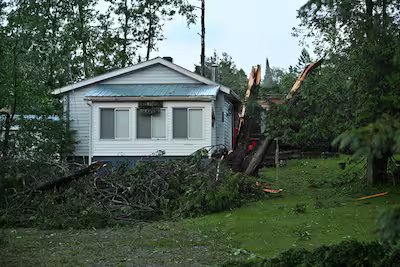
Numerous trees were downed Tuesday night in Harrington, Laurentians. Photo taken on Route 327.
Photo Martin Alarie
For tornado hunting organization Xtreme Chase Québec, there is no doubt.
“Here, looking at the damage, we don’t ask any questions. (…) It’s definitely a tornado,” says tornado hunter Mathieu Lussier, who was on the ground.
The Quebec security service (SQ) also confirms that it received a call shortly before 6:30 p.m. regarding high winds and storms impacting the Chemin-du-Mont-Oler area of Harrington.
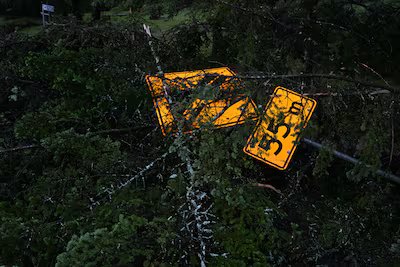
Signs are also down for a possible tornado in Harrington.
Photo Martin Alarie
Uprooted trees and damage to some infrastructure were noted, explains Frédéric Deshaies, a spokesman for the SQ.
Very stormy summer
According to MétéoMédia, the summer of 2026 is also marked by storm activity that is much higher than average.
In June, 28 of 30 days saw at least one storm, which is 47% higher than normal for the month.
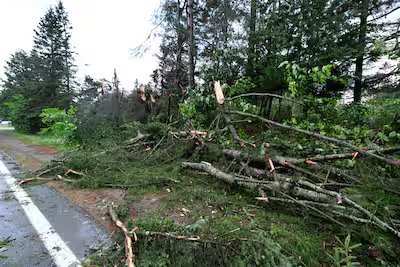
Several uprooted trees on Highway 327 in Harrington.
Photo Martin Alarie
“This is definitely the stormiest year,” emphasizes André Monette, meteorologist at MétéoMédia.
July promises to be equally turbulent, with 19 of the 21 days affected by storms. Specialized media believe that the day turns stormy as soon as lightning strikes in Quebec.
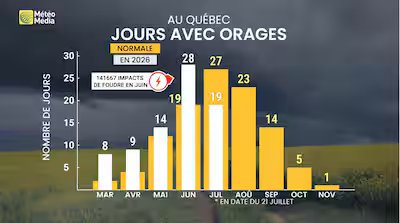
Graph showing monthly storm activity this year compared to average.
Photo taken from MétéoMédia website.
“Fortunately, it doesn’t affect the same city every day. It’s not a waste of time every day,” Mr. Monette said.
Fires
Therefore, it is no coincidence that forest fires have become more frequent this year.
In June alone, SOPFEU recorded 141,667 lightning strikes in Quebec, 3.75 times more than the average over the past seven years.
“Combined with drought, lightning strikes have sparked more than 250 fires in the northern zone in recent weeks, five times more than usual,” the organization said on its social media.
By Tuesday evening, 21,000 homes in Quebec were still without power.