

PressSplit
Follow us on Google
Sick but still working? The GKV reform provides for partial sick leave – but only if the boss and doctor play along with it. What does this mean for you?
Munich – On Friday (July 10), the Bundestag voted for the “Contribution Rate Stabilization Act” and the bill was adopted. Despite fierce protests from the health sector, Health Minister Nina Warken (CDU) pushed through the project. Even within the black-red coalition around Chancellor Friedrich Merz, there has long been disagreement over a savings package for health insurance companies that would ease their burdens and protect millions of insureds from higher premiums. One of the innovations of the “Law on Stabilization of Contribution Rates” is partial sick leave.
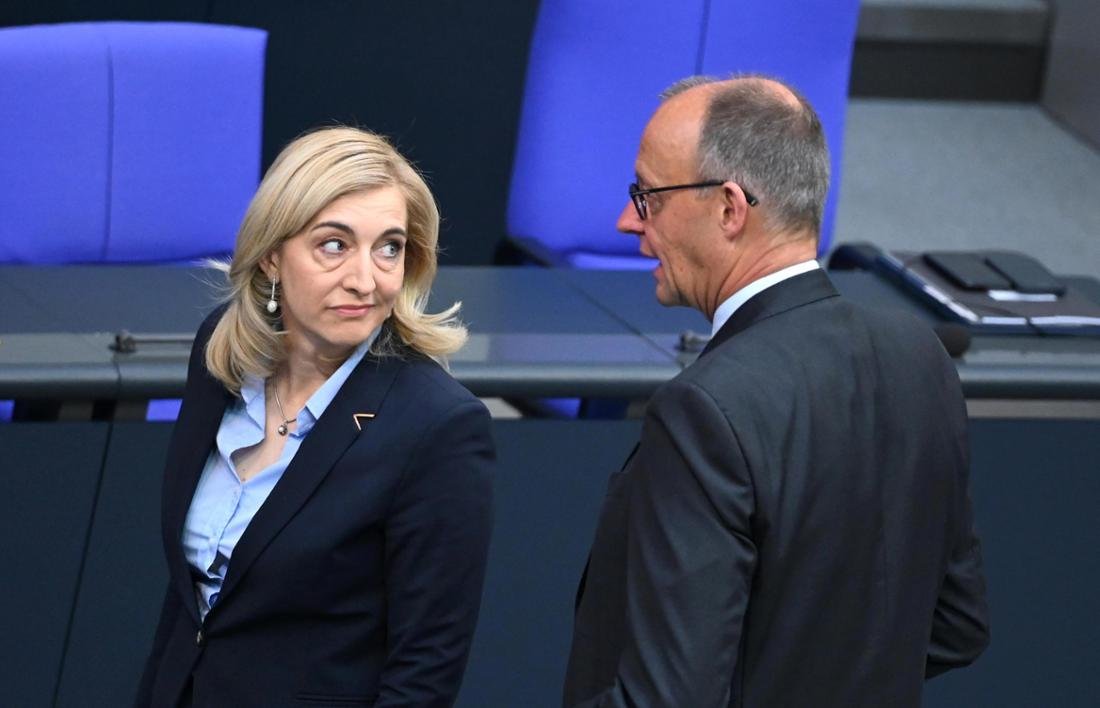 Federal Health Minister Nina Warken (left) and Federal Chancellor Friedrich Merz (both CDU) want to pass the Statutory Health Insurance Rate Stabilization Act in the Bundestag. © Elisa Shu/dpa
Anyone who is sick stays at home – this principle has been applied in Germany for decades. But that will soon change. On the recommendation of the Health Financing Commission (FKG), created by Federal Minister of Health Warken, the federal government would like to introduce partial registration of taps as part of the GKV reform from 2027. The employer plays a decisive role here.
Mandatory health insurance reform: partial sick leave must be provided – 25, 50 or 75 percent cannot work
In its first report, the FKG recommends “introducing gradual partial disability and partial sickness benefits with 25 percent, 50 percent and 75 percent disability.” The physician must determine the partial disability and determine whether the person can work 25, 50, or 75 percent of their work hours per week.
But employers can veto this. The law firm Küttner Rechtsanwälte explains this on its website: “Partial AU should not become mandatory unilaterally by the decision of the insured person and the medical opinion; rather, the employer must be given the right to object.”
In case of illness: ten things you need to know about sick leave
 View a series of photos
Partial sick leave: three points concern employers
When taking partial sick leave in relation to the employer, three points must be taken into account:
- As soon as partial AU is displayed, the employer is obliged to check within seven calendar days whether the insured’s workplace is suitable for short-time work and provide appropriate feedback.
- If the employer objects to partial sick leave, it remains a case of total disability.
- The job is considered suitable if the employer skips this period without giving any reason.
According to lawyers, the employer’s objection must be based on certain requirements: in the case of work organization considerations, the employer checks whether the processes can be adapted. If the employer is citing operational needs, it is necessary to discuss whether tasks can be reasonably reallocated. Occupational safety and health also plays a role – the question arises whether specific risk assessments are maintained even when working hours are reduced. However, there is no right to adjust the workplace.
This means partial sick leave for employees – two groups excluded
However, an employee can also count on some rights when taking partial sick leave:
- The patient must feel able to work for some time – partial sick leave cannot be taken against his will.
- For the first six weeks, the employer will continue to pay full wages, even if the sick person works part-time.
- After six weeks, partial sick pay comes into effect: the employer only pays for the hours actually worked (proportional) and the rest is covered by the health insurance company through partial sick pay.
- Important: Partial sick leave only applies to people with public health insurance and those who are chronically ill. Privately insured individuals and mini-jobbers are excluded.
Under the bill, the new regulation would apply primarily to illnesses that are expected to last more than four weeks, such as mental illnesses such as depression or anxiety disorders, back problems or cancer. In these cases, according to the project, a gradual return to work may make therapeutic sense. However, thanks to the GKV reform, changing your own health insurance company can also bring benefits.
In the office: micro-break exercises
This guide offers people who work in an office a compact collection of micro-break exercises that can be applied right away. Targeted stretching and strengthening exercises for the back, hips and neck, breathing techniques and an after-work ritual to promote relaxation and well-being in everyday life. You can download the free PDF here.
 You can download the Office Fitness Guide with Exercises in PDF format from the Media Library. © IPPEN.MEDIA/IMAGO/Westend61
Criticism of partial sick leave from doctors and public associations
Until now, gradual reintegration (the “Hamburg Model”), enshrined in the Social Security Code, has been used. On the portal gesund.bund.de – proposal from the Federal Ministry of Health – it says: “A typical course might look like this: First you work two hours a day, later four hours and then six hours a day. The number of hours and time to move to the next level depend on the person’s resilience. The step-by-step plan is flexible, so it can be adjusted at any time.”
Deputy Chairman of the Board of the National Association of Statutory Health Insurance Physicians (KBV), Dr. Stefan Hofmeister, criticized the planned partial sick leave as “completely unaffordable.” Moreover, the “Hamburg Model” is a proven method: “It has been working for a long time.”
Verena Bentele, president of the public association VdK Germany, also warns: “Particularly in industries with high personnel pressure, there is a risk that employees expect too much, too soon.” The German Social Association (SoVD) sees the same thing, and its CEO Michaela Engelmayer used a comparison to competitive sports: “If a Bundesliga professional returns too early, the next injury is inevitable.” However, a health insurance company executive proposed partial sick leave as a solution to the problem of high sick leave rates. (Sources: First report of the Health Financing Commission, law firm Küttner Rechtsanwälte, Gesund.bund.de, National Association of Statutory Health Insurance Physicians, VdK German Social Association, German Social Association) (X)