
From education to safetyHow the federal and state governments are preparing for an AfD victory in Saxony-Anhalt
July 13, 2026, 9:05 pm
Listen to the article(12:36 min)
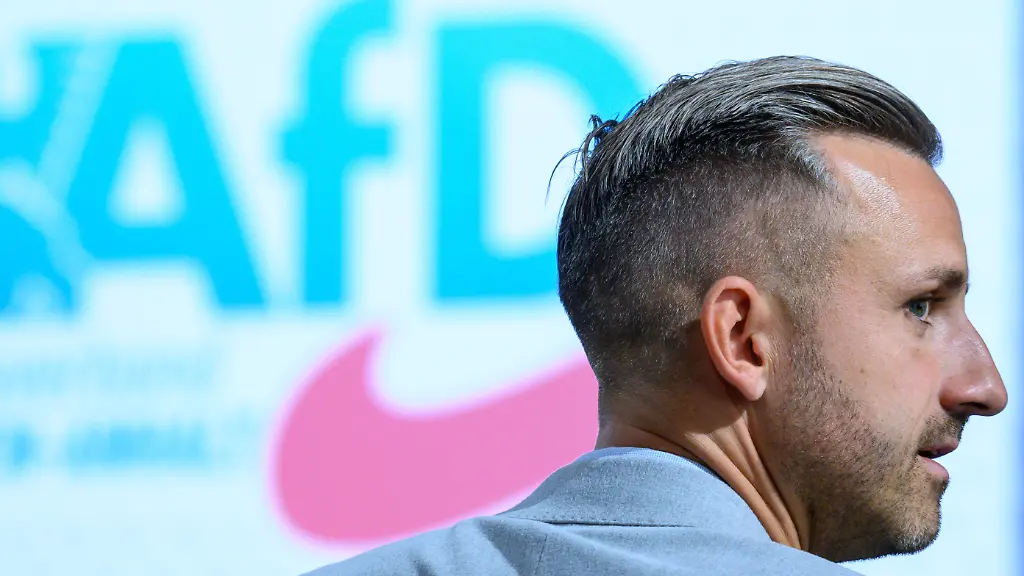 Ulrich Siegmund, the AfD’s leading candidate in the Saxony-Anhalt state elections, already has concrete plans for how he will restructure it if he wins an overall majority. (Photo: photo alliance/dpa)SplitFollow along:

What will happen if the AfD soon rules alone in Saxony-Anhalt? The party is working on plans and wants to make some changes in education, internal security and MDR. There is also concern that right-wing members of the Federal Council are blocking the entire country.
With polls showing that the AfD could win an overall majority in Saxony-Anhalt, parties and governments in the federal government and other states are increasingly thinking about how they can arm themselves. The goal is to prevent a possible radical government from destroying the complex federal structure or blocking the state at multiple levels. This affects a wide range of policy areas.
The AfD, for its part, is carefully preparing what it wants and can do if it takes over the government. One party leader, Alice Weidel, who was confirmed in her post, said in an internal interview with the AfD a few days ago that a department called “Government Participation” with four speakers had already been created in 2025 to do just that.
Article 37 of the Basic Law provides that the federal government may take action, with the consent of the Bundesrat, if the state does not fulfill its federal obligations. This ruling is intended to prevent the country from leaving the federal order. With the AfD’s growing popularity in opinion polls, this debate is no longer purely theoretical. After all, AfD co-chair Tino Chrupalla said back in 2024 that the country led by the AfD would no longer participate in the so-called Königstein Key, for example in the distribution of refugees among federal states. There are also concerns about the implementation of environmental laws – as long as they do not involve pure state legislation.
The federal government may withdraw money from Saxony-Anhalt
Constitutional lawyer Oliver Lepsius from the University of Münster noted to Tagesschau24 that the federal government could gradually take action if the state refuses to cooperate. According to the Basic Law, an order and a reprimand are possible, as well as a lawsuit in the Federal Constitutional Court. But there is also an extreme case of enforcement that has never been seen before, where the federal government can use its resources to enforce the law itself. According to Lepsius, a partial cessation of the federal state’s money supply is also possible. This could particularly affect financially poor eastern countries that rely heavily on the solidarity of the federal government and other federal states.
As a precaution, AfD leader Weidel is already calling any attempt to put pressure on a possible AfD government undemocratic. Bonn-based political scientist Philipp Adorf also sees the danger that the AfD, which already cultivates the myth of the victim, will exploit this for political purposes.
However, there are areas in which states have primary responsibility, such as education. The AfD in Saxony-Anhalt, which the Office for the Protection of the Constitution classifies as a “safe right-wing extremist organization”, has already presented a controversial program that would, for example, weaken compulsory schooling and reorganize the content of education. The AfD usually wages a culture war against other parties and, above all, wants to significantly change the curriculum. Education ministers are therefore asking the question: How can qualifications in a federal state governed by the AfD be compared with qualifications in other federal states?
Educational qualifications may lose value
“The situation is simply difficult,” says Bavarian Science Minister Markus Blume of the CSU. “Anyone who… educational standards, who questions the paths of education, who perhaps blocks the paths of education, who puts their hands on compulsory institutions, then, of course, also jeopardizes the future of the children of their country.” In simple terms: with this development, diplomas from Saxony-Anhalt could no longer be recognized, and high school graduates could no longer study in other federal states. However, we are far from this, says Blum.
Like US President Donald Trump, the AfD wants to change science policy because it is supposedly no longer “ideology-free.” If the AfD takes over the government, it will likely make significant changes to universities and research funding. For example, it has already announced measures against gender studies, which will have consequences for non-university research institutions established throughout the country.
Therefore, the legal scholar Frauke Brosius-Gersdorff proposes that the distribution of funds be transferred to commissions independent of the state, which, however, will be difficult since the so-called center parties always want to implement the research priorities they want. Concerned about future interference with academic freedom, the German Research Foundation (DFG) also presented a document with recommendations on how research could be made more “resistant” to unwanted political influence.
Does secret service information go through the AfD?
A few days ago, Defense Minister Boris Pistorius pointed out the danger that sensitive security data could get abroad through the AfD. This concern does not only exist in connection with a possible government takeover. Because of the Russian ties of leading AfD officials, among other things, no party member has yet been elected to the Bundestag’s secret parliamentary control commission, in which representatives of ministries and intelligence agencies must answer questions. Even if the AfD rejects suspicions of treason, the government and government factions have long expressed concern that the AfD is conducting extremely detailed investigations into areas of infrastructure important to security and defense.
If the AfD actually took over responsibility for government in a federal state, a similar problem would arise with the police and the Office for the Protection of the Constitution. Security authorities are not only concerned that the AfD could use its position to take action against political figures it does not like. The data network between federal and state constitutional protection agencies has improved significantly in recent years, which can now become a problem. The Office for the Protection of the Constitution is already discussing whether, in an emergency, the State Office for the Protection of the Constitution in Saxony-Anhalt should be cut off from certain confidential information – since the AfD itself is under surveillance. Similar considerations were already present when the left came to power in Thuringia in 2014.
When the AfD’s main candidate Ulrich Siegmund presented his immediate government program at the party conference in Magdeburg last Saturday, the first measure he mentioned was the termination of the state media treaty. The AfD, which relies heavily on social media, views public broadcasting, which it views as too left-wing, as its opponent. Ironically, with its long-standing attacks on the MDR, the CDU in Saxony-Anhalt paved the way for withdrawal from the state treaty, although it has so far avoided the step of terminating the agreement in the state parliament.
Concerns about AfD’s Trump-like behavior
It is unclear what implications such a move would have for the ARD broadcast community. On the one hand, the MDR also serves Thuringia and Saxony, so it cannot simply be dissolved unilaterally. On the other hand, there is a nationwide obligation to pay broadcasting fees – completely independent of a possible AfD government in an individual federal state. “However, like Donald Trump, the AfD can simply break the law publicly – and then see what happens,” says a leading coalition politician in Berlin. MDR may then have to try to recover fees in thousands of lawsuits.
During the last legislative period, other parties began to make the country’s important institutions more resilient to extremist political forces. Therefore, when it comes to the election of judges to the Federal Constitutional Court, the Federal Council can also intervene in the appointment if the required two-thirds majority in the Bundestag is blocked. On Friday, science ministers agreed to replace previous unanimity in some areas with a gradual procedure towards Rule 13:3. This is to prevent one or two countries from paralyzing funding for the Conference of University Presidents.
There is still no agreement on what to do with the fact that Saxony-Anhalt, and not all places, is to take over the presidency of the conference of prime ministers in October as an important coordination tool between the federal government and state governments. “In the event of an emergency, we could change the way the chairmanship is distributed among the federal states after the elections,” says a state spokesman. But they don’t want to discuss it openly.
AfD complains of sabotage by other parties
Party leader Weidel made it clear that the AfD is also preparing for a possible battle between the institutions. By taking control of the country of Saxony-Anhalt, it would be possible to show what the party is capable of – “if we are not all sabotaged.” It is to be expected that other parties will constantly want to throw sticks between the AfD’s legs. “We have to reflect that too,” she said in an internal interview with the AfD. “This will be done in Saxony-Anhalt: switch off the state financial equalization system and no longer accept certificates from Saxony-Anhalt,” she predicted, for example. She then wanted to point out that other parties were reluctant to accept votes from voters to change policies.
A ban on the AfD has been discussed for many years, but the Union rejects it, arguing, among other things, that such a process would take years, during which the party could always portray itself as a victim of an undemocratic system. The leader of the CDU/CSU parliamentary group, Jens Spahn, has now proposed, as a small solution, to deprive AfD Thuringian Chairman Björn Höcke of the right to vote and stand for election.
Hoeke was twice convicted of using a prohibited license plate for an unconstitutional organization. In his election speeches, he used the banned SA slogan “Everything for Germany.” Höcke must pay a total of almost 30,000 euros in fines in two cases. Because he exceeded the 90-day limit on both occasions, Hoecke officially has a criminal record.
Approval came from other CDU politicians, as well as from the parliamentary managing director of the SPD parliamentary group, Dirk Wiese. The Federal Ministry of Justice plans to make it easier to disqualify people from standing for election, but only for people sentenced to at least six months in prison for inciting hatred. The CSU is also discussing a partial ban on the AfD, especially the radical regional association. However, CSU leader Markus Soeder fears this will only strengthen the AfD’s martyr status.