

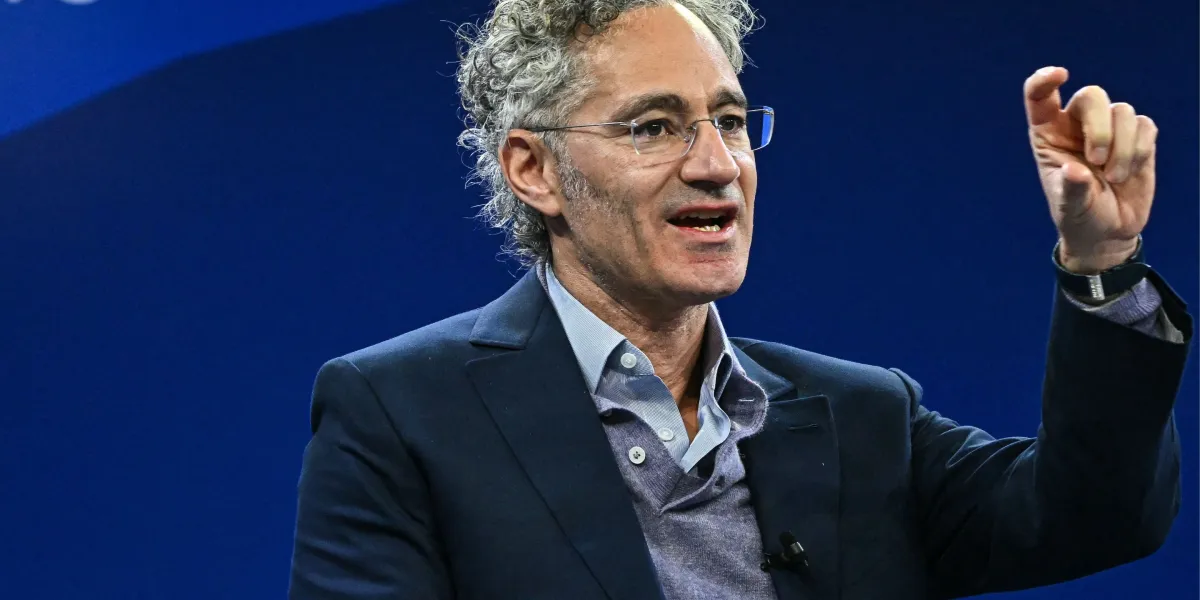
The artificial intelligence boom has boosted Palantir’s market value to about $322 billion and CEO Alex Karp’s net worth to about $15 billion. But the 58-year-old has just warned that the wealth imbalance caused by AI will only get worse.
“The biggest problem in this country is that (AI) will improve the standard of living of the average person, but the people involved will probably become 10, 100 times richer than they already are,” Karp told Axel Springer CEO Matthias Döpfner on the MDMeets podcast. “It’s a societal problem.”
Karp estimates that AI could make him “20 times richer,” implying a fortune approaching $300 billion. Middle-class workers’ wages could simply double over the next decade, he said. Karp criticized this inequality, calling it “a complete separation of unimaginable wealth and normal wealth.”
For Karp, the problem is not only the scale of wealth, but also who can accumulate it.
“It’s done by people you don’t really have anything to do with, like specimens of very odd IQ shapes that you probably wouldn’t want to invite to dinner,” Karp said. “And if they came to dinner, you would have nothing to talk about with them, and vice versa.”
Many of the people who stand to benefit most from AI are also overestimating its promises, he added: “The resale of AI in this country is really a little embarrassing, but it’s also depressing because you don’t have to do it.”
Income inequality has been rising for generations, and 2025 was a record year for billionaire wealth.
Wealth inequality has been a topic of debate for decades, with the wealthiest households receiving an ever-larger share of economic benefits while wage growth for many workers remains comparatively modest.
The boom in artificial intelligence has only accelerated this trend. Global billionaire wealth grew by more than 16% in 2025 – three times faster than the previous five-year average – to $18.3 trillion, the highest level in history, according to Oxfam.
No one has embodied this explosion of wealth better than Elon Musk. The Tesla and SpaceX CEO is now worth an estimated $833 billion after briefly becoming the world’s first trillionaire earlier this year.
The scale of this wealth is almost difficult to comprehend.
Oxfam estimates that a person with a net worth of $1 trillion could pay a 10% wealth tax—roughly $100 billion—and still be among the richest people on Earth. The organization also estimates that $100 billion would be enough to lift more than 800 million people out of extreme poverty within a year.
Even Jamie Dimon and Larry Fink share Karp’s concerns about workers being left behind.
Karp was not the only leader to sound the alarm about rising income inequality.
BlackRock CEO Larry Fink, whose net worth is estimated at $1.3 billion, warned earlier this year that artificial intelligence risks leaving much of the world behind if its benefits remain concentrated in the hands of a few winners.
“More wealth has been created since the fall of the Berlin Wall than ever before in human history, but in advanced economies that wealth has gone to a much narrower share of people than any healthy society can ultimately sustain,” Fink said at the World Economic Forum in Davos, Switzerland.
“The first benefits flow to model owners, data owners and infrastructure owners,” Fink added. “The open question is: What will happen to everyone else if AI does to white collar workers what globalization did to blue collar workers? We need to confront it head on today. This is not about the future. The future is now.”
Nobel Prize-winning computer scientist Geoffrey Hinton, often called the “godfather of artificial intelligence,” has expressed similar concerns.
“What will actually happen is that rich people will use AI to replace workers,” Hinton said last year. “It will create massive unemployment and huge increases in profits. It will make some people much richer and most people much poorer. It’s not the AI’s fault, that’s the capitalist system.”
However, JPMorgan Chase CEO Jamie Dimon has a more balanced view. While he questioned some of the rhetoric surrounding inequality, he acknowledged that many low-income Americans face hardships.
“If you were an ordinary citizen here and you said, ‘These rich people are getting incredibly rich and this segment is being left behind,’ it’s kind of annoying.”
He added to Axios that “we have effectively left low-income people behind.”