

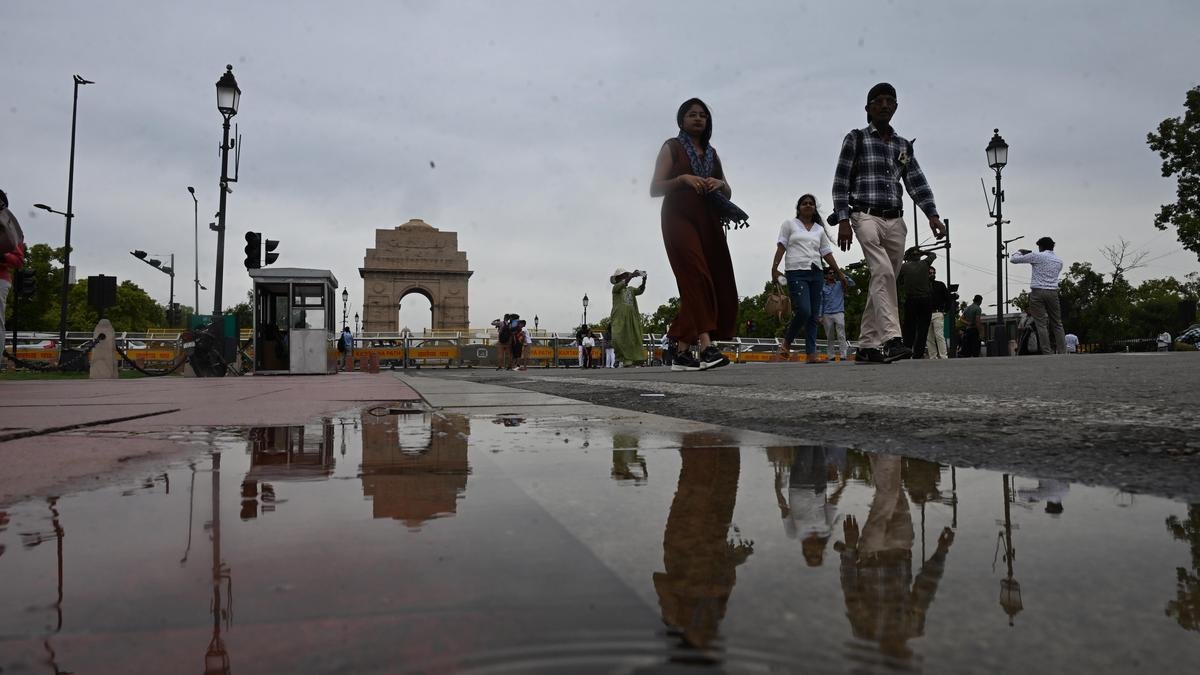
Conditions are favorable for further expansion of the southwest monsoon into several northern states over the next five to six days, the IMD said on Sunday (28 June 2026), even as the national capital recorded its warmest morning in two years amid delayed monsoons.
The India Meteorological Department (IMD) said in a release that conditions are favorable for further advance of the southwest monsoon into parts of the North Arabian Sea and parts of Uttar Pradesh and Uttarakhand, among other states, over the next two to three days.
It is likely to continue moving over parts of Uttar Pradesh, Uttarakhand, parts of Himachal Pradesh, Jammu and Kashmir, Ladakh and southeast Rajasthan for the next two to three days.
However, it also warned of extreme heat in Uttar Pradesh on July 28 and 29.
Delhi is likely to see the arrival of monsoon on July 4 if weather conditions remain favorable, according to weather forecasting agency Skymet.

Meanwhile, recording its warmest morning in two years, Delhi’s minimum temperature was 31.1 degrees Celsius, 3.2 degrees above the seasonal average, while the maximum rose to 41.8 degrees Celsius.
The last time the city’s minimum temperature was higher was June 14, 2024, when it was recorded at 33.3 degrees Celsius.
According to the Met Bureau, a heat wave has begun over Delhi and the temperature at 5:30 pm, as per IMD calculations, was around 50.7 degrees Celsius. However, thunderstorms and rain are expected on Monday.
Skymet said the delay in the onset of the monsoon and the interaction of dry and wet winds had resulted in temperatures and humidity becoming unusually high.
“Usually, the monsoon reaches Delhi around June 27-28, after which the temperature starts decreasing and humidity increases. However, this year the monsoon is likely to be delayed by about a week. Dry westerly winds from Pakistan keep temperatures high, while southwesterly winds from the Arabian Sea also reach Delhi and increase humidity,” said Mahesh Palawat, vice president, meteorology and climate change, Skymet.
“When these dry and moist air masses interact, clouds do form, but there is not enough moisture for widespread precipitation. By the time the clouds form, usually around 4 or 5 p.m., the day’s maximum temperature has already been recorded. That’s why both the maximum temperature and the ‘felt’ temperature remain unusually high,” he said.
The Meteorological Center in Shimla has predicted monsoon in Himachal Pradesh till July 4, saying a fresh western disturbance is likely to affect northwest India from July 2.
A thunderstorm warning and wind gusts of 30-40 km/h were issued at an isolated location in the state from June 30 to July 4.
Isolated parts of the state are likely to experience a heat wave in the next 24 hours, the department said, adding that thunderstorms/lightning accompanied by gusty winds are very likely at isolated places over eastern Uttar Pradesh. In Jammu and Kashmir, Srinagar recorded a maximum temperature of 33.8 degrees Celsius, 3.8 degrees above normal, and a minimum of 19.7 degrees Celsius, 2.6 degrees above normal. In Jammu, the maximum temperature was 37 degrees and the minimum was 3.8 degrees below normal of 22.5 degrees Celsius.
The Meteorological Bureau said that the plains of Jammu and surrounding areas are likely to experience pre-monsoon showers on June 29, with intense heavy rainfall, thunder and gusty winds predicted at some places.
Published – June 28, 2026 10:03 pm EST.