

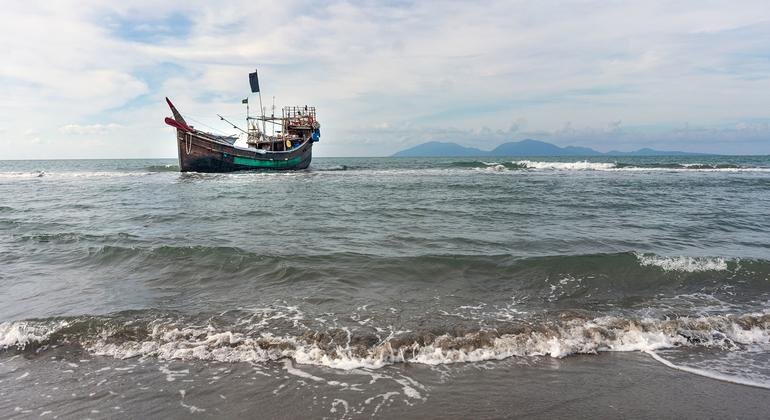
In a joint statement on Thursday, the UN Migration Agency (IOM) and the UN refugee agency (UNHCR) said both ships sailed from Myanmar’s Rakhine state in late June.
Why is this important
- Hundreds more ethnic Rohingya likely drowned
- Funding cuts leave refugees in Bangladesh with fewer options
- Myanmar conflict encourages dangerous sea journeys
Contact was lost with one boat carrying approximately 250 people shortly after it departed. A second boat with 280 people on board is believed to have sank off the Ayeyarwaddy coast in Myanmar on July 8.
The passengers were mostly ethnic Rohingya from Rakhine state, who have been persecuted by Myanmar authorities for decades.
The boats used on such trips are often ill-equipped to handle the high seas and are overcrowded.
Some of those on board also came from the Cox’s Bazar refugee camp in neighboring Bangladesh, home to about a million Rohingya who fled state violence against them in 2017.
Open sea
The UN agencies noted that the boats were sailing outside the normal sailing season, when conditions are more dangerous.
“This is part of a worrying trend that has been going on for some time. Many people, hundreds of people have already reported dying in the same region, in the same seas this year,” UNHCR spokesman Matthew Saltmarsh said.
Before these latest tragedies, nearly 300 people, including Rohingya refugees and Bangladeshi nationals, had already been reported missing or drowned in the Andaman Sea and Bay of Bengal this year.
Recent heavy rains and flooding in the region are believed to have increased the risks associated with dangerous sea crossings, according to UNHCR.
The agency’s Mr Saltmarsh also noted that the situation in Cox’s Bazar was becoming increasingly difficult for those there due to severe funding cuts.
“These reports highlight the devastating impact of protracted conflict and displacement, and the continued lack of sustainable solutions for Rohingya communities,” the IOM-UNHCR statement said.
Consequences of the war
The agencies pointed to a deteriorating humanitarian situation in Myanmar, where civil war continues due to a military coup in February 2021. “Limited assistance and facilities” in refugee camps in Bangladesh have also contributed to convincing more people to risk their lives on dangerous sea voyages in search of safety and protection.
A recent report by the UN Human Rights Office highlighted that foreign parties continue to supply weapons, spare parts, ammunition and munitions to the Myanmar military, as well as aviation fuel and other dual-use goods.
The report warns that cuts and freezes in foreign aid are jeopardizing locally-led civilian protection efforts aimed at saving lives and ensuring minimum levels of access to basic services despite persistent military attacks on civilians.
Helping the most vulnerable
UNHCR and IOM help governments coordinate the search and rescue of vulnerable people in transit, their reception, protection and durable solutions throughout the Asia-Pacific region.
This cooperation – through agreements including the Bali Process to combat human smuggling, trafficking and related transnational crime – covers refugees, migrants and stateless persons along key migration routes, including in South and Southeast Asia. “This route-based approach aims to save lives, protect people and reduce harm, and support states to effectively manage mixed movements,” the agencies said.