
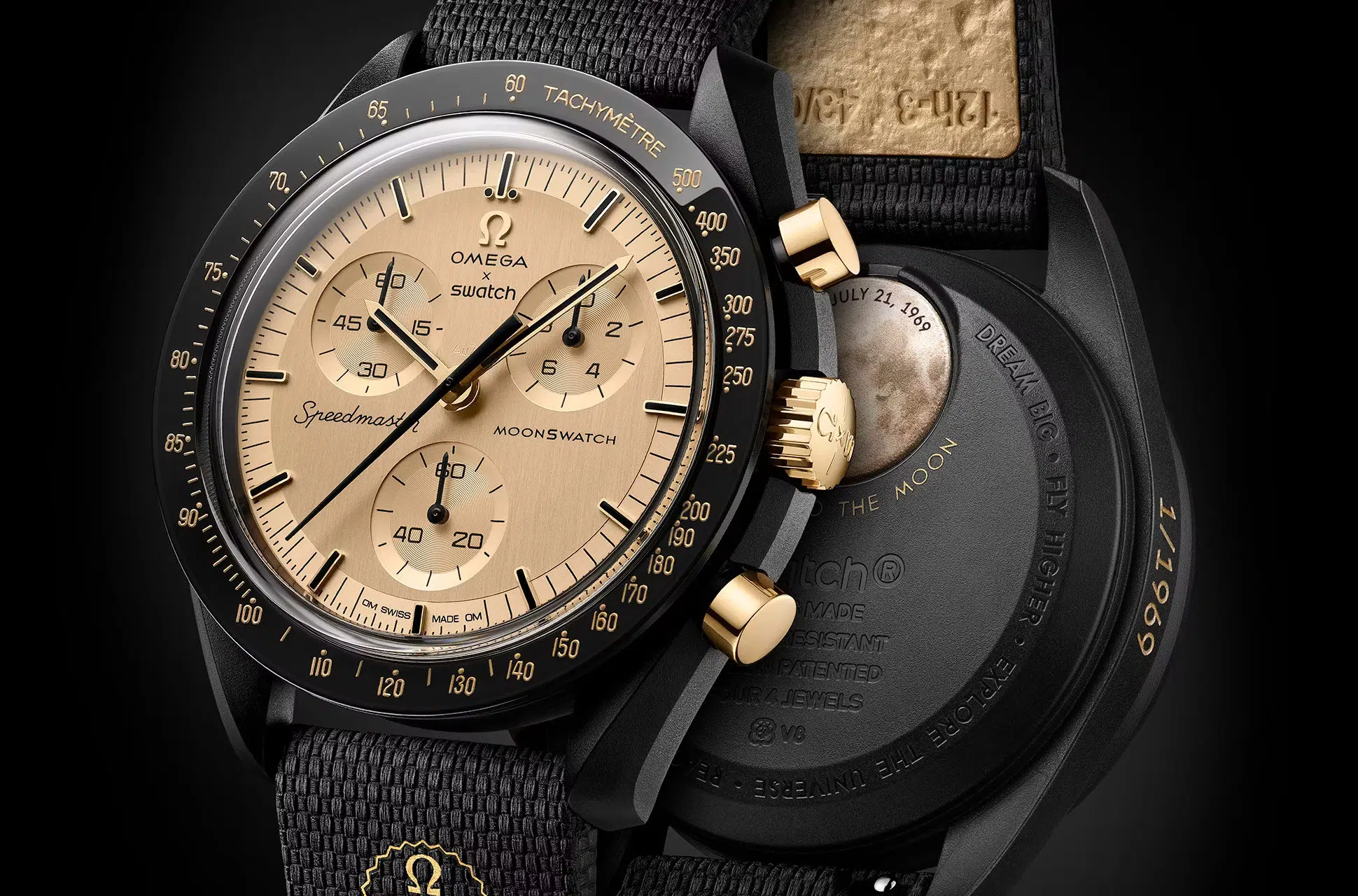
Exactly 57 years ago, Neil Armstrong set foot on the moon wearing a steel Speedmaster ST 105.012. Three months later, Omega celebrated this feat by gifting the crew of Apollo XI with an 18-karat yellow gold Speedmaster, reference BA145.022. This Thursday, July 16, 2026, Swatch and Omega renew this gesture with the launch of a new MoonSwatch, aptly named Mission to the Moon 1969, limited to 1,969 numbered pieces. On paper, another MoonSwatch. In fact, it is the most valuable ever created and likely the most commercially viable since the collection’s launch in 2022.

Eleven grams of gold were found in ancient workshops
The crux of the case lies in the numbers: eleven grams of 18-karat Moonshine gold, a special alloy developed by Omega for its luxury editions. There is nothing anonymous about this gold. It was recovered directly from Omega spare parts dated to the exact period of the Apollo missions, and then redesigned to outfit four elements of the 1969 Moon mission.
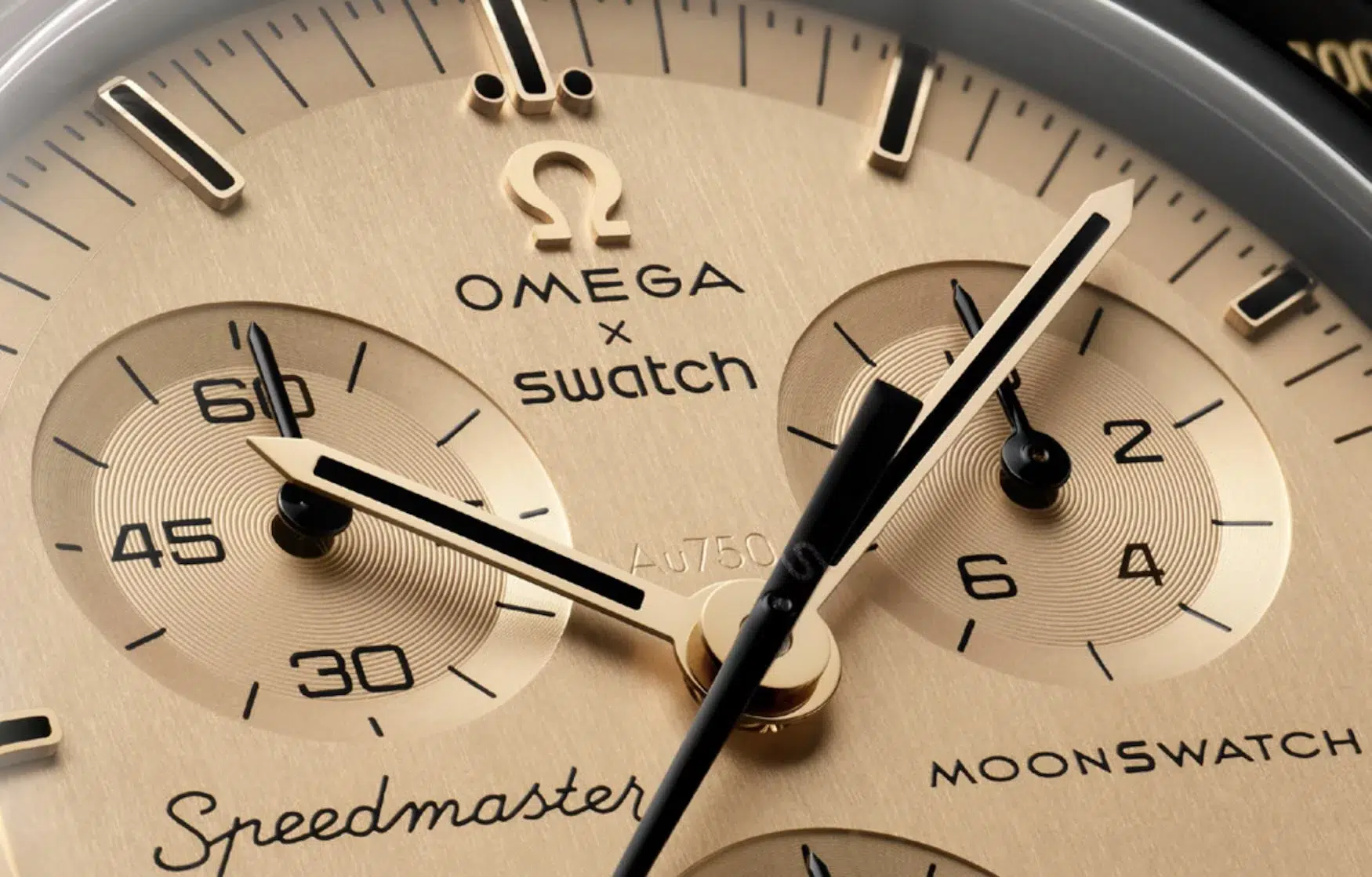
The matte dial is made of solid Moonshine gold and features a logo. Omega In a period design, the hands, as well as the crown, are forged from the same metal, and two chronograph pushers complete the display. The rest of the body is made of the usual black bioceramics of this line (that is, plastic), which here plays the role of foil.
The piece’s individual numbering, 1969, is engraved on the side of the 9 o’clock position, and the battery compartment cover in the shape of a golden moon is located on the case back. The black Velcro strap is covered in a gold-tone material with a lunar regolith-inspired texture, a detail that Swatch wanted to highlight.
Everything about the watch’s design points to a historical reference to BA145.022 without even naming it, which is a clever way to place the MoonSwatch in a respectable watch line without stepping on the toes of Omega’s current model.
The price corresponded to the price of gold in July 1969.
This is perhaps the most elegant detail of the story. Sample decided to bill the 1969 Moon mission not at the current market price of gold, but at the one prevailing on July 21, 1969, the exact date of the Moon landing. Brand communication requires detailed calculations.

In 1969, eleven grams of 18-karat gold cost approximately $11, or approximately 48 Swiss francs at the then exchange rate of 4.31 Swiss francs per dollar. At the July 2026 price, the same eleven grams in principle cost CHF 870.37, or CHF 79.13 per gram.
However, the MoonSwatch would sell for 500 Swiss francs, which is roughly what a full Speedmaster with a dose of gold would have cost at the time. Selected Marketing Formula worth its weight in history rather than worth its weight in goldis expected to the end and turns what might have seemed an opportunistic operation into a coherent homage to Omega’s symbolic gesture in 1969.
Thus, on a purely material level, the buyer receives approximately CHF 370 in gold for a CHF 500 invoice (EUR 600), which remains an economic equation very beneficial to the owner, regardless of the hourly value of the object.

ESTA, digital draw to avoid disturbances
The file’s second marketing move concerns distribution. After the chaos that accompanied the launch Royal pop Last May, with queues on the sidewalks and law enforcement intervention in several cities, Swatch clearly learned its lesson.
The brand invented a procedure called ESTA to Application for Swatch electronic watcheswhich is a direct link to the form of the same name, which is filled out by travelers wishing to travel to the United States. Thirty-two questions are waiting for buyers, applications will be accepted starting July 16 at 15:32 Pacific Time. CEST until July 21 at 11:59 p.m., a date apparently chosen in response to the moon landing.
From all received applications, a total of 1,969 candidates will be randomly selected to receive the right to purchase watches. The lucky winners will then receive personalized instructions on how to pick up their copy from a Swatch store. This approach avoids overnight camps, defuses the black market for early resales, and offers all applicants a fair chance, regardless of their geographic location or their availability at the time of issue. This will not prevent secondary speculation after the coins are distributed, but it will at least protect the initial buying process.

MoonSwatch that remains MoonSwatch
On a technical level, Mission to the Moon 1969 retains the already familiar architecture of the line. The bio-ceramic body measures 42mm in diameter, 13.25mm in thickness and 47.3mm lug-to-lug, with curved glass made from bio-based material with anti-scratch treatment.
Water resistance remains a modest 30 meters, and the in-house movement is an ETA quartz movement that controls the hours, minutes, small seconds, moon phase, and chronograph functions.
We might expect a little more mechanical sophistication from a piece placed at this price level, but MoonSwatch’s DNA has always favored storytelling over technique, and replacing the quartz movement with a mechanical one would see the price explode, well above the listed €600. The weight of gold here remains historical rather than technical, and this is probably what gives strength to this assumption.
We Love Watches review
After the original MoonSwatch, Snoopy, Neptune or Mission on Earth, fatigue began to set in over the Swatch x Omega collection, with an overly fast release pace and chromatic variations that struggled to justify each launch.
Mission to the Moon 1969 changes things up completely and reminds us that the Bioceramics duo are still capable of big surprises when they take the trouble to tell a story. Using real gold from ancient workshops is an idea that is both romantic and industrially credible, and the 1969 price tag makes it a piece of horology with meaning beyond storytelling.
Obviously, we can sneer at the fact that the quartz movement now features an 18-karat gold dial, an alloy that has historically been used to craft Omega’s finest complications. But it is precisely this contrast that gives the Mission to the Moon 1969 a unique character in the modern watch world.
However, the real genius lies in the distribution method. By modeling its lottery after the ESTA, Swatch solves one of its own model’s recurring problems in one move and offers a method that may well inspire other brands facing hysterical launches.
It is hoped that the form will not ask for evidence of the exact reason for the desired lunar trip. See you on July 21st at midnight for the closing of entries and a little later for the drawing.
Price: 600 euros, limited edition of 1969 copies.
More news about this brand

Author:
Alexander H.