

Climate experts describe how the combined forces of El Niño and global warming are fundamentally changing the Indian monsoon, leading to a delayed onset but more intense short-lived rainfall across the country.
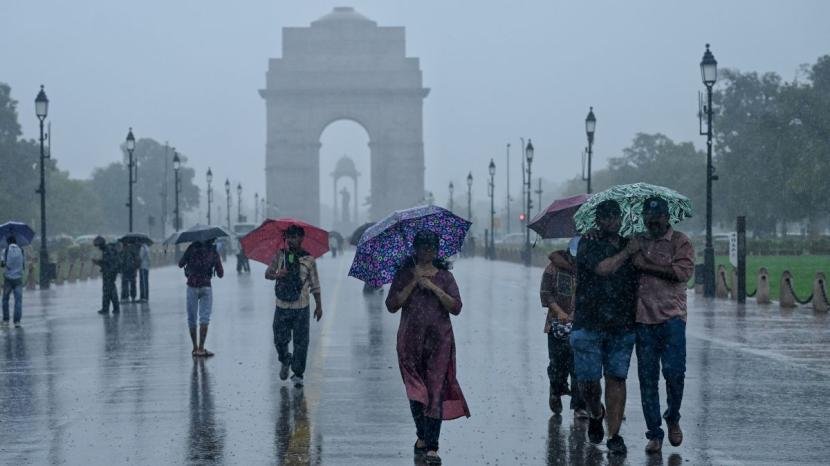
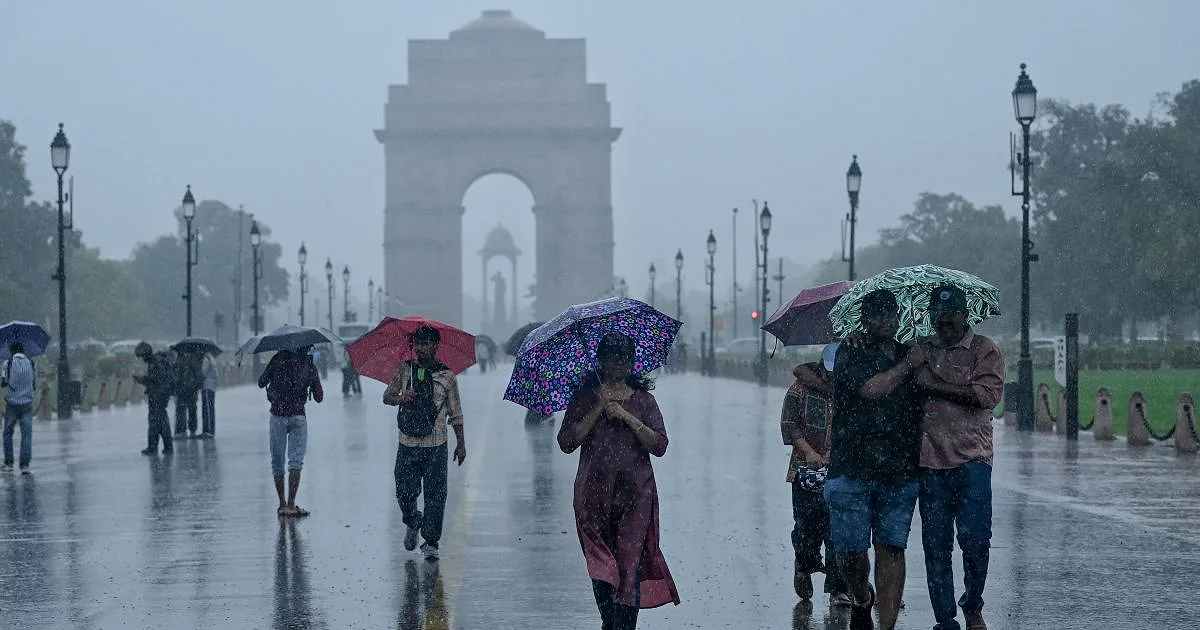
IMAGE: People walk with umbrellas in the rain at India Gate in New Delhi on Wednesday. Photo: ANI Photo
Key Points
- El Niño and climate change are linked: El Niño delays the onset of the monsoon, and climate change increases precipitation.
- India experienced significant rainfall deficits in June due to El Niño, followed by intense rainfall in western regions as the monsoon intensified.
- Record warming of the Arabian Sea and changes in atmospheric circulation are increasing humidity, resulting in heavier, shorter-lived and more intense rainfall.
- Monsoon dynamics have changed with weather systems now moving westwards rather than north-westwards, affecting rainfall patterns in states like Rajasthan and Gujarat.
- Experts warn that the pattern of the monsoon has been permanently altered by global warming, regardless of the presence of El Niño.
El Niño, a recurring weather pattern that causes global temperatures to rise, and climate change cannot be considered independently as one delays rainfall while the other enhances it, according to climate experts.
A rapidly strengthening El Niño in the Pacific delayed the onset of the monsoon and kept rainfall low until late June, leaving India with a 40 percent rainfall deficit by the end of the month. However, a few days later the scenario changed dramatically. As the monsoon entered its active phase towards the end of June, Mumbai and much of the west coast of India suffered exceptionally heavy rainfall.
Experts say the new reality is that climate change is fundamentally changing the behavior of the Indian monsoon.
Understanding the active phase of the monsoon
“The monsoon is currently in an active phase with several weather systems prevailing across the country. There was a depression over Odisha and a cyclonic circulation over Maharashtra due to which the western and eastern monsoon arms remained active,” said Mahesh Palawat, vice president, meteorology and climate change, Skymet Weather.
“Along with this, the constant entry of moisture from the Arabian Sea has led to continuous resumption of clouds over Maharashtra in the last three to four days, resulting in heavy rainfall,” Palawat said.
El Niño interaction with global warming
Raghu Murtugudde, professor emeritus at the University of Maryland and retired IIT-Mumbai professor, explained that Mumbai experienced a delayed onset of the monsoon, which was partly attributed to El Niño.
“But the global warming pattern in warm West Asia and shifting winds in the Arabian Sea began as expected. There has also been a flurry of winds as part of larger heavy rains in the core monsoon zone. The Arabian Sea and Bay of Bengal are causing heavy rainfall in the interior areas. El Niño simply can no longer be separated from global warming.
“Both the Arabian Sea and Bay of Bengal are active and a low pressure system is also originating from the Bay of Bengal. When this happens and both sides burn, heavy rainfall occurs in the main monsoon zone and this supply of moisture also passes over Mumbai. The Western Ghats make the air rise, which is why Mumbai receives a lot of rain,” Murtugudde said.
Changes in the nature and intensity of precipitation
While triple-digit rainfall in Mumbai and places along the west coast is common during the monsoon season, meteorologists suggest that July and August saw a significant increase in such flood-like spells in Maharashtra, Gujarat, south Rajasthan and southwest Madhya Pradesh.
Scientists stress that El Niño and climate change can no longer be viewed independently.
While El Niño influences monsoon circulation and often reduces the number of rainy days, record warming of the Arabian Sea and changes in atmospheric circulation increase moisture availability, allowing weather systems to produce much heavier precipitation once conditions become favorable.
Continued impact of climate change on monsoons
“El Niño is delaying the rains while climate change is increasing them. Monsoon dynamics have changed over the past few years, which may be directly related to climate change. Weather systems that form in the Bay of Bengal move in a westerly direction rather than in a northwesterly direction.
“In addition, due to record ocean warming, there is an increase in moisture loading from the Arabian Sea. This leads to constant regeneration of clouds over the region in the presence of a weather system,” Palawat said.
K.J. Ramesh, former director general of the India Meteorological Department, explained that during El Niño years, the number of rainy days decreases.
“But we know that the monsoon pattern has changed forever due to global warming. The rains will be short and intense, regardless of whether there is an El Niño or not. Anomalies caused by climate change can be seen in the way rainfall patterns have changed in the northwestern parts of the country.
“We are seeing heavy rainfall in Rajasthan, Gujarat and Western Madhya Pradesh these days due to western disturbances and associated systems. We all know that these western disturbances alone are not capable of causing rainfall in these regions, but the increase in moisture input from the Arabian Sea has changed the rainfall pattern in these regions,” he said.