

CAIRO (AP) — The U.S. military announced a 13th night of strikes on Iran Thursday as clashes escalate over maritime routes. The attacks came after Iran-backed Yemen Houthi rebels said they had attacked two Saudi oil tankers in the Red Sea, potentially widening the war with Iran as international oil exceeded $100 per barrel.
A short time later, Iranian state media reported explosions along the strait in Qeshm and Bandar Abbas, where two people were reportedly wounded, and in the northwest near Andimeshq, Omidiya and Firuzabad.
US Central Command said the latest attacks ended shortly before 5 a.m. local time. The strikes were aimed at “further weakening Iran’s ability to threaten civilian sailors and commercial vessels transiting regional waters” as the Americans seek to regain control of the Strait of Hormuz and restore the flow of international shipping.
Meanwhile, the Houthis threatened to close another key trade routewith the global economy already staggering due to closure by Iran Strait of Hormuz. Iran and the United States have stepped up attacks as they vie for control of the strait, through which a fifth of the world’s oil and gas supplies passed in peacetime. starting the fight for alternative routes.
President Donald Trump threatened “serious military punishment” against the Houthis if their attacks on ships continued.
“If they do this again, the US will hold Iran responsible because the Houthis are a surrogate and/or proxy for Iran, and severe military punishment will be inflicted on Iran and, of course, the Houthis themselves,” Trump wrote on social media.
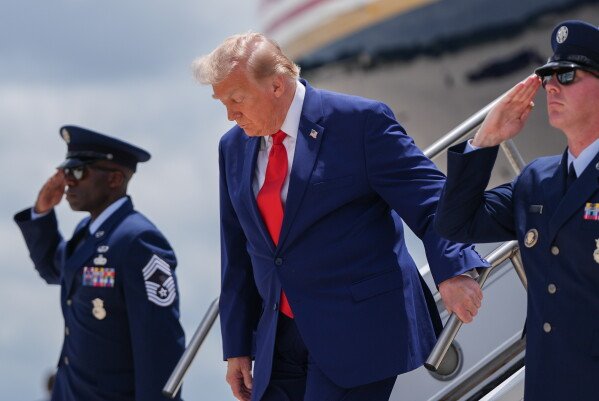
President Donald Trump arrives on Air Force One at Dobbins Air Force Base, Wednesday, July 22, 2026, in Marietta, Ga. (AP Photo/Julia Demaree Nikhinson)
President Donald Trump arrives on Air Force One at Dobbins Air Force Base, Wednesday, July 22, 2026, in Marietta, Ga. (AP Photo/Julia Demaree Nikhinson)
Add AP News to Google
Add AP News as your preferred source to see more of our stories on Google.
Share More
AP AUDIO: Yemen’s Houthis attack Saudi tankers in the Red Sea, threatening to expand war with Iran
AP correspondent Charles de Ledesma reports Yemen’s Houthi rebels say they have attacked Saudi oil tankers.
As the rhetoric escalated, so did the economic fallout. The price of Brent crude, the international standard, jumped more than 6% on Thursday to around $100 a barrel. That’s the highest level since May, before the two sides reached a preliminary peace agreement last month. which has since collapsed.
Iraqi Prime Minister Ali al-Zaidi, who has close ties to both the United States and Iran, was in Tehran on Thursday to call for peace and dialogue and vowed to prevent Iraqi territory from being used for attacks on Iran, his office said. Al-Zaidi met with Trump earlier this month in Washington.
U.N. Secretary-General Antonio Guterres warned on Thursday that the region is being drawn “into an ever-widening circle of confrontation,” with one crisis fueling another and each escalation triggering the next.
Subscribe to Morning Wire:
Our flagship newsletter brings together the day’s biggest headlines.
“Diplomacy is the only way forward,” Guterres told the UN Security Council. He called on Pakistan to step up efforts to mediate an end to the war.
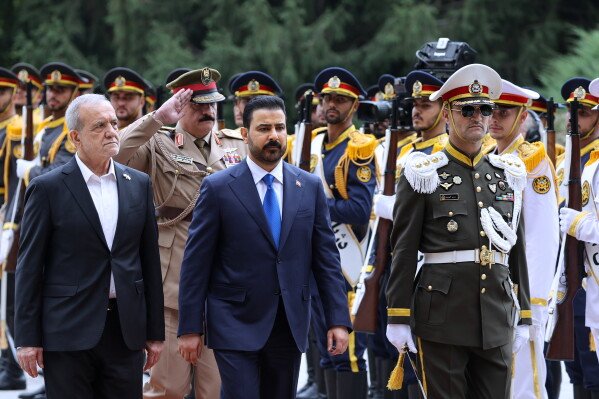
In this photo released by the Office of the President of Iran, Iraqi Prime Minister Ali al-Zaidi (center) inspects a guard of honor as he is greeted by Iranian President Masoud Pezeshkian (left) during an official welcoming ceremony in Tehran, Iran, Thursday, July 22, 2026. (Office of the Iranian President via AP)
In this photo released by the Office of the President of Iran, Iraqi Prime Minister Ali al-Zaidi (center) inspects a guard of honor as he is greeted by Iranian President Masoud Pezeshkian (left) during an official welcoming ceremony in Tehran, Iran, Thursday, July 22, 2026. (Office of the Iranian President via AP)
Add AP News to Google
Add AP News as your preferred source to see more of our stories on Google.
Share More
Houthi attacks are a ‘double blow’ to oil supplies
The Houthi news agency SABA said rebels struck two tankers, the Enselia and the Laila, in the Red Sea, causing fires on both. There were no reports of casualties.
It was the first Houthi attack on a ship since they announced a blockade of Saudi-linked ships across the Bab al-Mandeb Strait earlier this week in response to the Yemeni kingdom’s blockade and recent attack at the international airport in Yemen’s rebel-held capital Sanaa.
Bab el MandebLocated at the southern tip of the Arabian Peninsula, it is an important transport hub connecting the Red Sea to the Gulf of Aden. About 12% of global trade passes through it, including a quarter of global container traffic, moving between Europe and Asia through Egypt’s Suez Canal.
The state-run Saudi Press Agency said the attack caused the Anselia to catch fire in the Red Sea overnight. There was no mention of Leila.
The United Kingdom’s Maritime Trade Operations Center said it had received a report that the tanker had been hit by an “unknown projectile” 130 kilometers (80 miles) southwest of Al Shuqaiq, Saudi Arabia, in the Red Sea.
The Houthi attacks have threatened oil supplies from the Saudi Red Sea port of Yanbu and represent a “double whammy” on top of disruptions in the Strait of Hormuz, maritime data and analysis company Lloyd’s List Intelligence said.
Saudi Arabia has diverted millions of barrels of oil exports a day to Yanbu via an overland pipeline as the war clogs the Persian Gulf.
The Houthi threat “raises questions about the viability of this route,” Lloyd said in slides accompanying Thursday’s online webinar.
The rebels claim to be blockading Saudi Arabia, but during their declared blockade of Israel at the height of the war in the Gaza Strip, they attacked numerous ships with little or no connection to the conflict. disrupting global trade.
Both sides occupy the Strait of Hormuz
Iran says it has the right to manage traffic and potentially charge tolls in the Strait of Hormuz, which was free to everyone before the war. It attacked ships traveling through the strait, which is controlled by US forces and intended to go beyond Tehran’s control.
On Thursday, Trump said on social media that authorized Iranian funds held by the United States would cover the cost of repairing boats damaged during the war.
“Please allow this statement, until further notice, to serve as confirmation that, from this point forward, any and all damage to vessels, cargo, or anything related to them will be paid for with Iranian money that the United States owns and controls,” Trump said.
It was unclear what legal mechanisms Trump would use to access and spend the funds, but he said it would be a “fair and equitable thing to do.”
In response to the Iranian attacks, the US began expanding its campaign of strikes against Iran and reinstated a naval blockade of Iranian ports. U.S. Central Command said it had diverted about a dozen commercial vessels and disabled one since the blockade was renewed.
The war of words has also escalated. Iranian Foreign Minister Abbas Araghchi said Tehran will adopt a tit-for-tat policy regarding US strikes on its infrastructure. US Secretary of State Marco Rubio responded that Trump’s policies are “a head for an eye.”
“The price will go up every night until they come to their senses,” Rubio told reporters during a trip to the Philippines. regional summit.
Iran’s health ministry said on Thursday that 55 people have been killed and 629 injured since US airstrikes resumed on June 27.
Iran responded to US attacks by targeting energy infrastructure and desalination plants providing drinking water to the arid neighboring Gulf countries.
Opinion polls have shown the war is unpopular among Americans, a fact reflected in Thursday’s narrow passage US House of Representatives resolution to stop the war. Although a handful of Republicans crossed party lines to support the measure, the vote remained largely symbolic.
___
Bekatoros reported from Athens, Greece, and Binkley from Washington. Associated Press writers Munir Ahmed in Islamabad, Pakistan; Bassem Mrou in Beirut; Michelle L. Price and Jim Gomez in Manila, Philippines; Qasim Abdul-Zahra in Baghdad, Matthew Lee in Washington; and Christopher Weber in Los Angeles contributed to this report.