

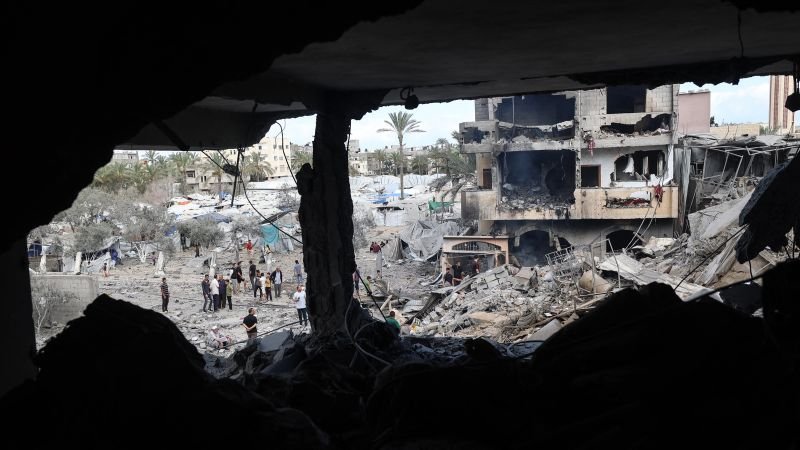
Hamas announced Monday it would dissolve its government in the Gaza Strip, a move experts say puts pressure on Israel as progress on a U.S.-brokered ceasefire stalls.
Ismail al-Twabta, head of Hamas’ government press office (GMO), said the militant group was ready to hand over control to a Palestinian technocratic committee that would lead the enclave under the agreement. Hamas’ statement made no mention of disarmament, one of the key demands of the second phase of the ceasefire agreement, which the group has so far rejected.
The announcement makes little difference on the ground, where Hamas and its security forces maintain tight control over the part of Gaza not occupied by the Israeli military. But the symbolic move shifts the focus of the ceasefire agreement back to Israel as President Donald Trump pressured Prime Minister Benjamin Netanyahu to move forward with elements of the plan. This includes the creation of “pilot zones” in the Gaza Strip in which Palestinians would live under the direction of a technocratic committee.
Hamas appealed to mediators and the international community to obtain permission from Israel for the committee to enter the Gaza Strip.
“We call on all interested and relevant parties to immediately accelerate steps for the rapid entry of the National Committee for the Administration of Gaza (NCAG) and assume their national and administrative duties and responsibilities in order to strengthen the resilience of our noble Palestinian people and heal their wounds,” al-Twabta said in a statement at Al-Aqsa Martyrs Hospital in Gaza City.
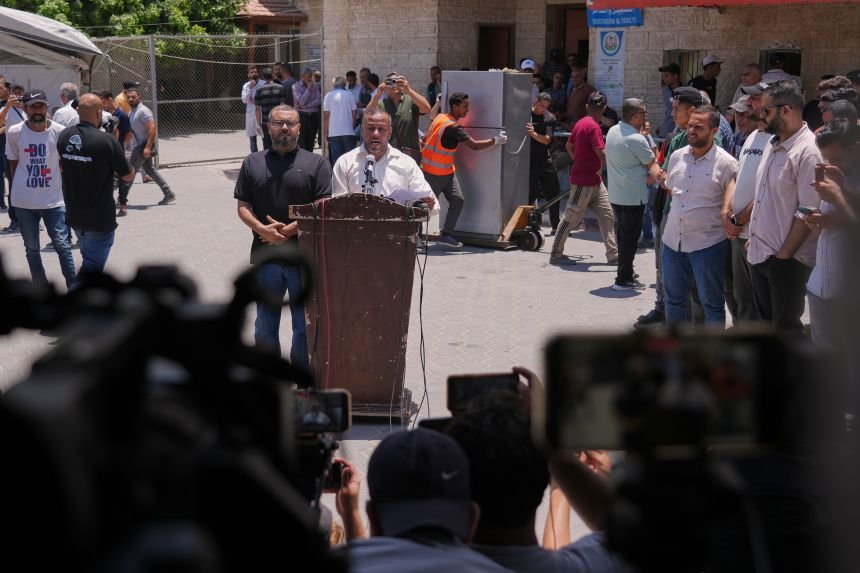
The Peace Council, set up to promote the ceasefire, said it “took note” of Hamas’ statement but would wait for “actions, not promises.” In a statement at X, the board called on Hamas to disarm, saying: “The basic principle remains one government, one law and one weapon.”
Muhammad Shehadah, a Gaza expert at the European Council on Foreign Relations, called the announcement an attempt by Hamas to “talk over Netanyahu’s head” and appeal to Trump.
“The Israelis (say) Hamas refuses to give up government and especially security, so what they (Hamas) tried to emphasize in this statement is that they are willing to give up everything about governance, from A to Z,” Shehadah told CNN.
Hamas views the committee as “the only way” to place a Palestinian government in Gaza that the international community recognizes without reservation, Shehada said, calling it a “smart move.” But he said it would likely come too late.
“Even if this bet pays off – even if Trump is convinced, and even if everything goes according to plan – Israel will still have complete control over everything in the Gaza Strip,” he said. “Israel will still interfere with NCAG.”
The creation of NCAG was conceived in October as part of a US-brokered ceasefire plan to take over control of Gaza from Hamas. But the committee remained in Cairo, unable to enter Gaza or exercise any powers there.
Al-Thwabta said there is “full confidence” that Hamas has made “all administrative and legal preparations and measures” to transfer power to NCAG. Hamas also said that its government employees will be considered civil servants who can continue to work under the NCAG. The Gaza government has about 60,000 employees, according to GMO.
But the timing of such a transition to NCAG is unclear. Last week, the Peace Council, created to promote the ceasefire plan, touted two days of “highly productive” meetings in Cyprus. The council said it was preparing for NCAG’s takeover of Gaza “once the necessary conditions are met”, but those conditions were not laid out amid wider difficulties in moving forward with the deal.
Michael Milstein, head of the Forum for Palestinian Studies at Tel Aviv University, said Hamas’ announcement was not a surprise. Instead, he called it an attempt by Hamas and the middlemen to change the formula.
“Hamas made clear that this move was intended to pave the way for a breakthrough,” Milstein told CNN. Key mediators Qatar, Turkey and Egypt are trying to present a united front to Trump to show him that the deal is moving forward, he said, and that U.S. pressure on Israel will increase to meet the next stages of the agreement.
A 20-point ceasefire plan for Gaza that took effect in October has stalled and key elements of the agreement have not been implemented. The first phase of the agreement called for a complete cessation of hostilities in Gaza, but Israel launched almost daily strikes on the enclave. Since the ceasefire began, Israeli strikes on the Gaza Strip have killed more than 1,000 people, according to the Palestinian Health Ministry.
In accordance with the second phase of the agreement, instead of withdrawing troops from the Gaza Strip, the Israeli military seized most of the territory – for the stated purpose occupy approximately 70% of the band – forcing two million Gaza Palestinians to live on an ever-shrinking patch of land. An international force meant to secure parts of the Gaza Strip and allow NCAG to take over has yet to materialize. Instead, Hamas has reasserted its power in parts of the Gaza Strip not occupied by Israel, recently executing a Palestinian accused of collaborating with Israel.
CNN’s Tal Shalev contributed to this article.