

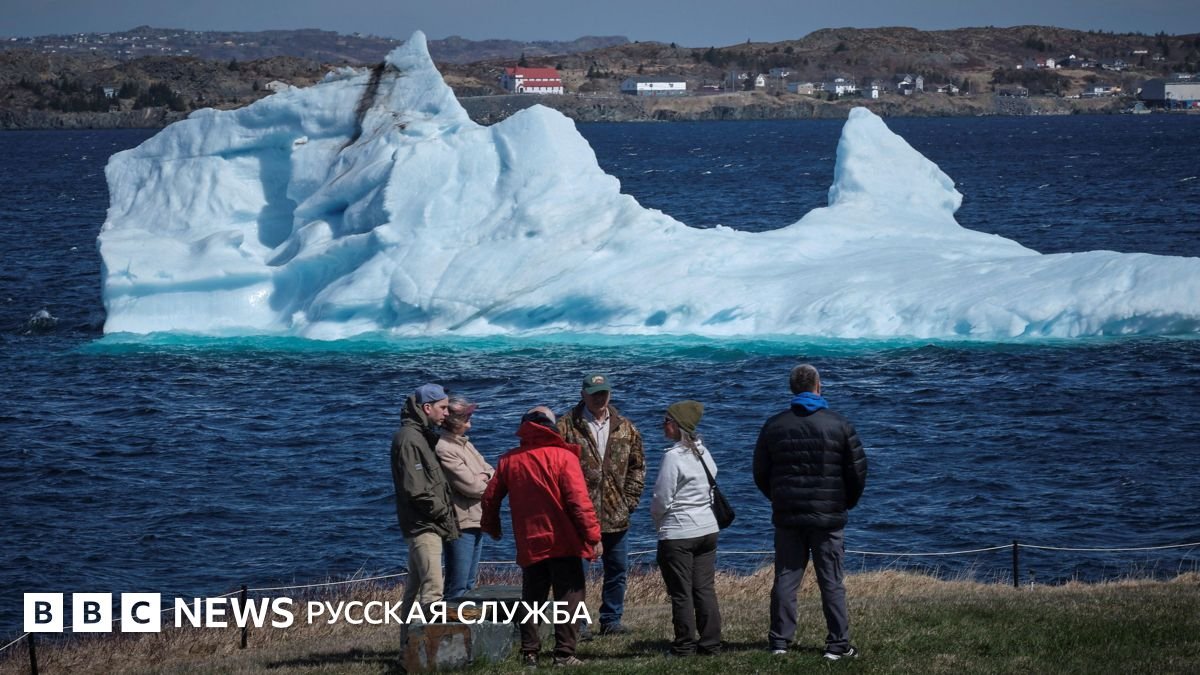

Author of the photo, Reuters
Photo caption, The Arctic is warming four times faster than the rest of the planet, accelerating global warmingAbout the article
Published 9 July 2026, 02:00 GMT
Reading time: 4 min
Global warming leader Europe experienced its hottest June in modern history after a record-breaking heat in late May and an unusually cold winter. Such weather swings are a direct consequence of climate change on the planet, remind European scientists and warn that warming oceans and melting ice in the Arctic promise new cataclysms.
The first heat arrived in western Europe unusually early this year – at the end of May. France, Great Britain, Ireland and Portugal especially suffered. Before they had time to catch their breath, they were covered by a June wave of hot air. As soon as it subsided, it was almost immediately followed by a new heat wave in early July.
The succession of these waves underscores a new reality: extreme heat waves are becoming more frequent and intense not just in Europe but around the world, the European Center for Medium-Range Weather Forecasts (ECMWF) said in a monthly report released on July 9.
June records are not limited to Europe. Ocean surface temperatures outside the polar latitudes (between 60° south and 60° north latitude) were also the highest on record.
“June 2026 showed just how severe climate change is,” said ECMWF co-leader Samantha Burgess. “Temperature records are direct evidence that the planet’s climate system continues to accumulate heat.”
The air conditioner is acting up
The last 11 years have turned out to be the hottest 11 years on record, with the three most outstanding being the last three: 2023, 2024 and 2025, according to data from UN meteorologists.

The current year will easily fit into this schedule, as the El Niño phenomenon is gaining strength in the Pacific Ocean. It is caused by weakening winds, as a result of which heated masses of surface water spill over the Pacific Ocean between South America and Asia, preventing the normal circulation of cold water from the depths.
During the El Niño period, the ocean warms up, however, unlike global warming, the phenomenon itself does not change the total amount of energy on the planet, although it temporarily enhances its effect.
But the melting of ice in the polar latitudes has not a temporary, but a long-term effect on the climate, since the Earth loses its white shield that reflects solar energy, and the dark waters are rapidly warming, which is why the rate of ice melting increases – a vicious circle closes.
The ocean is the planet’s air conditioner. It covers more than 70% of the Earth’s surface and has absorbed 90% of excess global warming in recent decades. At a depth of just a few tens of meters, the same amount of heat is stored as in the entire atmosphere. The warmer the ocean, the worse it smooths out temperature fluctuations – the air conditioner malfunctions.

Author of the photo, Reuters
Photo caption, June turned out to be unusually dry, which promises drought in Eastern Europe and has already led to a surge in forest fires, especially in Spain and Portugal. Boats in a dry harbor on Lake Velence in Hungary
As a result of ocean warming, the Arctic has been warming four times faster than the rest of the planet in recent years. On one September morning, there will be virtually no ice left there – a development that is guaranteed at least once before 2050 under any emissions reduction scenario, scientists warn.
It was the warming of the Arctic that brought Europe to the forefront of global warming, and Russia took the main blow, because a significant part of it is located in the Arctic. As a result, Russia is warming up 2.5 times faster than the rest of the planet, scientists have calculated.
June did not change the sad statistics of recent years. In the Antarctic, average sea ice extent in June remained below normal by about 8%, and in the Arctic by about 5%. The situation is worst in the northern Barents Sea, off Spitsbergen and Franz Josef Land, ECMWF said.