

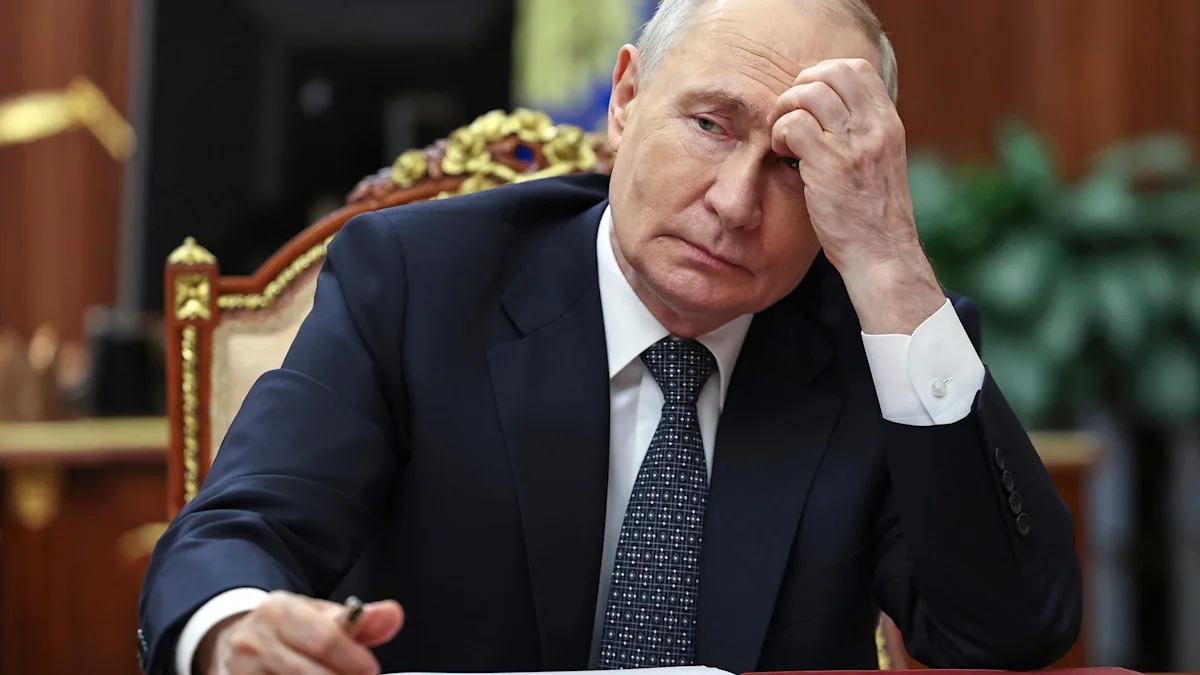
The Russian stock market is going through one of its darkest times. The leading index has lost 30 percent since the beginning of the year. Many large corporations are falling to historic lows. The expert identifies five points of a downward trend.
The past week has been busy. With a daily loss of 4.24 percent, Thursday marked the darkest trading day in nearly four years. But in fact, this was just a continuation of what had already been going on for five months: the Russian stock exchange experienced a sell-off on a scale rarely seen. And this initially continued on Monday until there were signs of stabilization at a lower level. For the first time, the leading iMOEX index, which stood at over 2,800 points a year ago, fell below 1,900 points on Monday morning.
What is the reason for such excessive pessimism? Experts in Moscow note that dividend cuts by some stock market heavyweights have led to a further drop in the index, especially in the last few days. These include the country’s largest banks, Sberbank and VTB, which together account for almost 20 percent of iMOEX’s market capitalization.
Yet the dividend cut only added to a downward trend that has been going on for almost five months. This trend has accelerated since the beginning of summer. The stock market fell more than eight percent in June and more than 15 percent in July.
Up to 40 percent of oil refineries could be damaged
This is not just a negative factor affecting the market, it is the accumulation of a number of problems, some of which have become chronic, and new risks. Mikhail Zeltser, an analyst at the Russian investment bank BKS, in his report, as reported by the Russian business publication RBC, highlights five main points: On the one hand, the impasse in negotiations on the war in Ukraine is depressing the market. The extent to which the market hopes for movement on this issue has been shown repeatedly since US President Donald Trump took office. However, since Trump was distracted by the war in Iran, this driver also disappeared from the Russian capital market.
On the other hand, Zeltser talks about various aggravations of the political situation. The Moscow Exchange takes into account the increased sanctions pressure from not only Europeans, but also the United States.
The fuel crisis caused by Ukrainian drone attacks on Russian oil facilities has long gone unnoticed on the stock market. An estimated 40 percent of oil refineries have already been damaged. It is no coincidence that Russia banned the export of diesel. Fuel shortages, production rationing and corresponding price increases can, of course, only be mitigated, but not eliminated.
Gazprom shares fell to historic lows
As a result of this situation – the fifth main reason for the stock market decline, according to Seltzer – inflation is rising again, leaving the central bank with an extremely difficult task at its next interest rate meeting this week. It just shocked Russian businessmen and the stock market because it cut interest rates not by 0.5 percentage point as expected, but by only 0.25 percentage point. That means the key interest rate remains high at 14.25 percent, making investment difficult and businesses and consumers stifled by debt servicing.
Kremlin boss Vladimir Putin – uncharacteristically – called for monetary easing for the second time. That’s becoming increasingly difficult to resist for central bank chief Elvira Nabiullina, a fierce inflation fighter, especially since her tight monetary policy has long seen her as a scapegoat for a weakening, even stagnating economy. Yet he could shock the market again this week by keeping monetary policy tight.
What is striking is that shares of some of Russia’s largest corporations reached historic lows last week. These include the second largest bank VTB, telecommunications group Rostelecom, diamond group ALROSA, aluminum and electricity holding En+ and the world’s largest gas company Gazprom.
Gazprom shares, for example, fell five percent on Thursday, falling below 84 rubles, marking their lowest level since trading began in 2006. This was caused not only by the general situation, but also by news of possible punitive US tariffs for importers of Russian gas. In addition, the construction of a second gas pipeline to China, called Power of Siberia 2, means that paying dividends in the future will no longer be possible, as it has been for several years, due to high investments. Recently, there have been signs that China is insisting on buying gas at low domestic tariffs when building a gas pipeline. Gazprom is almost entirely at the mercy of China now that Europe receives almost no gas from the Russian company.
The Russian stock market has long been oversold, analysts have been saying for several weeks. Renewed high oil prices resulting from the war with Iran should soon provoke opposition. This became apparent on Monday. Bloomberg news agency reported that the EU is considering easing or delaying a package of sanctions on liquefied natural gas imports from Russia. Experts have long noted that supply disruptions due to the war with Iran and the simultaneous refusal of Russian liquefied gas will lead to price explosions in the market and will especially affect Europe. The stock market in Moscow turned positive on Monday afternoon. However, it is too early to talk about a trend reversal.
This article was created for the WELT Business Competence Center and Business Insider Germany.
Eduard Steiner writes in WELT primarily about the Russian economy.