

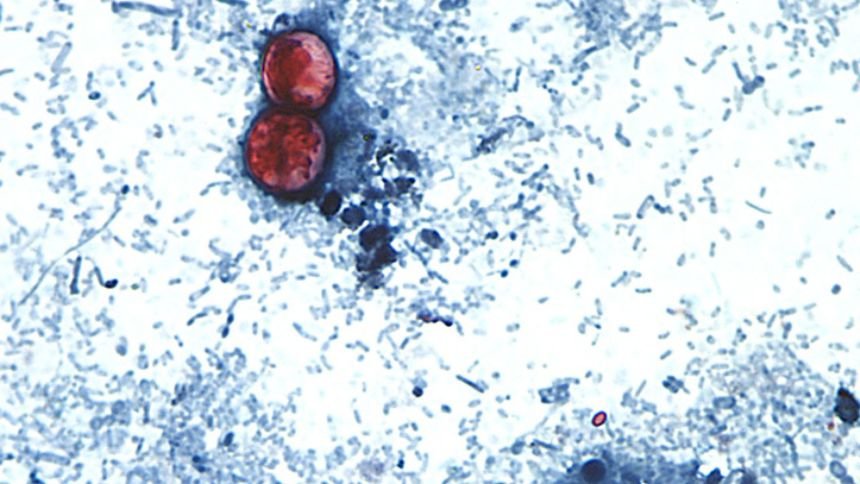
An outbreak of diarrhea caused by the parasite Cyclospora has grown to more than 3,000 cases in Michigan and Ohio, and an ongoing investigation suggests the source may be lettuce or salad greens.
However, Michigan health officials said other products could not be ruled out and no specific type, manufacturer or supplier was identified as the source.
“Preliminary information indicates that lettuce is a common food item that regularly comes up during the investigation,” Dr. Natasha Bagdasarian, Michigan’s chief medical officer, said in a statement Monday. Authorities said the investigation is ongoing.
As of 9:30 a.m. Monday, Michigan has 2,640 cases, including 44 hospitalizations. Ohio reported 361 cases since June 1. At least 46 people were hospitalized.
As of July 10, 31 states had reported cases to the US Centers for Disease Control and Prevention, although it is unclear if they are all part of the same outbreak. The CDC says “several states” reported an increase in cases in the past two weeks compared to the same period in 2025. The agency said Friday that its national tally — 843 confirmed cases since May 1 — is lower than the states’ tally, although the cases are undergoing further analysis.
Investigators are finding it difficult to determine the source of the outbreak. Cases of cyclosporiasis are counted slowly, and patients may need to remember what they ate several weeks ago; genomic testing of cases is difficult; and some public health systems that track foodborne illnesses have recently seen sharp declines.
In 2025, after cutting staff and funding for public health agencies, the CDC phased out one of its foodborne disease surveillance systems. The FoodNet system is a partnership between the CDC, USDA, US Food and Drug Administration and 10 state health departments that proactively identifies cases of foodborne illness by contacting laboratories directly to obtain test results rather than waiting for them to be reported.
Until July 1, 2025, FoodNet collected data on eight pathogens, including Cyclospora. Currently, the network collects information about only two pathogens: salmonella and a particularly dangerous type of E. coli bacteria. The rest is optional.
Cyclosporiasis remains a nationally notifiable disease, meaning confirmed cases are reported to state health departments and ultimately to the CDC.
But these cuts mean U.S. surveillance of the pathogen is not as robust as it once was.
“I don’t think it’s in our country’s best interest to cut these programs,” former CDC director Dr. Robert Redfield told CNN on Monday. “Surveillance is kind of the key to early detection.”
The U.S. Department of Health and Human Services says cyclosporiasis cases are expected to increase during the summer months and they are working with federal and state partners to monitor case numbers and cluster activity.
“The FDA and CDC are actively working with government partners to identify the source of the growing number of illnesses,” Emily Hilliard, a spokeswoman for the U.S. Department of Health and Human Services, said in an emailed statement.
“To be clear, CDC continues to collect this data on cyclospora through surveillance systems other than FoodNet and reporting occurs through those systems. Funding for government foodborne illness efforts remains stable, with approximately $33 million available annually,” Hilliard said in an emailed statement Monday.
Cyclospora is more difficult to track than other pathogens.
For some foodborne pathogens, such as E. coli and Salmonella bacteria, scientists can sequence or read their DNA to match the strain that makes people sick with the strain that contaminates food or water. It is the matching of genes that allows scientists to identify outbreaks of foodborne illnesses in the first place.
A national network of surveillance laboratories called PulseNet continuously sequences the genes of bacteria that make people sick so they can compare the DNA fingerprints of disease cases in near real time. When fingerprints match on multiple occasions in different states, scientists know to look for a common source.
But gene matching only works because the genetics of a particular strain of E. coli or salmonella change very little when passed to us from food or from person to person. The letters of their instructions read the same way every time, so they are fairly easy to follow.
With cyclospora, things are different, says Jennifer McIntyre, a microbiologist and founder and CEO of Food Safety Strategies, which advises clients on cyclospora control.
“For bacterial pathogens, the technology is quite mature and the organisms are actually very, very simple. It’s like reading a children’s book instead of reading ‘War and Peace’ – Cyclospora is ‘War and Peace.'” McIntyre said.
“They’re all letters of the alphabet, but they’re not the same,” she said.
Cyclosporiasis is not usually transmitted directly from person to person. People are most likely to get sick when they eat or drink something that was contaminated several weeks ago, usually fresh produce or pool water. In its update Monday, Michigan said there is “currently no evidence linking recreational water activities to this outbreak.”
People with cyclosporiasis may experience symptoms, including watery diarrhea, cramping and bloating, for several weeks. Dehydration can land people in the hospital. Treatment takes seven to ten days with the antibiotic combination sulfamethoxazole-trimethoprim, sold as Bactrim or Septra.
The number of illnesses caused by the parasites is believed to be under-reported because many people with cyclosporiasis, which causes unrelenting diarrhea, cramping and bloating, may be embarrassed to see a doctor or try to wait out the symptoms at home.
Making an accurate diagnosis can also be challenging because Cyclospora is shed intermittently in the stool. People may need more than one test to identify him. This test is also not included in all routine laboratory tests for stomach disease and may require a special order from a doctor who suspects it.
Thus, by the time a person is actually considered a “confirmed case” and their case is reported to public health authorities for follow-up, several weeks will have passed since the exposure that made them sick.
Michigan said it will take some time to complete the investigation given the size of the outbreak, the emergence of symptoms and the complexity of food distribution systems.
Some restaurants have reportedly removed some fresh ingredients from their menus while the investigation continues. These measures are voluntary, Baghdasaryan told CNN.
“Preventive measures have been taken to prevent infection,” Baghdasaryan said.
There are no nationwide recalls of any food products suspected of being linked to the outbreak, Baghdasarian said.
“We’ve seen some signals. We’re looking for signals, and we’re seeing some early signals,” Baghdasaryan said Friday.
When it became clear they were in the midst of an outbreak, Bagdasarian said her team rushed to release guidance over the July 4 holiday weekend for food service workers — at home and in restaurants — on general practices for preventing illness caused by the parasite.
To reduce the risk of infection, people should thoroughly wash produce and prepare fruits and vegetables. Michigan health officials recommend buying whole heads of lettuce instead of pre-washed lettuce; removing outer layers of lettuce; and washing the inner leaves.
She said identifying the source of the outbreak will take longer as they work to interview every person with a confirmed case – there are now more than 2,600 in Michigan. More than 1,000 interviews have been completed so far.
People who agree to be interviewed will be asked to remember what they ate weeks earlier, which is difficult and unreliable. So in addition to interviews, they also examine people’s digital and paper records, including restaurant and grocery receipts.
“It actually requires us to check every single item they ordered at the restaurant, what was on those menu items, and get customer cards,” Bagdasarian said.
“You can imagine how much effort and work went into this.”
Correction: A previous version of this story incorrectly stated the number of cyclosporiasis cases reported in Ohio since June 1.