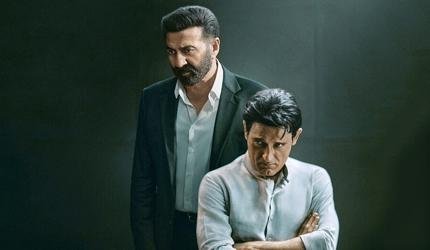
By then Still reaches its overblown ending, complete with a repetitive stunt ending, the verdict is clear: melodrama wins, logic loses, observes Mayur Sanap.
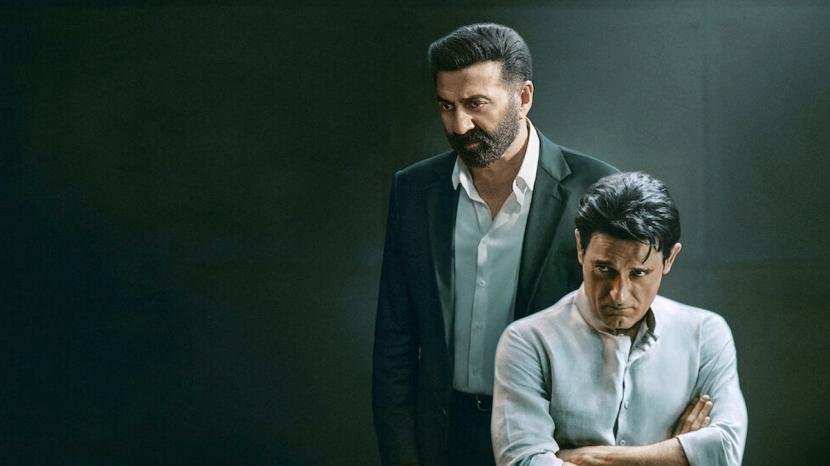
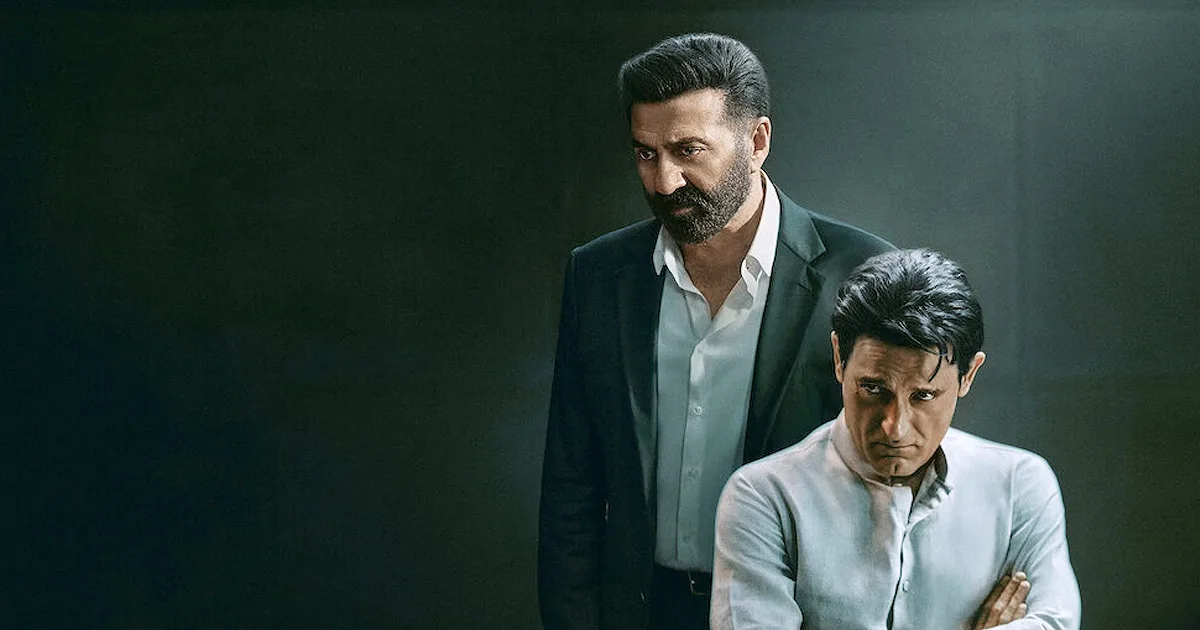
IMAGE: Sunny Deol and Akshaye Khanna in Still.
Key Points
- Sunny Deol and Akshaye Khanna star in Siddarth P Malhotra’s legal drama Still.
- The clash between the two stars is the film’s biggest winner.
- The only problem is that these moments are quite short, leaving you wanting more from this confrontation.
There’s a release line Still: “When lawyers don’t persuade, they confuse.”
It’s meant to be a heated courtroom debate, but ironically it sums up the film itself.
The narrative wants to convince you with moral dilemmas, courtroom fireworks, and arcane secrets. It creates all the necessary ingredients for a gripping legal thriller, but somewhere along the way Still gets carried away by his own theatricality.
It’s disappointing because the film starts out with a really compelling conflict.
Role of lawyer Sunny Deol
Sunny Deol plays Arjun Mehra, a dynamic lawyer who has long served the powerful Gaur family and whose successful track record has earned him the nickname “Ikka”.
Arjun, like the warrior from the Mahabharata, finds himself trapped in a moral crisis regarding the true meaning of justice. But there is no Krishna next to this Arjun to guide him.
It’s nice that Sunny Deol is presented here as a protagonist rather than a grandiose hero.
He becomes the devil’s advocate for Shuryaman (Akshaye Khanna), the privileged heir of the Gaur family, who is accused of attempting to murder a young woman (Akansha Ranjan Kapoor). Contrary to what his name suggests, Shuryaman has very little courage or dignity. He is entitled, sloppy and drunk on power.
Arjun reluctantly comes to Shuryaman’s defense over the situation involving his wife Avantika (Dia Mirza), making the matter as personal as it is professional.
Courtroom drama issues
On paper Still has a compelling setup. With its character-driven approach, it promises an exploration of law and justice. But the problem is that the film rarely believes in the strength of this premise.
Director Siddharth P Malhotra designs the film to be a crowd pleaser and to some extent it will satisfy the audiences looking for old school courtroom theatrics powered by Sunny Deol’s towering screen presence. But the film’s loud approach often belies moments when the script tries to be more nuanced.
Rather than allowing courtroom arguments to naturally build tension, the film insists on delivering a ruthless background assessment to each point. Each revelation is accompanied by thunderous background music. And every courtroom exchange devolves into operatic melodrama, with the film too often mistaking noise for intensity.
Maybe melodrama isn’t such a problem. Last Year’s Telugu Drama Court: state against no one have shown that courtroom dramas thrive on fiery monologues and emotional intensity, as long as they are backed by genuine conviction and strong character.
The absence of these two elements makes Still I feel like a throwback to an era that Bollywood has already surpassed in many ways.
Althea Kaushal and Mayank Tewari’s screenplay is laden with two competing narrative threads that never come together.
The central mystery of what really happened that night should have been enough to hold the audience’s attention. Instead, it’s written too conveniently, with last-minute witnesses, shocking video evidence and a cover-up plot that seems increasingly fabricated.
The second theme revolves around Dia Mirza’s Avantika. The film tries to say something meaningful about family, parenthood and marriage through its character, but the script remains too convoluted for any of it to really come through.
Realism doesn’t help either. In one of the wedding photographs, Dia’s real-life husband, Vaibhav Rekhi, appears in details that seem strange and distracting in a film that is already asking you to overlook several convenient plot twists!
Sunny Deol vs Akshaye Khanna
Sunny Deol carries the film on his (still) muscular shoulders and delivers his A-game performance.
The film contains a conscious allusion to its iconic two kilograms of milk image, but Still he’s more interested in showing Sunny in a dramatic space, even putting him in moments of vulnerability. For a man whose career has been built on displaying explosive rage on screen, it’s interesting to see him constantly keeping his temper in check.
The film also sometimes seems like a continuation of it Damini character where he takes on the fight for a woman seeking justice. This pro-woman attitude appears again here when Arjun stops his subordinate and makes it clear that he will not allow the “character assassination” of a woman.
The clash between Sunny Deol and Akshaye Khanna is another important moment. Whenever these two share a frame, the energy changes in those fiery moments. The only problem is that these moments are quite short, leaving you wanting more from this confrontation.
Akshay’s performance relies heavily on his usual smirking one-liners and clenched teeth, making his performance irritatingly monotonous. But he manages to deliver one standout courtroom scene, where his theatrical tears and sly smile remind us why he remains so watchable on screen.
Tillotama Shome is no less impressive. As prosecutor Madhur Banerjee, she brings a welcome restraint to a film that desperately needs it. She is presented as an ordinary working woman juggling household duties with professional responsibilities, much like Geetanjali Kulkarni from Court. Thanks to Tillotama’s incredible talent, she plays the character with a lively authenticity that makes her feel real amidst all the surrounding melodrama.
Unfortunately, Dia Mirza is given little to do other than the low-key supporting role she has become familiar with of late.
Things are even worse for Sanjeeda Sheikh. Since she is Akshay’s dutiful wife, her plot is more like a smokescreen added for dramatic weight before eventually fading into the background.
By then Still reaches its overblown conclusion, complete with a repetitive gimmick finale, the verdict is clear: melodrama wins, logic loses.
Still streaming on Netflix.
Still Rediff Rating Review: