

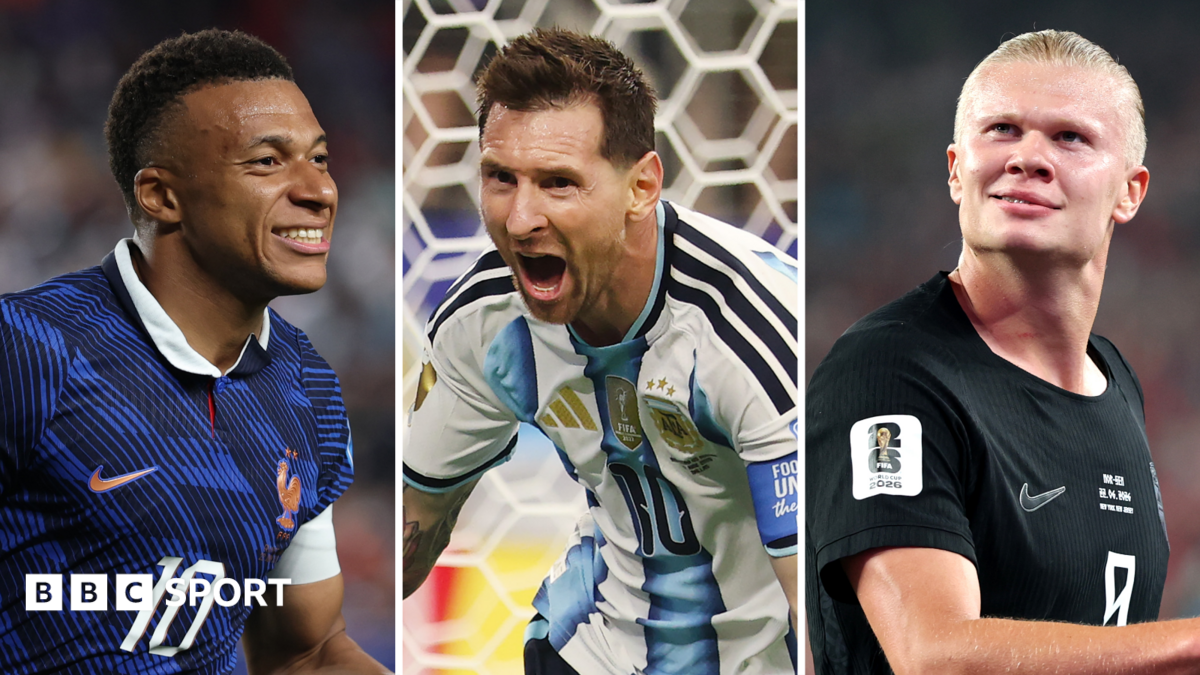
Some Golden Boot races move slowly. Others are formed by one runaway scorer. This one is different.
This is a Golden Boot race for the ages, a four-way sprint featuring Kylian Mbappe, Erling Haaland, Lionel Messi and Harry Kane. They all achieve numbers that could easily win most modern tournaments.
A double-digit result at the World Cup is one of the rarest achievements in football. Few players in nearly a century of competition have managed to score 10 or more goals in a single tournament. And here we are in 2026, with four attackers simultaneously advancing towards this territory.
The scoring rate alone makes this stand out as something special. Messi leads the way with eight goals. Mbappe and Haaland have seven goals each, while Kane has just under six.
At recent tournaments, this would have been enough to get the Golden Boot. Miroslav Klose won it with five goals in 2006, as did Thomas Müller in 2010, ahead of Diego Forlan, Wesley Sneijder and David Villa in assists. Even Harry Kane’s six goals in 2018 and Mbappe’s eight points in 2022 seemed outstanding. This year, these calculations are just a starting point.
Historical comparison sharpens the picture. Previously, only eight players had scored eight or more goals in one World Cup – Juste Fontaine, Sandor Kocsis, Gerd Muller, Ademir, Eusebio, Guillermo Stabile, Ronaldo and Mbappe. Messi has now joined them.
This list covers almost 100 years of football. Now, in 2026, three more players are simultaneously threatening to join Messi. The level of performance, consistency and spread across different teams and styles all combine to create a Golden Boot battle that feels truly generational.
Margin matters too. The Golden Boot is determined primarily by goals, then assists, and then minutes played, so each participation carries weight. Mbappe has two assists, Kane and Messi have one each. Haaland leads the way in ruthless efficiency, all aspects that affect the race can be resolved in the smallest detail.