
© Adobe Firefly (powered by artificial intelligence)
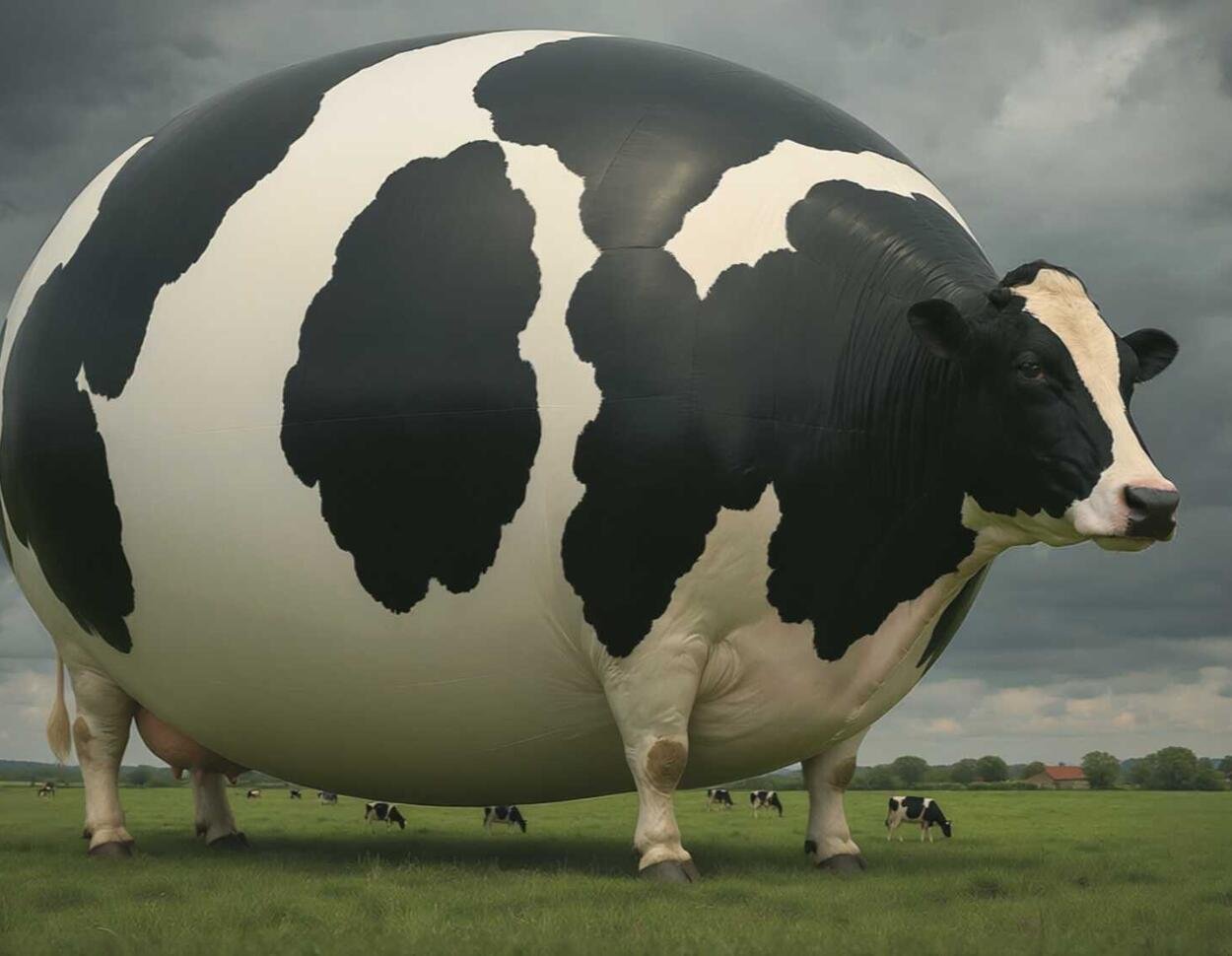
Monstrously bloated cow (symbolic image). The cow’s role in climate change is not as big as it has sometimes been portrayed in the past. This follows from the European Commission’s new livestock strategy.
From the farmers’ point of view, the EU Commission’s livestock strategy leaves many questions unanswered, especially when it comes to financing. But it has the distinct advantage of debunking the myth of cows as climate killers.
Anyone who has ever been involved in a discussion about animal agriculture knows the moment: sooner or later the term “climate killer cow” comes up. Livestock production produces large amounts of methane and thus contributes to climate change. The only solution is to reduce supplies and eat less meat.
Many in agriculture have opposed this over the years and called for a more differentiated approach. Now they have finally received justice from the highest authority – the EU Commission – in the form of a new EU livestock strategy. There is no new money in the strategy, but linguistic changes are still important.
Strategic autonomy versus the Green Deal

© Jacob Burr
Commentary by Simon Michel-Berger, editor-in-chief of agrarheute magazine.
For the first time, the Commission considers livestock farming from a European security perspective and uses the term “strategic autonomy”. This is a significant change for the government, whose slogan until recently was the “Green Deal.” It sees livestock farming, especially on the EU’s eastern border, as a defense against land abandonment and thus as a factor in regional security.
The Commission reiterates that livestock production is responsible for the majority of agricultural methane emissions. But here too she takes a new position. For the first time we are talking about biogenic methane, which is part of the natural cycle and thereby distinguishes it from fossil fuel emissions.
Member States should only reduce nutrient surpluses in areas with very high concentrations of livestock. But here, too, the solutions are voluntariness, innovation and new technologies.
The Livestock Strategy is even more positive in describing what needs to be done to reverse the decline of livestock farming in the EU. Modernization, better value creation, greater biosecurity and many other terms are mentioned, all of which are familiar to farmers. At one point, the Commission referred to the billion-dollar funding gap for the livestock industry as a whole.
But the strategy becomes weak when it comes to the question of where to get the money. Possibly from CAP, perhaps through the European Investment Bank lending programme, preferably from retailers and ideally from consumers. In support of the latter, a new seal of European origin may appear. We have been to this place many times. I no longer believe in a single new logo that will bring breakthrough. Modernization of livestock farming will either be paid for primarily by the market, or will not be paid for at all.
This latest construction can be regretted, and I myself have often done so in recent years. Perhaps one day Europe will realize that real progress can only be made through private sector partnerships such as the Animal Welfare Initiative.
Logic for the entire agricultural industry
However, this livestock strategy is a joy for all those in agriculture who have been plagued by the myth that cows are climate killers. If agriculture as a whole can now be recognized – on a par with defense – as a critical area for the entire EU, then other problems such as agricultural support or excessive bureaucracy can also be better addressed.