

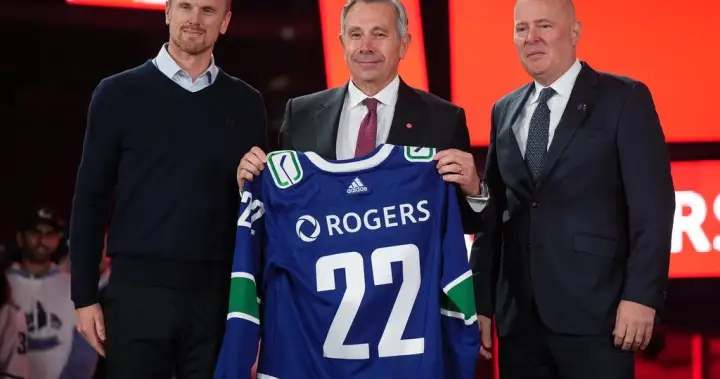
Rogers Sports and Media is closing its radio station Sportsnet 650 in Vancouver and station Sportsnet 960 in Calgary, as well as four other stations.

660 NewsRadio in Calgary is also closing, as well as 11:30 AM in Vancouver, 95.7 NewsRadio in Halifax and 570 NewsRadio in Kitchener.
The company said the station’s closure would result in 80 employees losing their jobs. These are among 230 total job losses at Rogers Sports and Media due to these and other organizational changes announced Tuesday.
Rogers cited dwindling audience numbers and declining advertising revenue.
“The media business continues to face headwinds from declining advertising revenues and changing audience habits. These changes are part of our plan to focus our investments in areas that will drive long-term growth,” Rogers spokesman Zach Carreiro said in an emailed statement.
Story continues below advertisement
“After a thorough review of our radio stations, we have made the difficult but necessary decision to close six radio stations in four markets due to declining audience and revenue trends.”
Carreiro said Rogers will continue to own and operate 44 radio stations in nearly 30 communities and will “invest in local news in impacted markets.”
Rogers will continue to broadcast Vancouver Canucks games on one of his radio channels in that city, but will no longer produce Calgary Flames broadcasts for radio.
Sean Kelso, a spokesman for Calgary Sports and Entertainment Corp., the Flames’ parent company, said in a statement that the Flames “learned of the closure of Sportsnet 960 on Tuesday and are considering their options.”
From October to May last year, Rogers said his Calgary sports radio station averaged just 1,200 listeners. During the same period, the average audience for a Vancouver sports station was 2,100 listeners.
Related videos

1:58
Toronto Raptors sign Kyle Lowry to one-day contract before retiring
Previous video
Next video
Story continues below advertisement
The move partly reflects an evolution in how consumers consume audio content, especially sports fans, said Christopher Waddell, former director of Carleton University’s School of Journalism and Communication.

Get the latest national news
Get the latest Canadian news delivered to your inbox as it happens, so you don’t miss the top stories.
He said many listeners have migrated to podcasts from traditional sports radio shows.
“For people who are interested in sports, almost everyone has an opinion about sports, and a lot of them now have podcasts too,” Waddell said.
“The audience is probably shrinking, and when the audience is shrinking, it obviously becomes harder to get advertising.”
Waddell added that sports radio stations compete not only with new media for listeners and advertising revenue, but also for the teams they cover.
“The leagues do most of their own work. They have their own websites, they have their own reporters at some games, they may do podcasts, athletes do podcasts,” he said.
“What started out as an outgrowth of sports radio has now been swallowed up by sports radio.”
Rogers said his station Sportsnet 590 in Toronto will continue to operate.
Of the 230 job cuts, about half were in corporate and support roles such as sales, marketing and programming, Rogers said.
Story continues below advertisement
Rogers said the cuts would affect “a small number of other on-air positions across television and radio” due to changes in programming. This includes some union television news positions in Toronto and Vancouver.
Changes to the television newsroom will begin with a voluntary departure program in August.
The company is also making “adjustments” to the non-media portion of its business “to reflect current market realities as part of our multi-year plan to drive long-term growth.” The company said the changes affect a small percentage of its workforce, including corporate and front-line employees.
For Vancouver, the news is the latest blow to the city’s sports radio scene after Bell Media shuttered rival station TSN 1040 in 2021.
Rogers launched Sportsnet 650 in 2017, acquiring radio rights to Vancouver Canucks games. Four years ago, the company signed an agreement with Canucks Sports & Entertainment under which it will remain the regional television and radio rights holder for the team until 2033.
More about sports More videos
British Columbia Premier David Eby said in a social media post that journalism comes before profit.
“We all benefit from having local news outlets, and this is a blow to British Columbians,” Eby said.
“British Columbia will miss Sportsnet 650 and AM 1130. My thoughts are with all of their staff, producers and journalists today.”
Story continues below advertisement
The day before the announcement, Rogers announced that he would acquire the remaining 25 percent of the shares of Maple Leaf Sports & Entertainment that he did not already own for $4.35 billion.
MLSE owns the NHL’s Maple Leafs, the NBA’s Raptors, the MLS’ Toronto FC and the CFL’s Argonauts. Last year, Rogers struck a separate $4.7 billion deal with rival BCE Inc. to purchase its 37.5% stake in MLSE, making it the majority owner of the sports conglomerate.
Rogers reported in April that its profit rose in its latest quarter as overall revenue increased 10 percent year-over-year.
Rogers’ first-quarter profit attributable to shareholders was $438 million, up from $280 million a year earlier, and revenue was $5.48 billion, up from $4.98 billion.
Despite higher media revenue overall, Rogers said advertising revenue was lower for the quarter.
Rogers cut what it said were “several dozen” jobs in its audio business in 2024, citing an unpredictability in the advertising market that has led to lower revenue.
That same year, BCE sold 45 regional radio stations and discontinued several television newscasts as part of a larger reorganization that saw the company cut nine percent of its workforce.
Waddell said it’s “disappointing” but not surprising to see more local news disappearing.
Story continues below advertisement
“There has already been a significant decline in print versions of local news or online versions of local news as traditional online newspapers have closed,” he said.
“Radio still has a place, and the public broadcaster I think is still doing a good job with radio, but the private broadcasters obviously have more problems.”
This report by The Canadian Press was first published July 7, 2026.
Companies in this story: (TSX:RCI.B)