

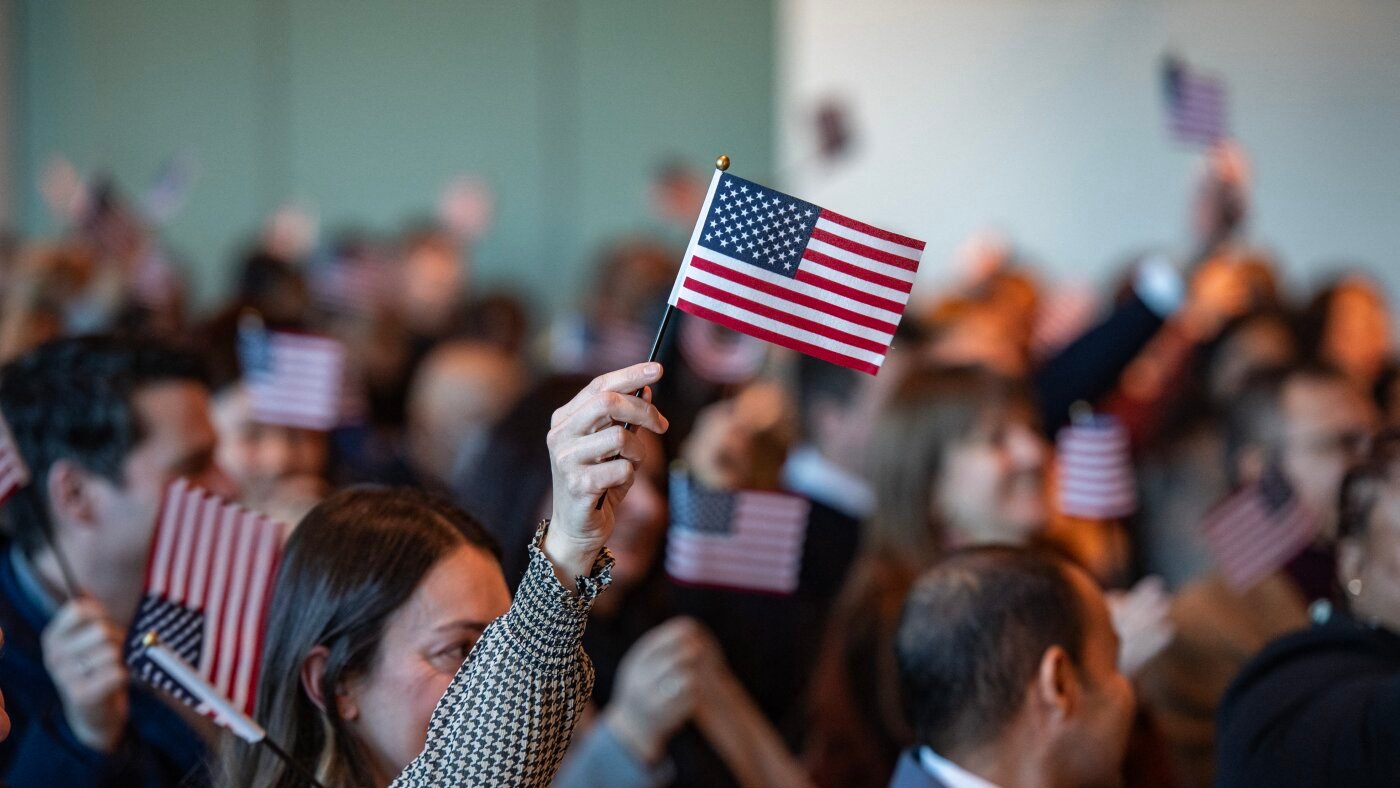

People wave U.S. flags to celebrate becoming U.S. citizens after taking the Oath of Allegiance during a naturalization ceremony in Boston in January 2025.
Joseph Prezioso/AFP via Getty Images
hide signature
switch signature
Joseph Prezioso/AFP via Getty Images
Stay up to date with our politics newsletter sent out weekly..
The Trump administration’s sweeping efforts to slow the pace of legal immigration have affected a group traditionally immune to such efforts: spouses of U.S. citizens.
The administration has implemented a host of policy changes since President Trump returned to the White House last year, from suspending immigrant visas for people from 75 countries to imposing greater scrutiny on green card applicants and expanding who can be deported. The changes hit hard all immigrants, including those seeking to enter and remain in the country through marriage.
Some non-U.S. citizen spouses have been separated from their American loved ones and are afraid to interact with the U.S. immigration system, according to lawyers and NPR interviews with affected families.
“Life has become much more difficult for Americans married to someone who was not born in this country,” said Ashley DeAzevedo, executive director of American Families United. The organization protects spouses of US citizens and immediate family members of those involved in various immigration proceedings.
She said the organization’s membership has grown over the past year as rapid policy changes affect more people. There are now about 1.4 million people seeking the group’s support in the US and about 300,000 outside the country – people who have left the US, as well as those who want to come.

“We have seen many of our members make the decision to self-deport, to leave the country, for fear of indefinite detention,” DeAzevedo said. “We saw some members who had their spouses detained – and that was something we hadn’t seen before because there was always such a priority as to who should be detained.”
Sharvari Dalal-Deney, senior director of government affairs for the American Immigration Lawyers Association, said the United States government has always screened and thoroughly vetted immigrants who sought to remain in the U.S. through marriage.
However, when applying for leave to remain, spouses of U.S. citizens generally were not involved in broader immigration law enforcement.
“This group of individuals has always had a special place before the law,” Dalal-Deney said. “Spouses of US citizens are not subject to immigration quotas. They don’t have to have an upper limit. Spouses of US citizens are not required (must maintain) their legal status here in order to accommodate. And therefore the law considers them a privileged class.
“But this administration treats them like all other immigrants.”

The administration says previous presidents also should have scrutinized such marriage-related applications more closely, and US Citizenship and Immigration Services (USCIS) is simply enforcing the law.
In a statement to NPR, USCIS spokesman Zach Kahler said that verifying the identity and personal histories of all people seeking immigration benefits such as a green card or citizenship requires a rigorous process — “one that prioritizes the safety of the American people by more thoroughly screening and vetting all aliens.”
He said simply marrying a U.S. citizen and starting the petition process will not protect a person from deportation.
“A pending or approved Form I-130, Petition for Alien Relative, does not provide any immigration status. All aliens are expected to comply with U.S. immigration laws,” Kahler said. “Those who entered the United States without inspection or who remained in the United States beyond their authorized period of stay are illegal aliens who may be subject to immigration enforcement action.”
Family and fiancé petitions account for nearly half of green card approvals.
Immediate family sponsorship, including spouses and fiancés, is one of the primary ways U.S. citizens interact with the immigration system.
The latest data released by the Department of Homeland Security for 2024 shows that about 343,000 people received green cards through their spouses—about a quarter of all green card approvals. For about a decade, that number hovered somewhere between 200,000 and 340,000.
The number of green cards approved doubles when other immediate family members who may sponsor immigrants, such as children and parents, are included. This speaks to how important this pathway is for US citizens and their immigrant families.
The average processing time for each petition was 13 months for family members and seven months for fiancés, largely consistent with wait times since early 2025, before the Trump policy took effect.
In the first quarter of fiscal year 2026, 167,401 next of kin petitions and 8,612 fiancé petitions were approved.
The number of approved petitions has generally risen and fallen across administrations.

Chaos for US citizens, including military personnel
The data may obscure other ways in which non-citizen spouses may be targeted. This is especially true for residents of one of more than 70 countries who face delays in obtaining a wide range of tourist and immigrant visas.
One such case is Es, a green card holder married to a US citizen. She was born in one of 39 countries affected by the US travel ban that was introduced last year. The pause means that although she has been in the country for three decades, her citizenship application, submitted last year, has yet to be processed.
There are no exceptions to the travel ban, even for spouses of US military personnel.

The past few months have thrown the couple’s life into chaos.
“We have to (move) to Germany,” Es said, speaking on condition of anonymity because her husband is in the military and her immigration case is pending. “We were actually supposed to leave in July, but we had to push it to October to see if we could get (my citizenship).”
Now the couple is deciding what to do with the home they own, whether they will have to travel separately and what not being a citizen means for their two young U.S. citizen children and their belongings.
“It will ruin his readiness (for military service),” Es said in an interview. “He’ll be thousands of miles away and he’ll have to think about his job and he’ll have to worry about us and it’s just not fair.” A federal judge ruled the pause was illegal, but her case is still pending.
“It doesn’t affect people who did something wrong. It affects everyone,” she said.

It’s not just about prohibitions and pauses. Several people told NPR that delays at consulates are also adding to tensions and leaving some spouses or fiancés without any legal status at all.
“People who marry U.S. citizens often no longer have status, whether they arrived legally, and then their status expires or their status is terminated as if they had (temporary protected status),” Dalal-Deney said.
“And now they are subject to additional scrutiny,” she said, referring to the USCIS approach to all applications.
Cooling effect when involved in the process
Advocates say recent policy changes have increased scrutiny of all immigration applications and made families less willing to engage with the government.
USCIS officers are tasked with conducting more interviews. A memo issued last month recommended that officers consider whether someone has returned to their home country to apply for a green card when reviewing an application; those who remain in the US may face longer and more intrusive scrutiny. Trump also asked financial institutions to review the bank accounts of those in the US without permanent status.

Eric Welsh, a California-based immigration lawyer, said clients should prepare to face questions about when and how they applied for a green card, including providing evidence of “good moral character” and other information – something not previously required of those seeking permanent residency or U.S. citizenship through marriage.
“It’s important to remember that spouses are vulnerable,” Welsh said, noting that while there are some ways to obtain something like a green card or citizenship, it’s not guaranteed. “There is no absolute right to remain, and there is no absolute right to adjustment of status. And so I think that’s something that most people generally don’t understand, especially U.S. citizens.”
He and DeAzevedo have seen how some families are hesitant to move forward with their immigration cases.
“(It) has had an absolute chilling effect on a lot of people in this country and their desire to put their spouse in that position,” DeAzevedo said.