

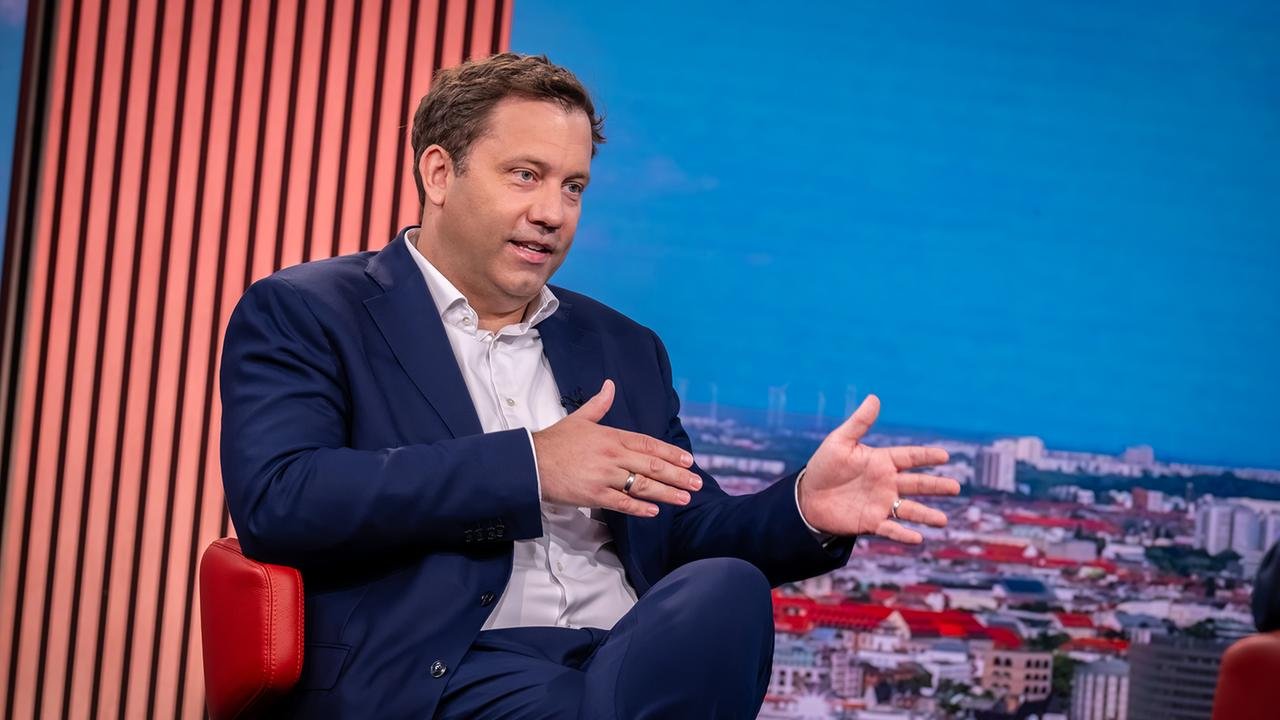
Coalition plans to tighten sick leave rules are sparking protests. IN ARD Summer Interview SPD leader Klingbeil defends the reform package. This is not about going to the doctor on the first day.
Since the federal government’s reform plans were unveiled, one topic has come up in particular: tightening sick leave rules. The coalition committee this week agreed that the mandatory presentation of a certificate of incapacity (AS) in the future should be required from the first day of illness. For now, a medical certificate is required only from the fourth day. Both medical representatives and labor unions sharply criticized the plans.
Part of the outraged reaction also reached the vice-chancellor and leader of the SPD, Lars Klingbeil. IN ARD Summer Interview He said it was a “very emotional debate”. The coalition’s plans are a compromise. Due to the large number of sick days in Germany, the Union proposed introducing unpaid waiting days. “We Social Democrats have said that we will not take part in this,” Klingbeil said. It should not be the case that “sick people suddenly stop receiving wages. This happened in the 1970s and it didn’t work then. And I didn’t want to repeat that.”
Klingbeil said what is needed now is pragmatic implementation. This can be found “by saying, firstly, that you don’t have to drag yourself to the doctor when you’re sick, and you don’t have to drag yourself to work when you’re sick.” You need a certificate from day one, but that doesn’t mean you have to get it from day one. Second, it is best if collective bargaining partners or companies have the ability to “handle things the way they want.”
“Politics thrives on compromise”
Regarding criticism that his party abandoned many of its positions in negotiations with the Union, the SPD leader said: “Politics depends on compromises. And anyone who believes that you are on a coalition committee and doing something in this country and that you introduce 34 measures, and say that those 34 measures are 100 percent what Lars Klingbeil thinks, does not understand how compromise and democracy work in this country.” We have to move to different places – which is what the coalition committee did.
While some business associations praise the federal government’s planned reform package and see opportunities for growth in Germany, trade unions criticize, among other things, the planned expansion of temporary employment opportunities and the weakening of dismissal protections for no reason. This criticism hit the SPD particularly hard.
Klingbeil also sees benefits for employees
Therefore, the party leader emphasized that the reform package “also contains a lot for employees.” The goal is to “further include Sunday and public holiday surcharges in the tax exemption.” Securing industrial jobs through tougher China policies will also benefit workers.
When it came to tax reform, he also fought for relief, Klingbeil said. Particular attention should be paid to small and medium incomes. He also advocated “extending the tax on the rich and that we now even have a tax on the super rich.” In fact, the coalition plans for a tax rate of 45 percent to apply to taxable income of €250,000 and a rate of 47 percent to taxable income of €280,000. A tax rate of 45 percent currently applies to taxable income of just under €278,000.
“And everyone will have burdens.”
Klingbeil explained that reforms in Germany were delayed for 20 years. Therefore, changes are needed now. Without pension reform, pension levels will fall from 2031, he said.
“Of course, I know, and I don’t want to deny it, that everyone will have a burden,” Klingbeil said. He cannot yet calculate this, since healthcare reform is currently being discussed, and pension reform is only at the very beginning. “But again, I am very clear: there will be tension.” Therefore, criticism is to be expected. But: “If we had done nothing, it would not have made the country better, maybe then there would have been less criticism, but it would not have helped Germany.”
Record debts in Budget draft
On Monday, the cabinet wants to approve Finance Minister Klingbeil’s draft budget. According to information from ARD Capital Studios He plans to have higher expenses and more debt. Next year, spending is expected to increase by almost six percent to 555 billion euros. In addition, new debt of more than 203 billion euros is planned, which is the second highest value in the history of the Federal Republic. This is the result of the fact that the Union and the SPD were unable to agree on further austerity measures.
Klingbeil stressed that he will present a consolidated budget. The fact that he also wants to access the reserves accumulated before 2019 was called “completely normal” by the Finance Minister. “Sometimes you do it, sometimes you don’t – and right now we’re in a time where Donald Trump’s war with Iran has slowed hopes for economic growth. It really affects us, we see it in the numbers and we have to deal with it.”
Klingbeil explained that there had been difficult negotiations on austerity measures and that he would ask ministers to identify further potential. The high level of new debt is also due to the fact that the Bundeswehr is modernizing. “I mean, you can’t defend against Putin with a black zero,” Klingbeil said. “We want our country to catch up with military spending within 20 years, and that’s what we’re doing, and we’re spending money on it.”
Klingbeil wants nothing Personnel debate
There are three more state elections this year: in Saxony-Anhalt, Berlin and Mecklenburg-Vorpommern. According to polls, the SPD faces poor results in all three federal states. If this happens, Mecklenburg-Vorpommern Prime Minister Manuela Schwesig and former Federal Labor Minister Hubertus Heil are already being considered as successors to Klingbeil and party leader Bärbel Bas.
When asked about this, Klingbeil said: “Well, I have never encountered that there was no personnel debate in the SPD. I can also tell you that when I see where we are in the polls, none of us like it.” He understands that there are such speculations. But: “My focus now is on moving this country forward. We have a decade of change ahead of us.”