

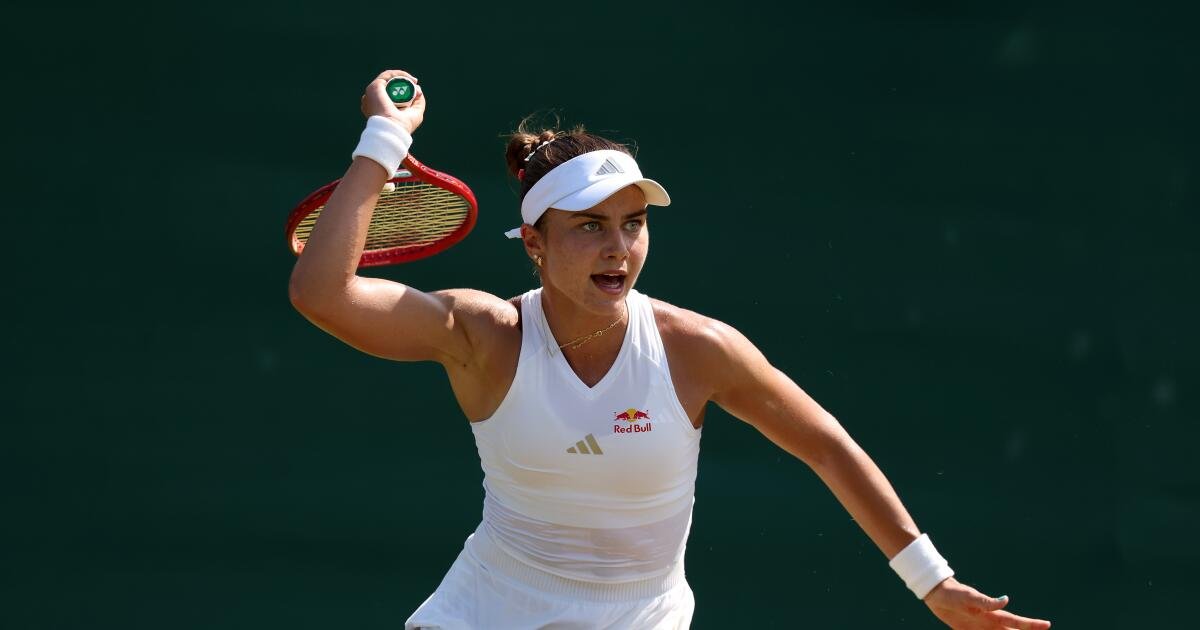
LONDON — For a weekend dedicated to life, liberty and the pursuit of happiness, Wimbledon offers America’s version of the quest for Grand Slam glory.
Sunday’s fourth-round match on Court No. 1 between Jessica Pegula, the highest-ranked American player and veteran standard-bearer, and Iva Jovic, the brightest young American star since Coco Gauff, represents a thrilling generational showdown between the present and future of US women’s tennis.
This match is worthy of a celebration with fireworks.
“I know she’s going to come after me hard,” Pegula, 32, said after her clinical 6-1, 6-3 third-round loss to Jessica Buzas Maneiro of Spain on Friday.
“I think everyone wants to be the best American,” agreed Jovic, an 18-year-old from Torrance who posted a 6-3, 3-6, 6-4 win Friday over Ekaterina Alexandrova of Russia to reach the fourth round of Wimbledon for the first time. “There’s a little extra competition there.”
Pegula and Jovic are hardly unfamiliar rivals, and not just because people have often told the young Jovic to model her game after Pegula. The two have met twice before, this year on hard courts in Dubai and on clay in Charleston, South Carolina. Pegula won both.
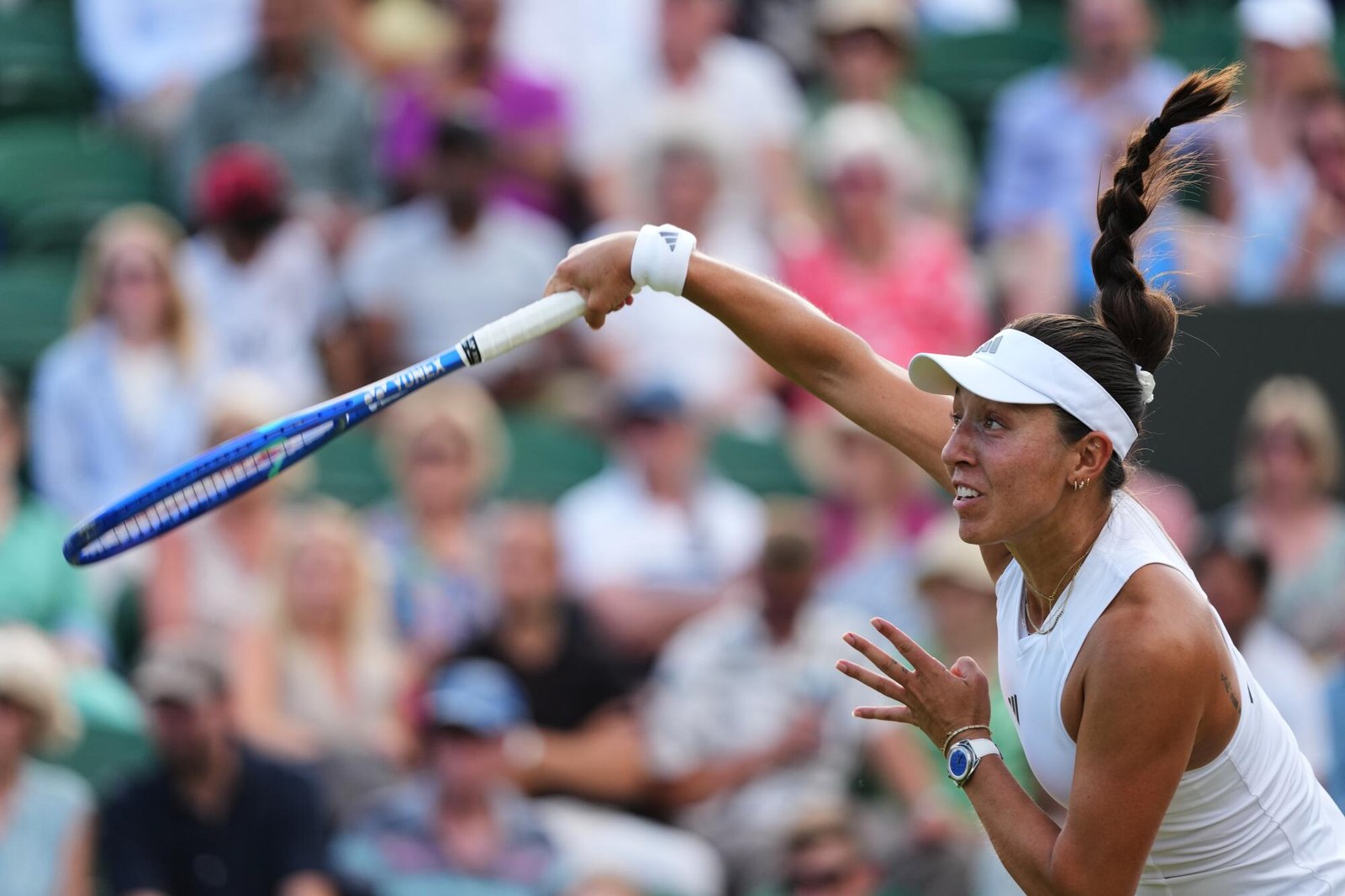
American Jessica Pegula serves during her win over Spain’s Sara Sorribes Tormo at Wimbledon on Wednesday.
(Kirsty Wigglesworth/Ap Photo/Kirsty Wigglesworth)
“There are a lot of things we do well and we do similar things, but there are a couple of things that are different,” Jovic noted of their baseline-focused tactical styles.
Pegula expects nothing less than a baseline mirror duel from the player she affectionately nicknamed “mini-me” after beating her in February.
Their careers took different paths before their first meeting at a Grand Slam tournament. Pegula spent years toiling away at the lower level of the Women’s Tennis Association before becoming a late-blooming top contender and a top-10 mainstay. The experience gap is still huge, with Pegula having 11 career singles titles against Jovic and more than 500 tournament wins compared to just over 100 for the teenager.
Jovic, ranked No. 1 among juniors at just her second Wimbledon, quickly made her mark on the tour, winning her first WTA title last season at 17 and then backing it up with a standout quarterfinal performance at the Australian Open in January. She is the youngest player in the top 80 of the WTA rankings and the youngest player remaining in the Wimbledon singles tournament.
Watching Jovic’s growth this season, Pegula praised her competitive instincts and quick adaptation to grass.
Jovic “competes like an animal,” Pegula said.
However, their relationship with grass couldn’t be more different.
Pegula has not historically been a strong side at Wimbledon and has only reached the quarter-finals once, in 2023. She admits that she is struggling with her own instincts on the surface.
“I feel like sometimes years ago I was really struggling with how to move forward, struggling with all the intangibles, all the pieces,” she said.
This year she has softened her approach, improved her balance and increased her serve, which are her main advantages on grass.
Jovic, on the other hand, quickly learned to adapt to the complex footing, sliding and occasional falls on the grass. She loves London’s greens as a natural, despite growing up in Los Angeles County where grass courts are virtually non-existent.
Jovic notes that from the ages of 6 to 13, she played left wing in local soccer leagues for her exceptional low-ground footwork. This cross-training has paid off. Last year she won her first professional title on grass in England and recently reached the semi-finals of the prestigious Queen’s Club warm-up tournament.
“It’s very closely related to the movements we make in tennis,” Jovic said of soccer.
Jovic, who is of Serbian and Croatian descent, is also following the World Cup, although rooting for the U.S. during a late start in Europe has proven difficult.
Hall of Fame analyst Pam Shriver says the age difference adds to the excitement of grass-court chess matches.
“It’s interesting when rivalries can create generations that are different from the same country, and I think they actually have a lot of respect for each other,” Shriver said.
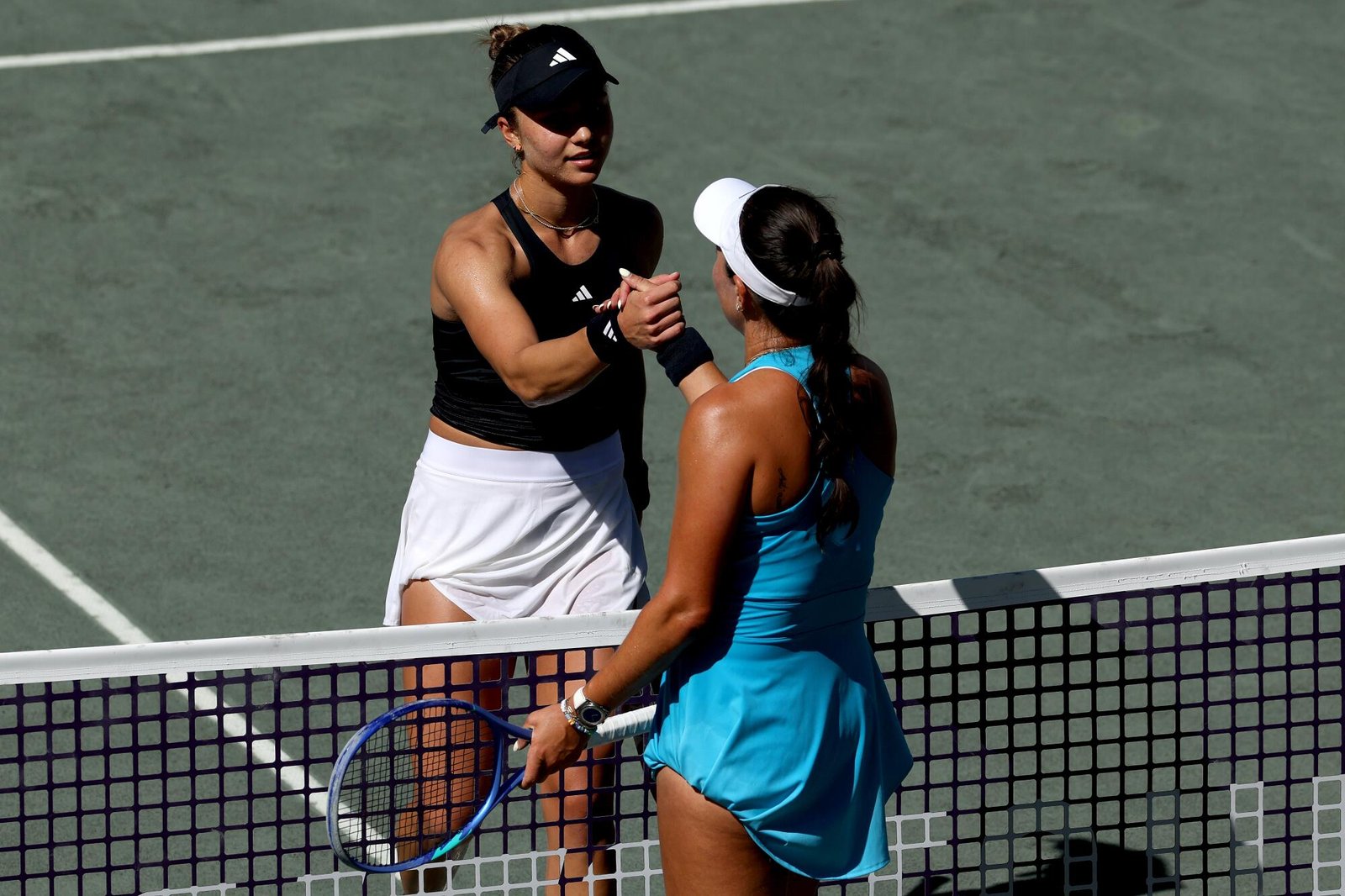
Torrance native Iva Jovic (left) congratulates American Jessica Pegula after Pegula won their match during the Charleston Open on April 4 in Charleston, South Carolina.
(Matthew Stockman/Getty Images)
Shriver added that Jovic can learn from Pegula’s intellectual approach, while veterans like Pegula can draw fresh thinking from the unwavering energy of the younger generation.
“Everything is going so fast,” Pegula admitted, aware of the growing sense of urgency in her quest for her first major title.
Jovic knows Sunday’s match is the perfect opportunity to prove her rapid rise is no fluke and flip the script on her personal decline.
“I hope this is the one I give her,” she said.
Pegula was in better shape in her first week in London. She didn’t drop a set in three matches, moved smoothly into the fourth round and looked more and more like the favorite in her quarter. She also feasts on fellow Americans. Since 2023, Pegula has an impressive 33-3 record against his countrymen.
“I’m always interested in beating other Americans in a unique way,” Pegula said. “I’m excited again to challenge someone who is much younger, who has nothing to lose and nothing to fear.”
However, reaching the final next weekend will require any player to go through the tough top half of the draw. It includes four-time major winners Aryna Sabalenka and Naomi Osaka, two-time major champion Gauff and the last remaining Wimbledon champion, 2024 winner Barbora Krejcikova.
On US holiday weekend, at least one American will be celebrating at Wimbledon when the fireworks go off.