

We humans are not the only ones who can count. Many other animal species have also demonstrated more or less complex mathematical abilities, including estimating magnitudes and probabilities and solving simple addition and subtraction problems. Monkeys, birds and even fish have already been tested. “However, ungulates remain underrepresented in this area of research,” writes a team led by Iker Loydi of the University of Barcelona in Spain.
Comparison of carrots in a range of numbers up to five
That’s why researchers have now tested four giraffes at the Barcelona Zoo on their computing abilities. All four animals were already used to this type of experiment: in a 2023 study, they had already demonstrated that they could estimate probabilities. For the current experiment, Loydy gave the giraffes two containers containing up to five tasty carrot pieces. After five seconds, he closed the containers so that the giraffe could no longer see the food.
The biologist then showed the giraffes a third container of a different color containing additional carrot pieces and added them to one of the original containers. The giraffe was now allowed to choose a container whose contents it could eat by nudging it. Does she know which one contains the most food?
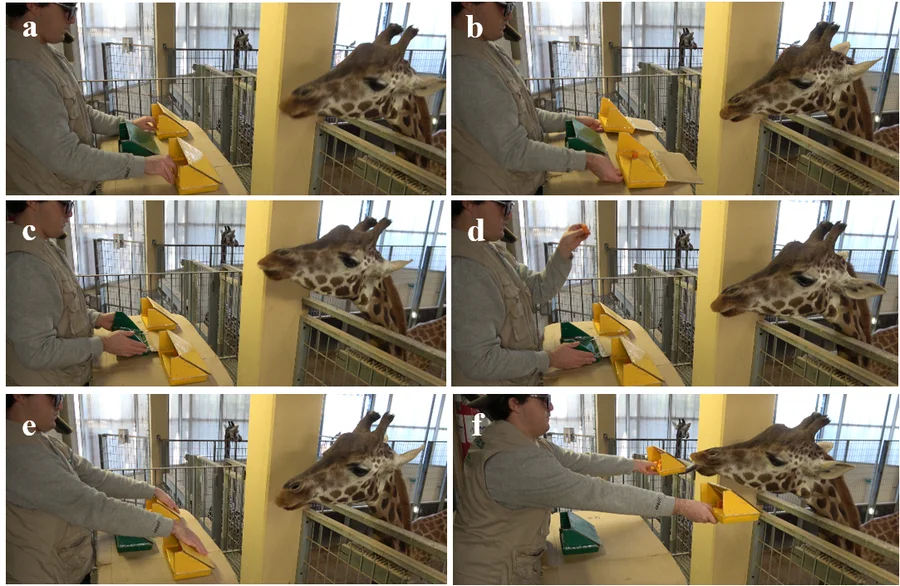
Experimental methodology in detail. The containers are designed in such a way that the experimenter can place or remove carrot pieces without the giraffe seeing the total amount. — © University of Barcelona
Mental arithmetic or fraud?
The giraffes actually aced this math test: “All giraffes performed above chance on this task,” the team reports. Although the animals did not see a finite amount of food in the containers, they were more likely than average to choose the fuller container. “This suggests that giraffes can remember observed values, mentally update this information after changes, and make optimal decisions based on this,” Loydy explains.
To ensure that the giraffes were actually calculating rather than relying on subtle signals from the experimenter, Loydy hid his eyes behind sunglasses during all experiments and tried to keep his body language as neutral as possible. However, the researchers suspect that two of the four giraffes used a “trick”: instead of stacking the carrot pieces, they simply chose a container into which they added something.
But at least two of the test giraffes appeared to have made the calculations: “However, two other giraffes were successful even when this strategy could not be used, suggesting the possible use of more complex mental calculations,” the team said.
Giraffes can’t cope with negative tasks
However, all four giraffes failed a subtraction task in which food was removed from one of the previously seen containers. According to the team, even in tests involving several sequential operations in which food was removed from one container and placed in another, the giraffes’ success rate was within the range of chance.
“These results are consistent with what we see in humans,” says Lodi. “There are individual differences in solving number problems, and in general, subtraction is more difficult than addition. “In addition, subtraction activates areas of the brain specialized for complex, controlled processing that are not stimulated by addition.”
Useful in the wild
But what evolutionary benefit do giraffes get from their ability to fold? “This ability may have evolved in response to socio-ecological challenges in the wild,” the researchers explain. Giraffes live in communities that divide into smaller groups and come back together depending on environmental conditions. Numeracy skills can help keep track of things.
The ability to fold may also be useful for giraffes when searching for food. Their main source of food is acacia trees, which grow widely throughout the savanna. “This may lead to the need to evaluate where, when and in what quantities these resources will be available,” Loydy says. Because where there are a few trees or large groups of trees, travel is more profitable for giraffes than into sparser thickets.
From the researchers’ perspective, the results provide further evidence that animals such as giraffes, whose brains are relatively small compared to their body size, may also have complex quantitative abilities. “These results help challenge overly anthropocentric views of cognition and highlight the importance of studying a greater diversity of groups and species to better understand the evolution of animal intelligence,” Loydy and his team said.
Quelle: Iker Loydi (University of Barcelona, Spain) et al., Scientific Reports, doi: 10.1038/s41598-026-54126-7