

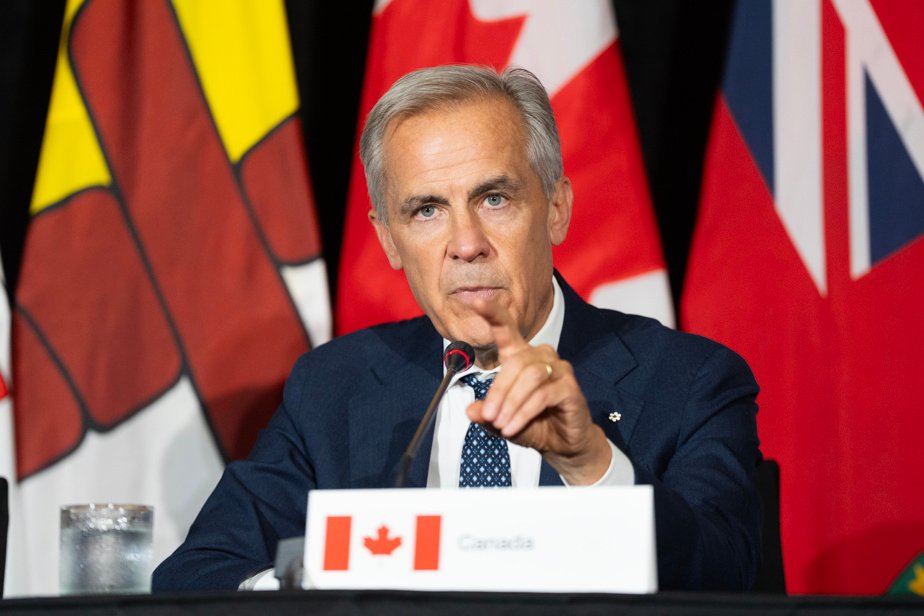
(Ottawa) “Everything is on the table,” but showing your cards too early could prove costly. Prime Minister Mark Carney said Thursday that Canada’s response to a new 50 percent U.S. surcharge on hundreds of Canadian products “will depend on the outcome of negotiations” with Washington.
Posted at 9:38.
Updated at 4:36 p.m.
“If these tariffs or other measures go into effect, there is no need to react in advance. In fact, I think it would be counterproductive at this stage to react prematurely,” Mr. Carney said during a press briefing following the meeting of Canadian prime ministers.
In recent days, some provincial premiers, including Ontario’s Doug Ford, have pressed Canada for a tough response and for the prime minister to show them a plan to prevent the White House from imposing more tariffs.
Mark Carney stressed that Canada has “a whole range of options” if it wants to respond to the Americans.
What is clear is that the US administration is noticing that Canada is forging closer relationships with other economies such as the European Union, England and major Asian economies.
Mark Carney, Prime Minister of Canada
Earlier this week, President Donald Trump’s administration announced a new surcharge of 50% on nearly $28 billion of imports from Canada, representing 5% of merchandise exports to the U.S. and about 0.8% of Canada’s gross domestic product (GDP). These tariffs, which could go into effect on August 19, will also apply to goods that have until now been protected by the Canada-United States-Mexico Agreement (CUSMA).
The Americans say they did so in response to bans on American alcohol, which has disappeared from shelves in most Canadian provinces in response to President Trump’s tariff war against Canada in the winter of 2025. Washington also opposes Canada’s supply management system in the dairy sector and quotas imposed on some American cars.
Quebec Premier Christine Frechette said she has asked Premier Carney for access to the federal plan for trade negotiations with the United States.
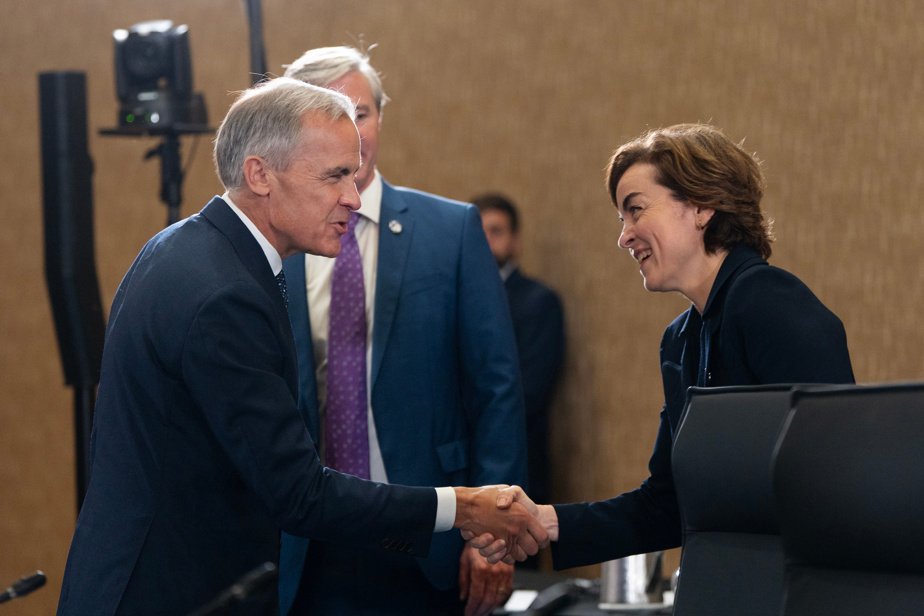
PHOTO DARREN CALABREESE, THE CANADIAN PRESS
Mark Carney and Christine Frechette in Charlottetown on Thursday.
“The decisions that will be made by the Canadian government will have a significant impact on our economy, so I ask that Quebec be informed and connected to Canada’s strategy,” she said in a video posted online.
But at the end of the prime ministers’ meeting in Charlottetown, Prince Edward Island, Mr Carney and his colleagues again sang a message of unity.
The prime minister, who confirmed his government will increase the pace of trade negotiations with the United States, says the priority in Canada’s response remains building a stronger national economy that is more resilient to the shocks of decisions emanating south of the border.
The investment announced here in Canada is $500 billion. It’s huge. These are real projects that we have been creating for the last 18 months and are just getting started.
Mark Carney, Prime Minister of Canada
Canadian prime ministers pride themselves on lowering interprovincial trade barriers and increasing economic activity across the country by billions of dollars. But most of the talk was dominated by the American threat. This is the fifth face-to-face meeting of the prime ministers and the 14th overall since March 2025.
The discussion was supposed to be about trade agreements and, in particular, about possible free trade agreements with India, Thailand, the Philippines and the Association of Southeast Asian Nations (ASEAN). But Canada’s reaction to the new customs duties was on everyone’s lips.
Mr. Carney also mentioned federal aid for workers and businesses hit by U.S. tariffs, which Quebec Premier Christine Frechette also asked for.
The next few weeks will be important. My government will protect our economy, our workers and our jobs.
Christine Frechette, Premier of Quebec
Moreover, if Canada has not yet reached an agreement with the Americans, it is because the Canadian government wants Washington to eliminate all customs duties it imposes on Canadian industries such as steel, aluminum, forestry and energy.
“We will intensify our negotiations with the United States to reach a comprehensive agreement that covers all sectors affected by the tariffs,” Mr. Carney said.
U.S. Trade Representative Jamison Greer has said in recent days that he would like to present U.S., Canadian and Mexican leaders with options for reaching possible “interim” agreements on CUSMA “before the end of the year.” This means that an agreement to extend CUSMA by 2027 seems unlikely. The Canadian government has been repeating for months that it wants a “comprehensive” agreement, not a few small agreements.