

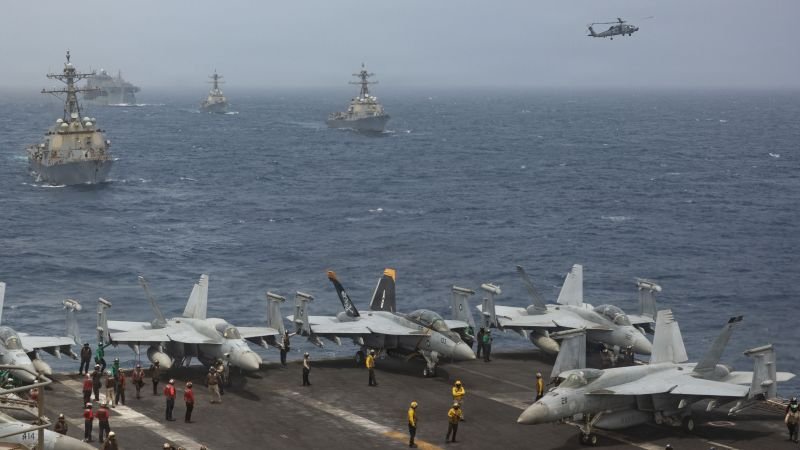
In the week since the U.S. resumed daily strikes on Iran and renewed a naval blockade of Iranian ports, the Trump administration has provided little clarity on how long the latest military campaign might last or its goals after the fragile truce breaks down.
Behind the scenes, President Donald Trump has been presented with options to further expand the operation as the military looks for ways to step up efforts to weaken Iran’s control of the Strait of Hormuz. But Iran has shown no willingness to cede control of the critical waterway.
Trump has signaled in public comments that he intends to escalate strikes, including threats to civilian infrastructure and possibly energy facilities, as he downplayed the duration of the fighting. “We’ve been in Vietnam for 19 years. We’ve been here four months, so I think we’ve done a lot,” President Kaitlan Collins told CNN this week.
Trump told Fox News on Tuesday that the strikes will “continue until I say enough is enough,” and in a prime-time speech on Thursday, in which Trump barely mentioned Iran, the president said, “You’ll see the fruits of this labor very, very soon.”
Meanwhile, Vice President J.D. Vance—the administration’s lead negotiator with Iran—suggested that military force alone would not be enough to completely wrest Iran’s control of the Strait of Hormuz.
“You can bomb them, you can take away their radar, you can take away some of their drones and some of their missiles, but it’s too easy to fire at ships in the straits,” he said in a podcast interview on Tuesday. “So you really have to be willing to talk and try to figure out the problem.”
Ryan Crocker, a former U.S. ambassador to several Middle Eastern countries, echoed the vice president’s sentiments, telling CNN’s Elex Michaelson today that bombing Iran “to subdue” will not work.