
Driving bans on the Brenner Pass are about to end – far-reaching consequences for traffic in the Alps
close notice
This article is also available in English. It was translated with technical assistance and reviewed by the editors before publication.
Don’t show it anymore.
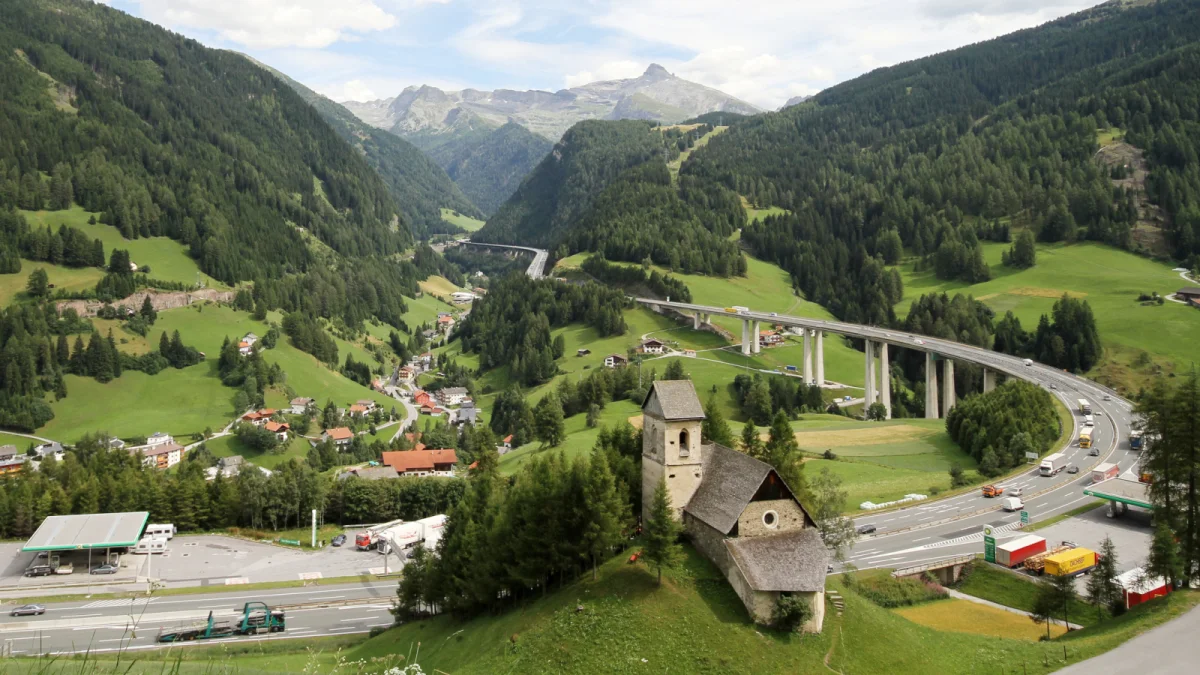
In the Brenner transit dispute, which has been dragging on for many years, the Advocate General of the European Court of Justice (ECJ) has taken a clear position: the night driving ban, the sectoral traffic ban and the winter traffic ban on the Intal A12 motorway and the Brenner A13 motorway in Tyrol thus violate the free movement of goods in the EU. According to the report, only so-called block processing is legal.
Read more after the ad.
In Case C-524/24, Italy is suing four measures taken by the state of Tyrol to restrict truck traffic. The oral hearing took place on April 21, 2026. Advocate General Campos Sanchez-Bordona expressed his opinion today. A final decision from the European Court is expected in autumn 2026 or early 2027.
In its claim, filed on July 30, 2024, Italy refers to Articles 34 and 35 of the Treaty on the Functioning of the European Union (TFEU), which protect the free movement of goods. The European Commission supports the claim. The EU Court of Justice’s procedural description states that despite two rulings in 2005 and 2011, Austria maintained the illegal restrictions and introduced others.
In particular, the claim is directed against the ban on heavy vehicle traffic at night on the A12 section, the sectoral traffic ban for 13 product groups, including an exception for Euro 4 trucks, the winter traffic ban on Saturdays on the A12 and A13 and the so-called metering, in which a maximum of 300 trucks per hour are allowed through Kufstein.
Tightening since 2016
Over the years, Tyrolean measures gradually expanded and became stricter. The industry-wide driving ban was introduced in 2016 and significantly expanded in 2020, according to the Federal Association of Road Transport, Logistics and Waste (BGL). Since then, 13 groups of goods are no longer permitted to be transported by Euro 4 trucks and other vehicles first registered before 1 September 2018. From 1 January 2021, the night driving ban has been tightened; Tolls in Brenner are twice as high at night from 10 p.m. and 5 a.m., same as during the day. Since 2019, on the Innthal Autobahn there has been a ban on the movement of trucks with emission class up to Euro-4, and from January 1, 2023 – also with emission class Euro-5.
It was not until 30 May 2026 that the Tyrol state government closed the entire Brenner corridor to traffic, including the B 182 federal highway and the L 38 state highway. All trucks were checked and unauthorized vehicles were returned.
Signal effect outside the burner
Read more after the ad.
Experts and associations classify this procedure as a possible precedent that could have implications far beyond Tyrol. The underlying conflict between the free movement of goods and regional transport traffic and environmental controls fundamentally affects all Alpine corridors and comparable transit routes in the EU. The ruling against Austria does not generally prohibit regional environmental policy, but may significantly strengthen the requirements of proportionality, non-discrimination and consideration of alternatives.
BGL, which is represented in the Alpine Transit Working Group, and other European logistics associations welcome the fact that a final decision is close. They point out that the European Court of Justice has already twice found the industry-wide driving ban in Tyrol to be incompatible with EU law. Reports from German associations described the policy of the Tyrol measures for many years as a burden on European trade. The Bundestag document also warns that German freight forwarding companies could be forced to make expensive investments in vehicles due to driving bans, which would impact transport prices and competitiveness.
Rail transport as an alternative under pressure
If the European Court does declare that the contested measures are contrary to EU law, Austria will have to adapt or repeal the affected rules. Then control and fines based on the prohibitions in question will cease to be legally justified. At the same time, it will increase political pressure to divert freight traffic through the Brenner to other routes.
The Brenner Base Tunnel, which is designed to allow freight and passenger trains to travel underground between Italy and Austria, is considered the central alternative project. If the courts limit roadside control tools, the pressure to make rail capacity and in particular base tunnel access routes more attractive increases, even if the European Court cannot immediately oblige the affected countries of Austria and Germany to implement a specific expansion project.
It remains unclear whether the lifting of Tyrolean driving bans will lead to alternative traffic on Austrian routes such as the Fernpass or the Tauern Axis. Tirol himself warns against similar consequences of traffic changes. For German freight forwarders, the lifting of the traffic ban may bring short-term relief, but in the long term it could create new capacity problems on alternative routes.
(FPI)
Sorry, this link is no longer valid.
Links to gifted items will not be valid if they are older than 7 days or have been accessed too frequently.
To read this article you will need the heise+ package. Try it now for a week with no commitment – no commitment!