


In the Eastern Pyrenees,
“Do you smell that burning smell too?” After the fire, Olivier has doubts. “I never know if it really smells or if it’s my imagination reinterpreting the smell of that night. I always feel like it’s burning. No olfactory illusion in this environment: the tramontane, the local wind of the Eastern Pyrenees, still carries that smell of ash, synonymous with bad memories in the village of Ile-sur-Tête. And even if his sense of smell played a cruel joke on him, the constant ballet of fire trucks on the streets of the village and the surrounding soot-black hills left no room for doubt: the fire was still there.
 In Ile-sur-Tête, on the left bank, a significant part of the buildings burned down after a fire.– JLD/20 minutes
In early July, a major fire occurred in the Eastern Pyrenees, resulting in the evacuation of some 12,000 people, including 6,000 from the village of Ile-sur-Tête alone, the most populous in the affected area. That night, Sarah doesn’t intend to forget it either. Walls of flame cascading down a hill, the sound of fire consuming everything in its path, and an emergency evacuation ordered by the prefect on the night of Saturday 4 July to Sunday 5 July. “Suddenly you are told to leave everything, and you leave everything. Your house, your bed, your furniture, your family necklace, your photo albums… Not knowing what you will find in the end.”
“Vegetation is just waiting to burn somewhere else.”
There was more fear than harm, since the fire, which covered a total of 4,900 hectares, was localized on the left bank of the city. Thus, the flames did not reach the most populous part of Ile-sur-Tête, to the right of the river. But from the moment they returned, five days later, a strange feeling reigned among the residents. “I returned to the house that I had already mourned in order to save myself,” Sarah continues. Everything is here, even the flowers in the garden, but everything seems more fragile than ever. “I told my sister to bring important and sentimental things, such as photo albums, to Paris. They will be safer than here,” insists the 50-year-old mother of two grown children.
Like Sarah, many are convinced that sooner or later, “the fire will return. And the fire will always win in the end. It burned here, but look at the whole area. The vegetation is dry and yellowed. It’s just waiting to burn somewhere else.” It’s hard to prove him wrong, to paraphrase numerous other fires have occurred in recent days elsewhere in the department, from Rivesaltes to Canet-en-Roussillon.
 Between Vince and Ile-sur-Tête, almost everything was on fire, and firefighters concentrated the fight against the fire on protecting the surrounding villages.– JLD/20 minutes
“It’s too noticeable here”
The desire to turn the page gives way to reality as soon as you cross the shore. Almost everything there is burned, the fire sticks to the skin. The shoes fall into soft ash – “you need to wash your socks three times before everything comes off,” advises Matilda, whose house was on the wrong side. Firefighters managed to save the house of a sixty-year-old girl, but traces of the fire spread to her garden. Around their houses there are burnt cars, abandoned houses, mutilated buildings, like bad Picassos…
The fire is too recent to make a clear decision, but some are already talking about possible action. “It’s too noticeable here,” she continues. Catalans, usually so talkative and loud, seem very silent. In a village like this, everyone knows someone who knows someone who has had a worse life than you. So, we don’t spill too much.
“One day we will have to leave”
Some symbols remain – that flowering tree still standing in the midst of the chaos, that house spared meters from the fire, or that playpen mysteriously spared from the fire – as residents struggle to recover and plan for the future. Even if his house survived, “I can’t see this view from my garden every day,” estimates one resident who has “already” returned home. “Something died that night and this house will never be the same.”
 Cars, agricultural buildings, fields, trees, forest… The fire took everything away and devastated the area. More than 4,900 hectares burned.– JLD/20 minutes
A few kilometers away, Vinsa, a tiny village in Languedoc-Roussillon, was evacuated, but she had better luck. The village is completely untouched. Its stone streets seem like a miracle after a ten-minute drive, when ash and charred trees are visible outside the car window. Anthony has since decided to return to Mass to “thank Heaven” for saving his home. “We got lucky once, but when will the fire start again?” It’s only mid-July, and firefighters have already given so much.
“One day we got lucky”
“The reality is that the region is destroyed,” he whispers. And insist: “It almost never rains here, everything is dry, dead or flammable. Last year the villages were deprived of drinking water. Last week it was 40 degrees. And now it’s burning.” He is convinced: “The Eastern Pyrenees will either end up in the desert or burn.” One day we will have to leave.”
In Caen-en-Roussillon, flames also broke out out of nowhere, partially consuming one of the campsites at the seaside resort and several buildings in the port, forcing part of the population to evacuate. “Now that it’s burning outside Paris, people might open their eyes… Or forget us even more,” muses Bastien, a real estate agent. His terrace partner politely rephrases: “We’re all in the same boat.”
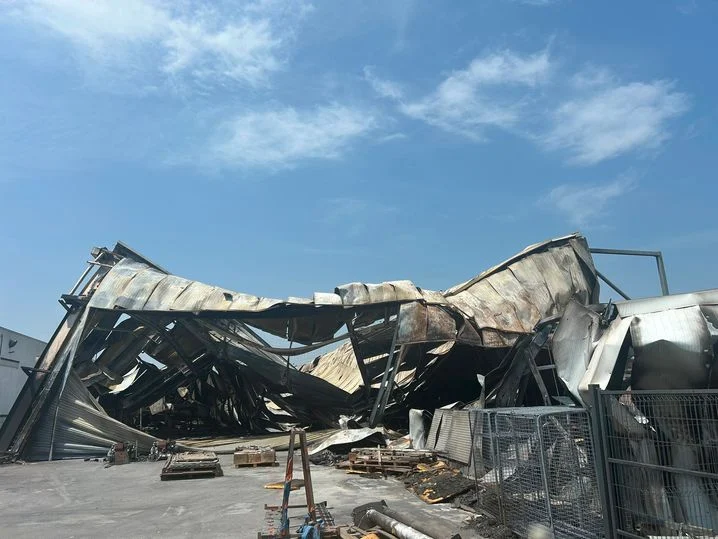 At Caen-en-Roussillon, part of the port burned down.– JLD/20 minutes
The city of Ile-sur-Tête, still very much marked by these events, canceled the 14th July celebrations, considering them undesirable. All that was left in my head was watching the semi-final and how Spain kicked France out of the World Cup. On Wednesday morning in the cafe, discussions over the fire were replaced by debates about arbitration or that damn Lamin Yamal. “It’s just football. It’s completely useless,” says one of the village elders. But talking about such a small thing again is also a sign that life is gradually returning.