

Published 04/07/2026 – 17:16 UTC+2•Updated 17:57
It is rare for archaeologists to discover a site that has remained almost completely impervious to natural and man-made changes for hundreds of thousands of years.

ADVERTISING
ADVERTISING
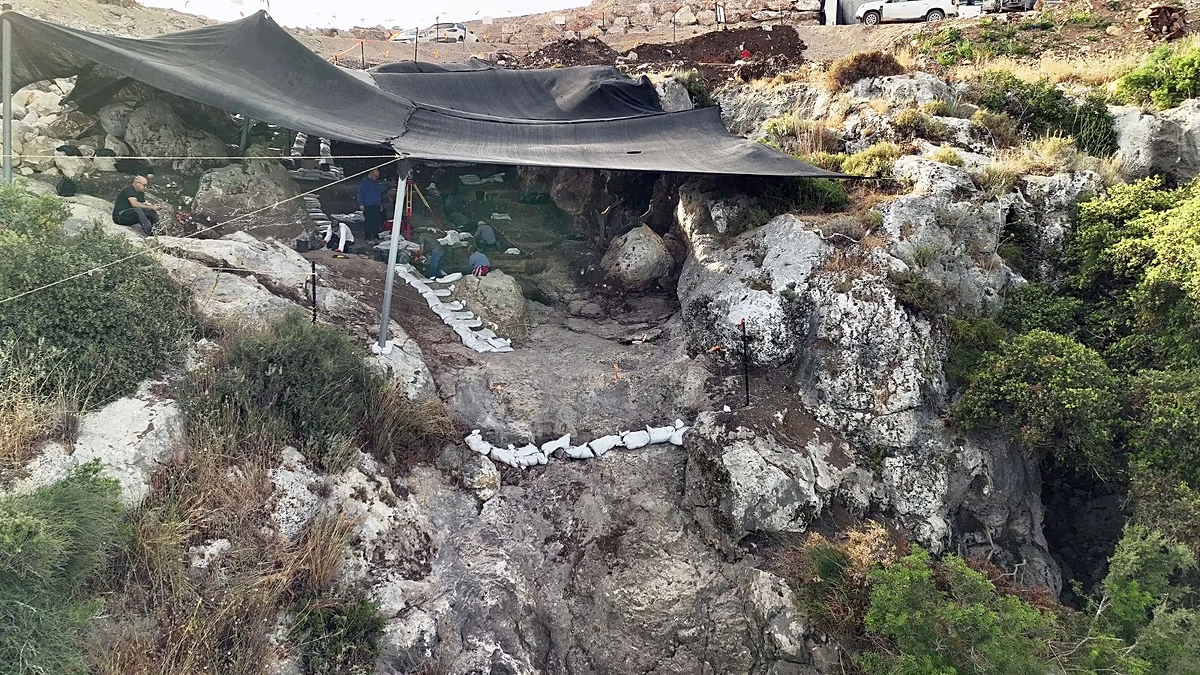
This is exactly the case cave located in the vicinity of Foreidisnear the Zichron Yaakov intersection, where researchers from the Israel Antiquities Authority and the University of Haifa are excavating the site dates from 400,000 to 250,000 years ago..
The work is aimed (source in Spanish) archaeologists Kobi Vardy and Amit Gabay together with Professor Ron Schimmelmitz. Officials describe the site as one of the most important discoveries in decades to understand the evolution of humans, whose preserved remains remain rare.
The cave belongs to the so-called Acheulean-Yabrudian culturea technological tradition characteristic of the Levant during the Late Lower Paleolithic period. According to researchers,exceptional state of preservation in essence, it is a veritable “time capsule” capable of providing information that is difficult to obtain on other sites in the region.
A defining moment in the history of our species
The period to which this site dates predates the spread of Neanderthals and anatomically modern humans. Experts believe that this is a stage of profound transformations in lifestyle, the formation of relationships and adaptation to the environment.
According to Schimmelmitz, it was during these millennia that behaviors that would later become commonplace among human populations began to evolve. These include the formation of larger groups, prolonged occupation of certain spaces, and more complex social organization.
The discovered evidence also indicates intensive use of fire and relatively long stays in caves, usually associated with increased cooperation between people and the systematic transfer of knowledge within communities.
Researchers believe that these developments laid some of the cultural and technological foundations that later became characteristic of Neanderthals and Homo sapiens.
Tools, animals and a resource-rich landscape
Among the already registered discoveries: numerous flint toolscreated using advanced technology of the time. Archaeologists have discovered small hand axes, scrapers and cutting blades crafted with great precision.
During the excavations it was also discovered animal bone remains such as horses, deer and wild asses. Along with these were signs of the presence of water in the environment, a resource that would have made the area a particularly attractive location for hunter-gatherer groups.
Vardi compares the scientific significance of this discovery to the famous site of Nahal Me’arot. (source in Spanish)listed as a UNESCO World Heritage Site and also important for studying the prehistory of the Levant.
The Israel Antiquities Authority and the University of Haifa intend to create an extensive research program for a more detailed reconstruction the lifestyle of these human populations, the exploitation of available resources and the evolution of their technologies.
Once the research is complete, the participating institutions hope to make the site available to the public to bring these discoveries to local residents, as well as students and visitors interested in human evolution.