

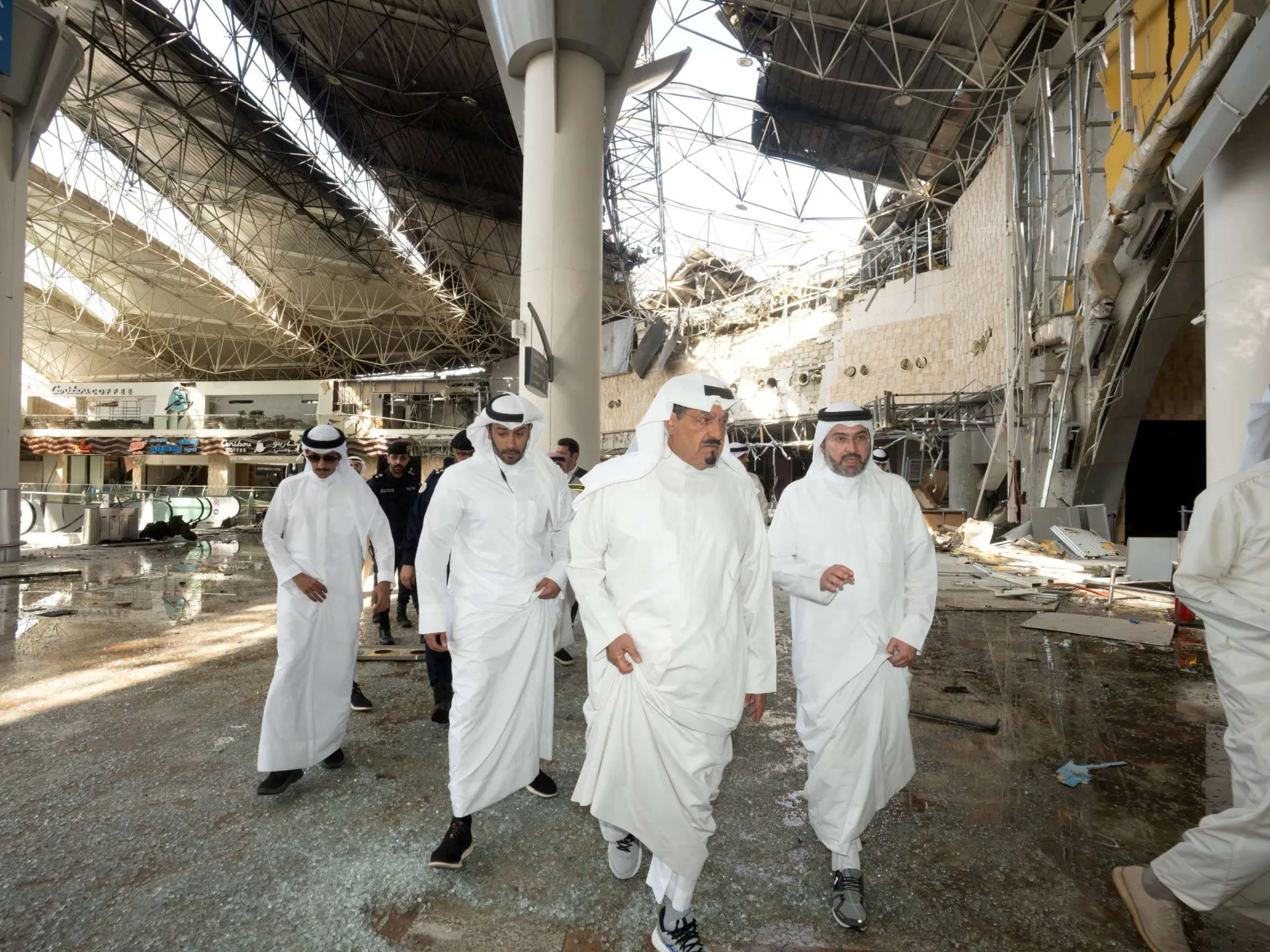
As the United States steps up its strikes on Iran, Tehran is retaliating by targeting military and civilian infrastructure in the Persian Gulf and Jordan while avoiding attacks on U.S. naval installations deployed near its coast and on Israel – a strategy that analysts say is aimed at putting pressure on U.S. President Donald Trump without escalating the war.
While Washington carried out attacks on railway stations, energy facilities, telecommunications networks and drinking water infrastructure in Iran, the Islamic Revolutionary Guard Corps (IRGC) responded with attacks on civilian airports, as well as water and power plants in Kuwait and Bahrain.
Military analysts say there is logic to the strategy.
An attack on US naval assets would “result in a devastating US response,” retired Lebanese brigadier general and military analyst Elias Hanna told Al Jazeera. “Another problem is that targeting naval assets is difficult from a military point of view because they are protected and equipped with sophisticated air defense systems.”
But why is Tehran targeting neighboring countries?
Atifeh Taghiani, a professor of political science at the University of Tehran, argues that the US is using the Gulf countries, especially Kuwait, to attack Iranian civilian infrastructure.
During the first round of the US-Israeli war against Iran in March and April, Iranian officials justified attacks on the Gulf states by arguing that US operations were carried out from military bases on their soil. They continue to make the same arguments today, even as the narrative has deepened the estrangement between Tehran and its neighbors, especially as Gulf states have repeatedly insisted that they will not allow their territories to be used to attack Iran.
In an interview with Al Jazeera, Tagiani said international law gives Iran the right to retaliate against any country from which attacks are launched, stressing that US warships deliberately target Iranian civilian infrastructure because Washington “wants to deepen hostility between countries in the region and is trying to make it more difficult for the Iranians to respond.”
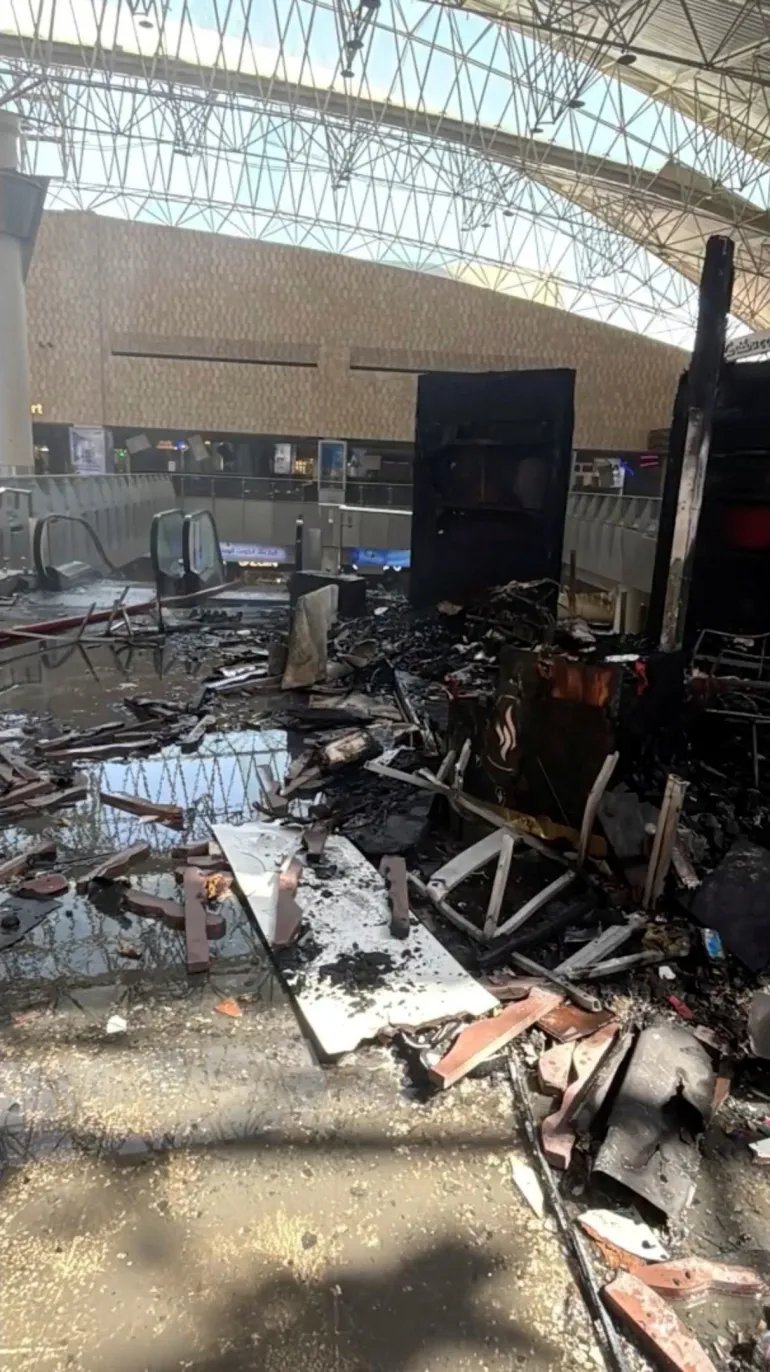 Debris lies on the floor after the attack on Kuwait International Airport on June 3, 2026 (Reuters)
Unrealistic “propaganda”
Abdullah al-Shaiji, a professor of political science at Kuwait University, called the Iranian academic’s remarks reworked Iranian “propaganda,” saying claims that U.S. attacks are coming from the Gulf are “no longer acceptable or realistic since all strikes are carried out from two American aircraft carriers, the George W. Bush and the Abraham Lincoln, which are no more than 150 km (93 miles) off the Iranian coast.”
The Gulf states agreed with the US that US troops stationed in the Gulf would remain solely for defensive purposes and informed Tehran that their territory would not be used to attack Iran, al-Shaiji said. He added that the Iranians “provided no evidence” to support their claims.
Al-Shaiji said Iran knows cruise and Tomahawk missiles are launched from U.S. aircraft carriers but fears the consequences if it kills even one U.S. service member in an attack on those ships.
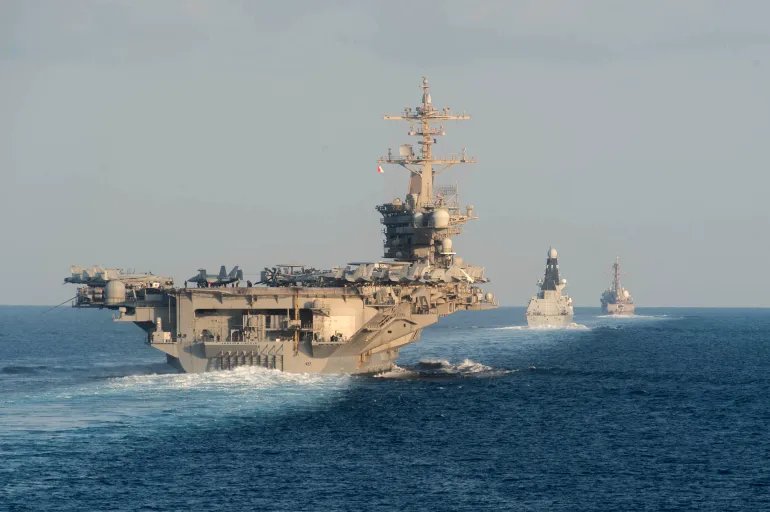 From left to right: the aircraft carrier USS Abraham Lincoln, the air defense destroyer HMS Defender and the guided missile destroyer USS Farragut pass through the Strait of Hormuz (AFP).
Instead, he said, Tehran is continuing what he called a failed strategy of attacking Gulf states in the hope that they will pressure Washington to end the war. This, in his opinion, is unlikely, since Trump “did not consult with the Gulf countries before starting this war and did not implement what was agreed upon.”
According to al-Shaiji, Iran’s continued attacks on desalination facilities in the height of summer in a country like Kuwait, whose population is heavily dependent on desalinated water, not only violate international law, but also reflect a deliberate attempt to make life difficult for civilians. He noted that Kuwait is among the Gulf countries most opposed to normalizing relations with Israel, but has taken the brunt of Iranian attacks.
Al-Shaiji said Iran has abandoned rational political calculation and is pursuing a course that will further isolate it while eroding what remains of its credibility. At the same time, he argued that Gulf states should develop a new regional security structure after the current war exposed the limits of reliance on U.S. defense.
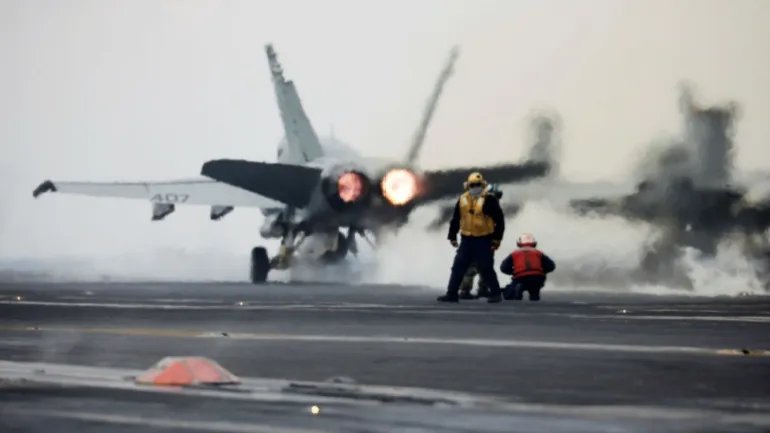 A US Navy F-18 fighter takes off from the deck of an aircraft carrier (Reuters)
Dragging the region into war
The war began in late February after Trump ordered a joint attack on Iran with Israel. Since the US and Iran signed a memorandum of understanding in June aimed at extending a fragile ceasefire and continuing talks on a peace deal, each side has accused the other of repeated violations of its pact.
While al-Shaiji acknowledged Trump’s role in the conflict, he stressed the importance of resuming mediated talks, refraining from Gulf states retaliating against Iran and developing a strategy of collective coordination while reducing dependence on the US to avoid inadvertently wider war.
Abdullah Bandar al-Otaibi, assistant professor of international relations at Qatar University, echoed al-Shaiji’s assessment. He said neither the United States nor Iran wants a full-scale war, and both sides are selective in their choice of targets.
Al-Otaibi also agreed that Iran had avoided attacking US naval installations for fear of “opening the gates of hell” to itself, relying instead on a strategy of pressuring Washington through the Persian Gulf, despite its limited effectiveness.
Selective targeting
Al-Otaibi also attributed Iran’s reluctance to attack American refueling planes flying from Israel’s Ben Gurion Airport to Tehran’s desire to avoid widening the conflict, preferring instead to attack Gulf countries in an attempt to calm domestic public opinion, especially because it believes those countries are unlikely to go to war.
Al-Utaybi told Al Jazeera that the situation could escalate if any Iranian attack results in significant civilian casualties in the Gulf state, pointing to Tehran’s determination to impose what he called a unilateral deterrence equation.
Regarding Washington’s focus on the Strait of Hormuz, he said the goal is to transform the strait from a strategic pressure card in Iran’s hands into a political liability, as Tehran will be unable to assert full control over it while its economy bears the costs of escalation.
Al-Otaibi said Iran’s attack on Oman just a day after Foreign Minister Abbas Araghchi visited Muscat highlights the failure of Iran-Oman talks and also reflects Tehran’s desire to assert full control of the strait rather than share influence with Oman.
He also noted that the Iran-aligned Houthis in Yemen are still staying away from confrontation after previous US attacks, seeking to avoid losses now being suffered by Hezbollah in Lebanon and Iran-linked groups in Iraq. This, he said, further increased pressure on Tehran.