

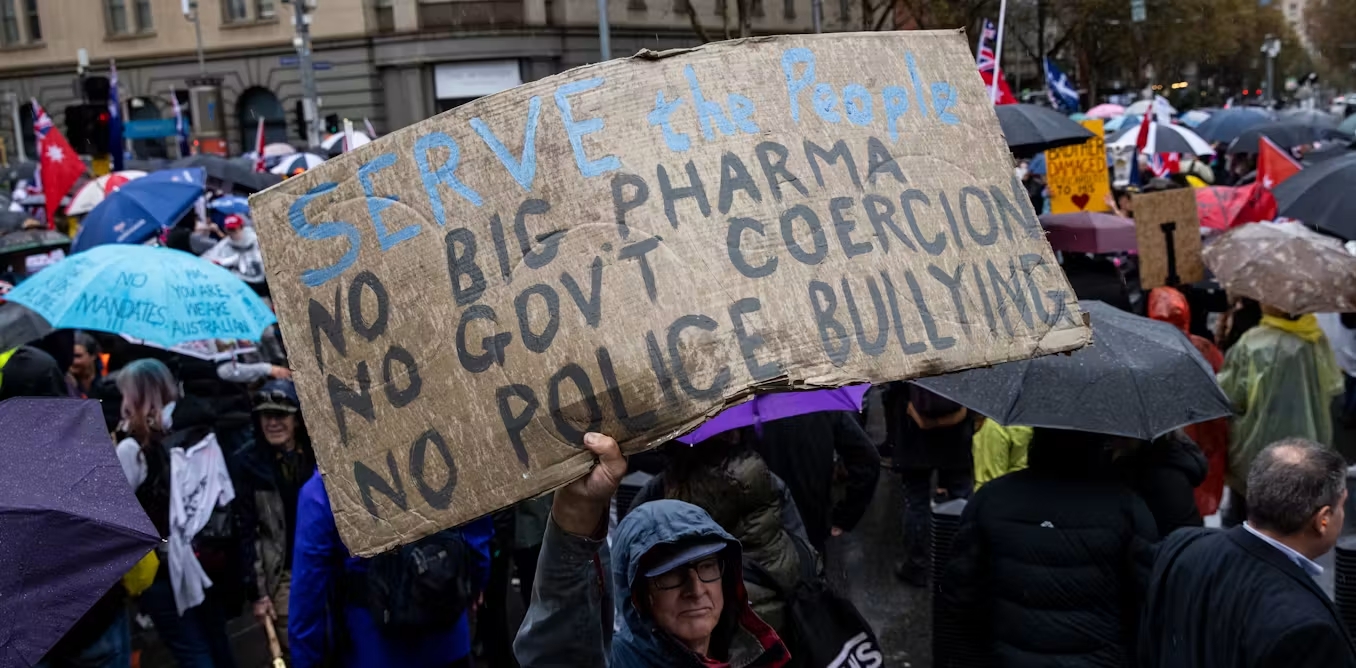
Child vaccination rates around the world have fallen sharply. In some countries, people are more reluctant to get vaccinated. Populist politicians promote distrust in government and scientific institutions. And the economics of disinformation mean that we cannot agree on the facts behind political debates.
Did COVID vaccine requirements that placed legal restrictions on where people who had not received a COVID vaccine could go or work led to this mess?
Some scientists in the United States seem to think so.
Australia’s COVID investigation has found that COVID vaccination requirements have led to vaccine hesitancy and skepticism. He drew a clear line between mandates and mistrust of government and medical science.
But it’s hard to make the case that COVID vaccination requirements are entirely to blame for today’s litany of woes. It is difficult to separate the impact of vaccine mandates from the effects of other COVID-era enforcement measures, such as quarantines or border closures.
Yet, as my colleagues and I are discovering, these mandates had consequences.
Leaders believed vaccine mandates were necessary
We assess the impact of COVID vaccine mandates on the uptake of COVID vaccines, how people feel about these mandates, the groups that may have been harmed, and how the mandates have been legally challenged.
As part of an ongoing MandEval project, I interviewed more than 130 senior people in government and politics in Australia, the UK, Europe and California to find out why many decision-makers believe vaccines are necessary.
While analysis of these interviews has not yet been published, generally speaking, each Australian state and territory had its own reasons for mandating COVID vaccination, as did governments overseas.
Leaders foresaw some negative consequences. They were concerned about negative reactions, including from people who were willing to comply with other preventative measures such as quarantines and border closures. They feared that people might become resistant to vaccines or stop trusting them in the future. But they believed vaccine mandates were necessary to protect lives.
This policy has certainly led to higher vaccination rates.
But there may be a price to pay: childhood vaccination coverage is currently suboptimal in Australia. More parents are falling for misinformation about vaccines than in pre-pandemic times. Even more concerning is the vaccination of adolescents and adults.
However, people unhappy with COVID vaccine requirements are not the driving force behind all these changes. Less direct mechanisms also contribute.
So what’s going on?
COVID vaccination mandates have contributed to “reactance,” where people respond to restrictions on their freedom with resistance.
The mandates could also increase political polarization over vaccinations. This is where political camps are divided over the safety and benefits of vaccination. This is dangerous because high vaccination rates are based on the fact that it is boring and bipartisan.
Influential people are joining us with their eyes on the money that can be made through public engagement on divisive issues. Even before the pandemic, foreign actors were using bots to fuel the vaccine debate in an effort to destabilize society.
Content creators have both financial and geopolitical incentives to cause outrage or polarization. As the disinformation economy flourishes, populist politicians benefit from low trust and high disillusionment with institutions.
In this situation, a small number of people – but more than before COVID – are refusing vaccinations. However, mandates are, at best, one of many driving factors. These issues also plague countries that have largely avoided mandatory vaccinations.
Declining trust in government
Vaccine hesitancy is also linked to distrust of government and health care institutions.
For example, people’s concerns about the safety or effectiveness of vaccines may reflect deeper concerns about the expert systems that manage vaccination programs. This mistrust has emboldened a minority who have been vaccine hesitancy long before COVID vaccination requirements were introduced.
COVID vaccination mandates have also undermined some people’s perception of the government.
My team’s research in Western Australia found that people who refused COVID vaccines already had negative views of the government, but when governments introduced mandates they felt morally punished.
This has given rise to nightmarish predictions of persecution and harm on an industrial scale. Based on their confusion and distrust, some of our members who were regularly vaccinated before the pandemic have vowed never to do so again.
More recently, we have been trying to understand the political shifts of mandate opponents in the progressive city of Fremantle.
Our new paper details how potential participants’ deep mistrust of government and university researchers led them to refuse to participate altogether or to skimp on what they disclosed.
What’s next?
If we want to use vaccine mandates in the future, we need to work differently with communities before the next extreme disease outbreak.
In the current climate, building trust in vaccinations and government institutions is not easy. However, governments can ensure transparent information about the benefits, risks and uncertainties of vaccination, and programs that are accessible and well communicated.
We also need mechanisms to allow communities to participate in decision-making about such outbreaks. Governments could create citizen groups that could comment on proposed policies, ask questions of experts, and make recommendations on communications.
We must also communicate the case for vaccine mandates more clearly. The public needs to hear transparent ethical arguments and understand the public benefit.
Finally, there is the issue of vaccine side effects. We know that vaccines, like all medicines, carry a risk of side effects. But during the pandemic, this was generally thought to be much lower than the risk of side effects from contracting COVID.
The COVID inquiry has recognized the importance of a compensation scheme for rare vaccine injuries. But the Australian scheme was short-lived and was criticized for being difficult to access. The investigation noted that very few claims were paid.
Without an accessible and fair scheme, dissatisfied consumers learn to distrust government motives and programs. This view threatens vaccination programs not only during the pandemic, but also after it.
I appreciate feedback on this article from Chris Blyth, Amy Thomasson, Jane Williams, and Chas Dolphin. I am grateful for the ongoing intellectual contributions of the entire MandEval team.