
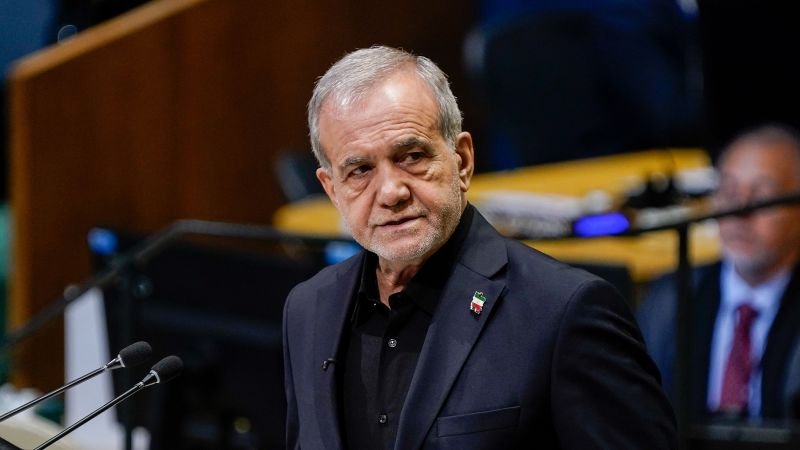
Iranian President Pezeshkian Addresses War, Nuclear Threats, and Sanctions in Rare New York Briefing
Iranian President Masoud Pezeshkian’s media appearances are typically tightly controlled affairs within his own country. But in a striking departure from the norm, the Iranian leader sat down on Thursday to face unscripted questions from a group of journalists in New York. The wide-ranging briefing took place at the Millennium Hilton hotel, a stone’s throw from the United Nations headquarters, where just a day earlier he had declared that Iran “will not bow down” as the war with the United States drags on.
Despite leading a nation actively at war with the United States, Pezeshkian is visiting American soil under the protection of the U.S. Secret Service. The session, held alongside Iran’s Foreign Minister Abbas Araghchi, covered familiar Iranian positions on the conflict, its nuclear program, and domestic dissent, while also addressing the profound impact of U.S. sanctions and controversial allegations of assassination plots against U.S. leadership.
An Unprecedented Visit Amidst Active US-Iran Conflict
The presence of Iran’s delegation in a country with which it remains at war is virtually unprecedented. The spectacle became increasingly unconventional as the Iranian president and his foreign minister briefed reporters, including correspondents from CNN, in a function room in Midtown Manhattan.
A U.S. State Department official clarified earlier this week that the visiting Iranian delegates were being admitted strictly for the purpose of representing the Islamic Republic before the United Nations. They are required to restrict their activities to UN-related business only. Furthermore, the delegation must seek and receive advance approval from the State Department to travel outside the immediate vicinity of the UN headquarters, John F. Kennedy International Airport, or Iran’s UN mission facilities.
Supreme Leader Mojtaba Khamenei’s Health and War Strategy
During the briefing, Pezeshkian addressed mounting speculation regarding the health of Iran’s Supreme Leader, Mojtaba Khamenei, who has not been seen in public since the outset of the war. Khamenei is understood to have sustained serious injuries during the U.S.-Israeli attack at the beginning of the conflict in February, an assault that killed his father and predecessor, Ali Khamenei.
Pezeshkian offered a reassuring assessment of the Supreme Leader’s condition based on recent interactions. “I did not see any major challenges with his health or physical appearance,” Pezeshkian stated. He noted that their most recent in-person meeting took place around one month ago, lasting approximately seven hours. The president added that the pair had sat on pillows on the ground and stood up to walk around during the meeting.
Despite his injuries, U.S. intelligence assesses that Mojtaba Khamenei is still playing a critical role in shaping war strategy alongside senior Iranian officials, according to multiple sources familiar with the intelligence assessments reported in May.
Denials of Assassination Plots Against Donald Trump
One of the most pointed moments of the briefing came when Pezeshkian addressed accusations that Iran was actively trying to kill U.S. President Donald Trump. He firmly denied these allegations, stating that it has “never been the position [of the Iranian government], overtly or covertly, to seek to assassinate Trump or his family members.”
“It has never been the position [of the Iranian government], overtly or covertly, to seek to assassinate Trump or his family members.”
These denials come amid a backdrop of escalating tensions and threats. Last month, the U.S. Secret Service acknowledged awareness of a video aired by Iran’s state broadcaster that appeared to threaten the life of Barron Trump, the president’s youngest son. This followed intelligence shared by Israel with the U.S. detailing an Iranian plan to assassinate Donald Trump. In late 2024, the U.S. Justice Department also announced federal charges over what it described as a thwarted Iranian plot to kill Trump before the presidential election.
Hard-line Iranian media have repeatedly featured content threatening the lives of Trump and his family. During funeral events for the late Ali Khamenei in July, regime loyalists were seen holding posters with the words “Kill Trump.” Trump himself has publicly discussed these threats, stating in July: “I’m on whatever list … so far, I guess I’ve been a bit lucky, but maybe that doesn’t last very long. These are evil, sick people.”
Economic Strangulation and the “Silent Murderous Campaign”
Pezeshkian did not shy away from discussing the severe domestic challenges facing Iran. U.S. sanctions and the ongoing war have suffocated the country’s economy, sparking significant price increases and widespread shortages of basic necessities. The economic situation was already dire before the war began, with poor conditions serving as a key driving factor behind the anti-regime demonstrations that erupted in Tehran in 2025.
“We have problems. Unprecedentedly difficult problems. [U.S. sanctions are a] silent murderous campaign.”
Despite the economic squeeze, Pezeshkian appeared confident that Iran would ultimately prevail. He insisted that U.S. military bases in the region were legitimate targets since they had been used to attack Iran, claiming that “most of the American bases in the region are no longer useable.”
A Path to De-escalation: The Islamabad Memorandum and the Strait of Hormuz
Amidst the tough rhetoric, there were signals of a potential diplomatic off-ramp. Pezeshkian mentioned that Iran wants a deal, though he emphasized that any agreement would not be tied to the timing of the U.S. midterms.
Separately, Foreign Minister Araghchi revealed that Iran had presented a proposal to the U.S. aimed at re-opening the Strait of Hormuz and restarting negotiations toward a “final deal.” The proposal, delivered through mediators this week, calls for the U.S. to meet certain conditions within seven days to restart talks and re-open the strategic waterway. While Araghchi declined to elaborate on the specific conditions, he noted they were “nothing more” than what was already included in the Islamabad Memorandum of Understanding.
| Islamabad MOU Key Provisions (June 2026) | Objective |
|---|---|
| Sanctions Relief | Ease economic pressure on Iranian citizens and state functions. |
| Release of Frozen Assets | Unlock Iranian financial resources held internationally. |
| Cessation of Military Operations | Halt active conflict, including military actions in Lebanon. |
Iranian Military Posture and Regional US Bases
Pezeshkian’s claims regarding U.S. bases are not without precedent. Iranian strikes damaged and destroyed hundreds of buildings and structures at U.S. bases across the Middle East during the first months of the war, according to an official Pentagon watchdog report released earlier this month.
Remarking on the broader military dynamic, Pezeshkian conceded the vast destructive power of the United States but remained defiant about Iran’s resolve. “Of course, the U.S. has the power to destroy anything anywhere, but it is impossible to bring about Iranian surrender,” he told reporters.
White House Response to Iranian Claims
In response to Pezeshkian’s comments, White House spokesperson Anna Kelly pushed back against the Iranian narrative. “The Iranian regime has murdered thousands of its own people, killed Americans overseas, executed acts of terrorism in the Strait of Hormuz, and launched indiscriminate attacks against its neighbors in the region,” Kelly said.
She further defended the U.S. administration’s posture, stating, “The president is courageously ensuring that such an evil country never possesses a nuclear weapon, which will make the entire world safer and more stable.”
As the UN General Assembly continues, the rare presence of the Iranian delegation in New York underscores the complex and highly volatile nature of the ongoing conflict. While diplomatic channels appear to remain marginally open through proposals like the Islamabad MOU, the fundamental disagreements over military actions, nuclear ambitions, and regional dominance continue to drive a deep wedge between the two nations.
News, Government, Business, Finance, Law, Society, People, US-Iran War, Masoud Pezeshkian, Mojtaba Khamenei, United Nations General Assembly, New York, Strait of Hormuz, Donald Trump, Sanctions, Nuclear Program, Iran, United States, Assassination Plot, Islamabad Memorandum of Understanding, Abbas Araghchi, Middle East, Diplomacy, Conflict, Economy

