

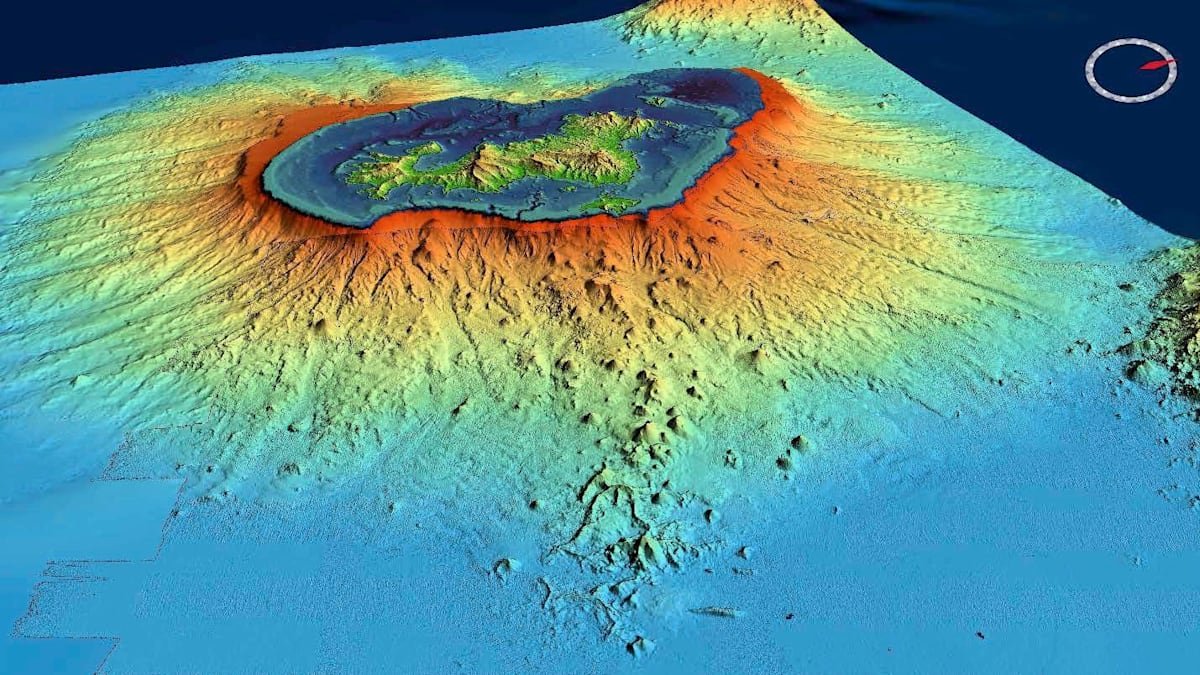
First, a volcano appeared where it should not have been. Now researchers are discovering that it even feeds on magma that is billions of years old. This find was a real success for geosciences.
The Mayotte archipelago in the Indian Ocean, located between Madagascar and the coast of Mozambique, is the crown jewel of the remaining French South Sea islands. Surrounded by the ocean, it sits on a volcanic plateau that is half submerged and forms one of the largest and deepest lagoons in the world.
In 2018, the idyll was shaken by a series of earthquakes. On May 15, the eruptions reached a magnitude of 5.9 on the Richter scale and damaged several buildings of the island’s residents. Scientists were surprised – before this, the area was considered seismically stable.
Several major research organizations, including eight French universities, have undertaken to find out the cause of the mysterious activity. Several ship expeditions deployed and soon found answers about 55 kilometers east of Mayotte.
There, at a depth of 3.5 kilometers, magma arose, which by 2021 formed an underwater volcano, which now rises 800 meters above the seabed. The volcano, named Fani Maore, is now surprising scientists again.
The study, published in the journal Nature, examined the chemical nature of the resulting rock and found evidence of material from our Earth’s early history that must have been preserved in the Earth’s mantle from at least 4.3 billion years ago.
For their discovery, the researchers used innovative methods. Based on the isotopic signatures of the rock samples, they were able to determine that the magma came from a deep chamber in the Earth’s mantle. The material appears to have been stored there for billions of years, protected from tectonic movements.
Until now, this was considered almost impossible. The constant movement of plates must mix the rocks of the Earth’s mantle. Consequently, mineral traces of the first days of the existence of the earth’s layers should disappear inside the mantle.
The materials found are likely some of the first rocks to crystallize as the early magma ocean cooled. Researchers from the Institute of Physics of the Earth in Paris believe that most of the ancient material is bridgmanite, a mineral that forms under the enormous pressure of the Earth’s lower mantle.
The age of the Earth is estimated at 4.54 billion years. The traces now found lead directly to the initial phase of the planet’s life cycle. The first small-celled life probably formed on it 3.5–4 billion years ago. During this time he underwent radical transformations.
Early in Earth’s history, Theia, a celestial body the size of Mars, collided with the planet. The young Earth survived the impact, and the Moon was likely formed from debris. But subsequently the earth’s surface was covered with a huge ocean of magma.
Only when it cooled did solid rock form. In the cooled magma of Fani Maore off the Mayotte Islands, remnants of this embryonic phase of the planet’s development may have been discovered for the first time in volcanic rocks.
Finding is luck. Lead author Catherine Chauvel said the discovery has far-reaching implications for geological sciences. For the first time, evidence has been obtained that relics from the time of the formation of the Earth have been preserved in the bowels of the Earth to this day and can reach the surface through volcanic processes. At the same time, the results show that the interior of our planet is much less mixed than previously thought.