

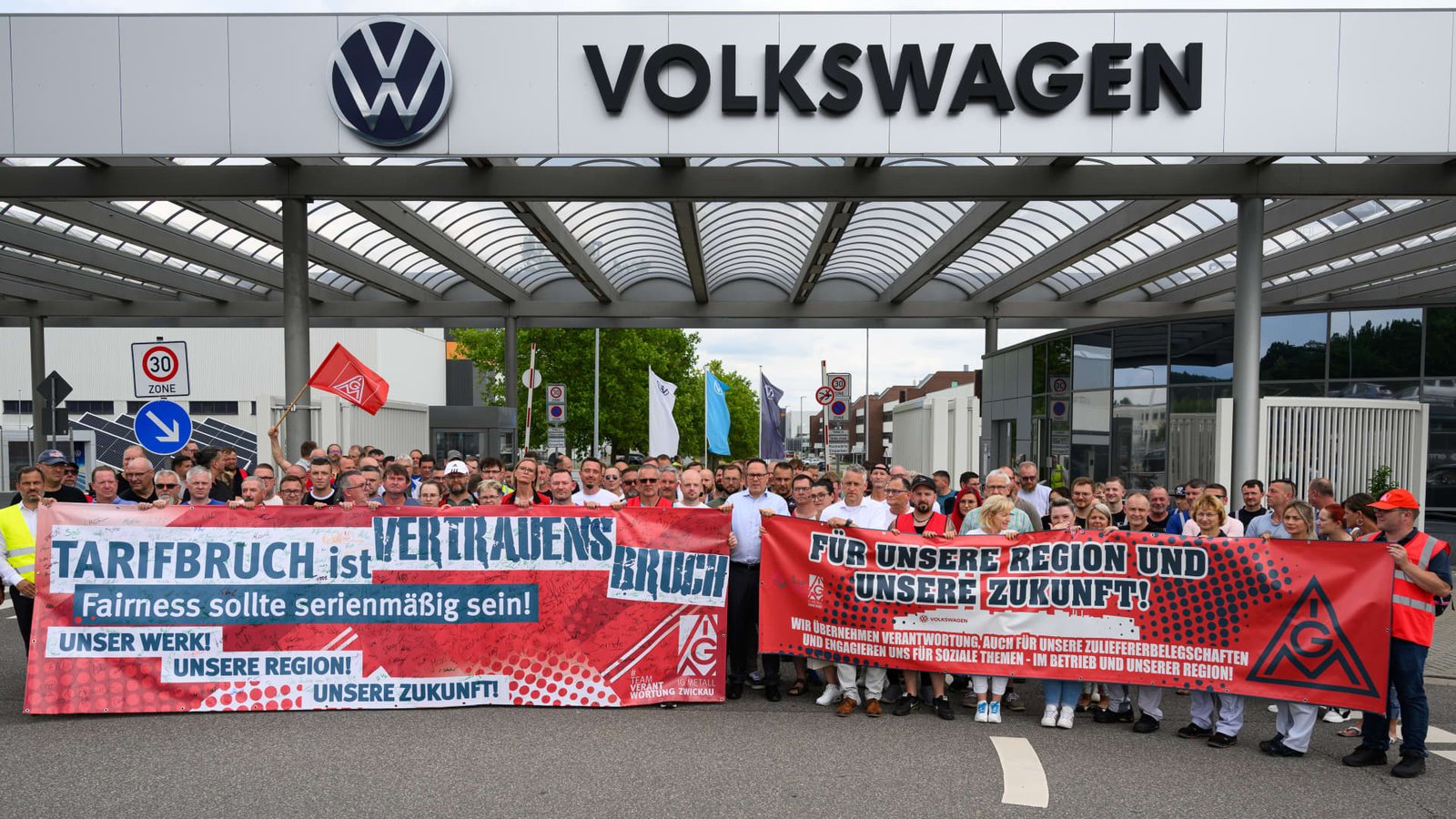
Employees of Volkswagen Sachsen GmbH stand with Dirk Panter (SPD, M), Minister of Economic Affairs of Saxony, in front of the gates of the Volkswagen plant.
Photo Alliance | Photo Alliance | Getty Images
Volkswagen is bracing for a high-stakes boardroom showdown after reports the embattled auto giant is considering closing four German factories and cutting up to 100,000 jobs.
The mass layoff plan, which would be the most radical reform in the firm’s nearly 90-year history, is strongly rejected by German lawmakers and powerful unions.
The standoff sets the stage for what will be the most anticipated corporate event of the year in German industry when Volkswagen management tries to win approval from the firm’s supervisory board on July 9.
The supervisory board will have to approve the cost-cutting program, according to Manager Magazin, which first reported the company’s restructuring plans on Friday.
Volkswagen’s notoriously complex board structure means the company’s management faces a difficult road ahead, auto analysts say.
A Volkswagen spokesman declined to comment ahead of the July 9 meeting. The company previously declined to comment on reports of layoffs and plant closures, saying decisions would be made and approved by the relevant governing bodies.
“The entire group, including its brands and subsidiaries, must undergo profound changes,” a Volkswagen spokesman said.
Europe’s biggest car maker has already laid out plans for massive job cuts and launched a major product offensive as it seeks to counter pressures ranging from US import tariffs to increased competition from Chinese car brands.
However, the latest reported layoffs are double the previously announced 50,000 job cuts and now presumably include the closure of four German plants: Hannover, Zwickau, Emden and the Audi plant in Neckarsulm.
Volkswagen Law
Volkswagen management will have to prove at a meeting of the supervisory board on July 9 that there is no alternative to these measures, said Thomas Besson, head of automotive research at Kepler Cheuvreux.
“This will be a very difficult step to implement,” Besson said, especially since the German state of Lower Saxony, where Volkswagen is based and operates several plants, is a key shareholder.
The state, which owns 20% of Volkswagen’s voting shares, has significant influence over the company, thanks in part to the so-called Volkswagen Law. This decades-old measure turned the company into a joint stock company and effectively limited management’s ability to close plants.
“They have no choice but to adapt. It will be a very complex process with stakeholders – and that’s why it’s a tough job for VW management right now,” Besson told CNBC’s “Europe Early Edition” on Wednesday.
An employee of Volkswagen Sachsen GmbH stands with his arms crossed in front of the gates of the Volkswagen plant.
Photo Alliance | Photo Alliance | Getty Images
Volkswagen’s General Works Council and German industrial union IG Metall have vowed to fight back against reports of job cuts and plant closures. “If such plans were to be implemented, we would prevent them with all our might,” the joint statement said, according to a translation.
Volkswagen’s decision to weigh layoffs and plant closures also faced stiff opposition from Chancellor Friedrich Merz’s coalition government, which is struggling with historically low approval ratings.
German government spokesman Stefan Cornelius told a news conference Monday that the government’s ultimate goal is to “preserve the locations of German manufacturers and guarantee jobs,” according to a translation.
At the end of 2024, Volkswagen reached an agreement with unions to avoid plant closures in Germany and to avoid forced layoffs until the end of 2030.
“Strategic step”
Resistance to Volkswagen’s reported restructuring plans opens the way to a tumultuous period of negotiations, said Rico Luhmann, senior sector economist specializing in transport and logistics at ING.
“It’s very difficult, but something has to happen, that’s for sure. Therefore, the supervisory board must also be aware of this urgency,” Luman told CNBC via video call.
Volkswagen’s problems are an illustration of the obstacles facing the European auto industry as a whole, Luhmann said, noting challenges to full electrification, competition with Chinese car brands and export problems in major markets.
Stock chart icon. Stock chart icon.
Volkswagen shares this year.
“They’re still profitable, aren’t they? But plans are said to be to brace for decline or losses over the next few years. So this is a strategic step for what will happen in the future,” he added.
Volkswagen shares fell slightly on Wednesday, trading at levels not seen since the summer of 2010. The shares, which are down nearly 33% year to date, hit a new 52-week low since news of the accelerated restructuring first emerged last week.
Choose CNBC as your preferred source on Google and never miss a beat from the most trusted business news source.