
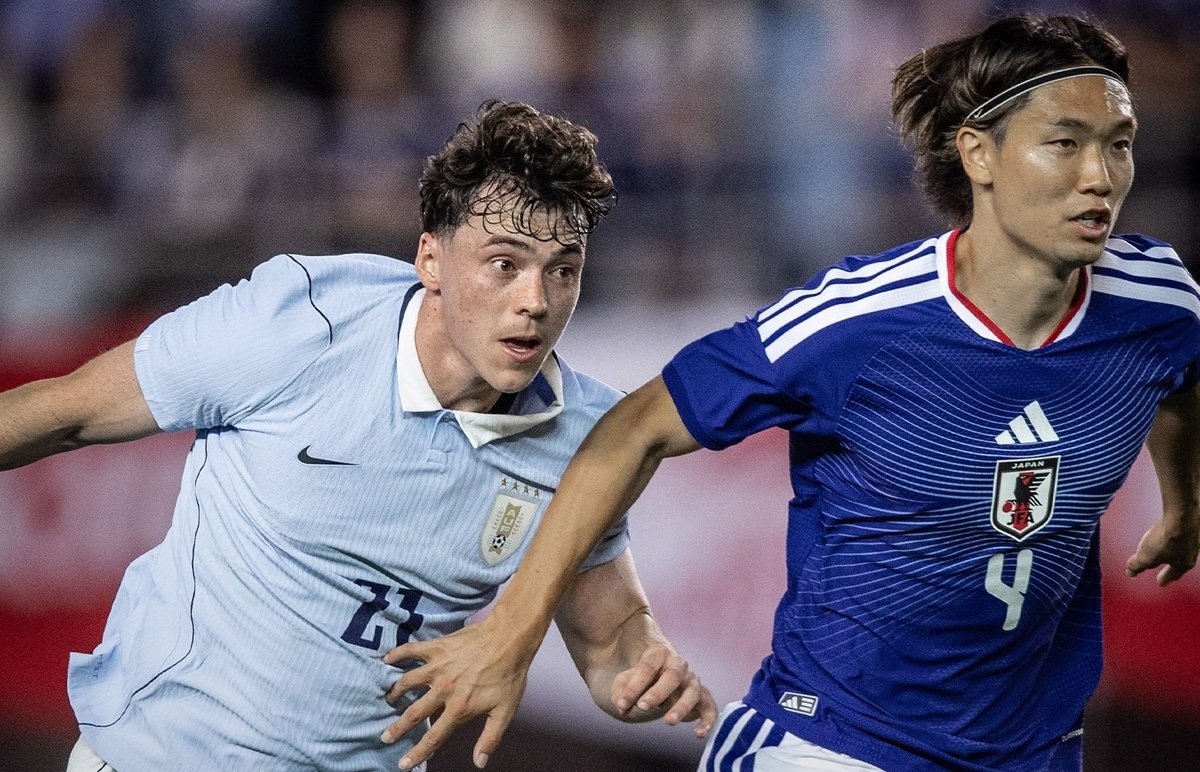
Diego Forlán’s Uruguay Debut Ends in 3-1 Defeat to Japan
Uruguay’s first friendly under Diego Forlán as national-team coach ended in a 3-1 defeat to Japan at Q&A Stadium in Miyagi. The visitors took control after an early Japanese goal, recovered to draw level before half-time, and then conceded twice in stoppage time as the match slipped away.
Forlán arrived at the stadium with Uruguay level at 1-1 in the 90th minute. Japan’s greater control in midfield and decisive finish in the final minutes made the result a difficult introduction for the former Uruguay striker.
How Japan Scored First and Uruguay Equalized
Uruguay created an early opportunity after six minutes when Rodrigo Bentancur found Brian Rodríguez with a long pass. Rodríguez attacked the space near the second post, but Federico Viñas could not reach the ball in time to turn the chance into a goal.
Japan responded after 11 minutes. Kuryu Matsuki received the ball from Keito Nakamura, turned inside from the right and fired a low, cross-body shot past Santiago Mele. The goal gave Japan momentum and allowed the hosts to settle into a more comfortable rhythm.
Uruguay’s best response came before half-time. Lucas Torreira pressed high to win possession, Bentancur found Viñas inside the area and the Toluca forward forced a save from Tomoki Hayakawa. Maxi Araújo scored from the rebound to put Uruguay 1-1.
| Minute | Event | Score |
|---|---|---|
| 11’ | Kuryu Matsuki scores for Japan | Japan 1-0 Uruguay |
| 42’ | Maxi Araújo scores from the rebound | 1-1 |
| 92’ | Kento Shiogai restores Japan’s lead | Japan 2-1 Uruguay |
| 96’ | Ayase Ueda finishes the counterattack | Japan 3-1 Uruguay |
Japan’s 3-4-3 Controlled the Middle of the Pitch
Japan’s 3-4-3 was more dynamic than Uruguay’s 4-4-2. The hosts won possession higher up the pitch, held the ball for longer periods and created sustained pressure through the midfield and wide areas.
Uruguay generally sought quick, direct passes, but Japan limited the number of repeated chances that followed. Mele was tested by a Maximiliano Araújo header in the 38th minute, although the goalkeeper produced the necessary rebound to keep the score level.
The tactical imbalance became clearer after half-time. Uruguay continued to look for transitions, while Japan combined compact defending with quicker changes of direction. The hosts’ numerical advantage on the flanks made it harder for Uruguay to retain possession or protect their box consistently.
Late Errors Sealed Japan’s 3-1 Win
Uruguay produced some of its better moments of the second half. Rodrigo Zalazar tested Hayakawa with a shot from outside the area, while a mistake from Junya Ito created a promising counterattack for Darwin Núñez.
Núñez had a clear opportunity after Ito passed the ball badly behind him, but the striker attempted to beat the goalkeeper rather than take the simpler finishing route. The missed chance left Uruguay needing a late response.
The decisive phase began with Kento Shiogai, one of Japan’s most effective substitutes. He combined with a teammate against a passive Uruguayan back line and finished face-to-face with Mele in the 92nd minute. Four minutes later, Ayase Ueda converted a counterattack with a long dribble past Mele, completing Japan’s comeback.
Diego Forlán’s Lineup and Substitution Choices
Uruguay started with Santiago Mele in goal. The defensive line featured Nahitan Nández, Ronald Araújo, Mathias Olivera and Juan Manuel Sanabria, while the midfield was anchored by Brian Rodríguez, Lucas Torreira, Rodrigo Bentancur and Maximiliano Araújo. Federico Viñas and Darwin Núñez led the attack.
Forlán introduced José María Giménez for Araújo and Rodrigo Zalazar for Rodríguez in the 67th minute. Giorgian de Arrascaeta replaced Viñas at the same stage, before Facundo Bernal came on for Bentancur and Facundo Pellistri replaced Maximiliano Araújo.
Japan’s coach, Hajime Moriyasu, started Tomoki Hayakawa in goal behind Kou Itakura, Hiroki Ito and Ayumu Seko. Ritsu Doan, Kaishu Sano, Kodai Sano and Keito Nakamura played in midfield, with Kuryu Matsuki, Daizen Maeda and Yuito Suzuki ahead of them.
The supplied team sheet lists Juan Manuel Sanabria both as a starter and as a 79th-minute substitute, an internal duplication that should be checked against the official lineup before publication.
Uruguay’s Next Fixtures After the Japan Friendly
Uruguay will next face South Korea on Monday, Sept. 28, at the world-class stadium in Seoul. The tour will close against India on Tuesday, Oct. 6, at the VYBK in Calcutta.
Those matches provide Forlán with further opportunities to establish his preferred structure. The immediate priorities are clear: improve defensive concentration, reduce the space between the lines and turn counterattacking chances into goals.
What the Defeat Reveals About Forlán’s Uruguay
The defeat does not erase the positive signs from Uruguay’s first match under Forlán. The team responded after going behind, Torreira’s pressing helped create the equalizer and Viñas produced an important save. Uruguay also had chances to control the second half and forced Japan to work for the decisive goals.
Nevertheless, the final 15 minutes exposed the central lesson of the debut. Japan punished a passive defensive block and converted one mistake into a winner, then added a second through a fast counterattack. Forlán’s next challenge will be giving his side enough structure to remain compact when the match becomes tight.
Sports, News, Football, International Football, Uruguay National Team, Japan National Team, Diego Forlán, Friendly Matches, Q&A Stadium Miyagi, Miyagi, Seoul, Calcutta

