

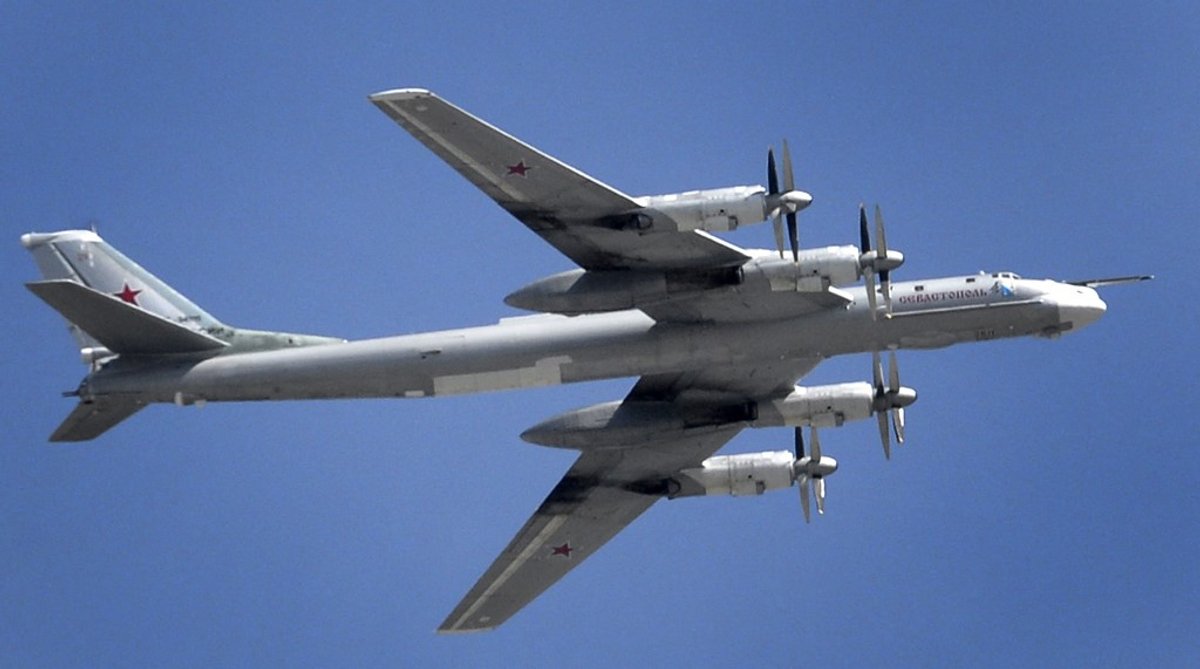
Ukraine’s Security Service (SBU) said it destroyed a Russian Tu-95 strategic bomber at Engels Air Base in Russia’s Saratov region during a long-range drone strike, with President Vladimir Zelensky praising the operation as another successful “long-range sanction” against Moscow.
On Friday, July 17, the SBU said its long-range drones flew about 800 kilometers (about 500 miles) to reach the target.
JOIN US ON TELEGRAM
Follow our reports about the war on @Kyivpost_official.
“The SBU’s long-range drones covered about 800 kilometers to the target. According to preliminary data, the plane was seriously damaged – its tail was completely torn off,” the agency reported on Telegram.
The SBU said the bomber was regularly used to carry out large-scale missile attacks on Ukraine.
The agency said the operation was carried out as part of efforts to reduce Russia’s military and economic potential in accordance with the tasks set by Zelensky.
“The SBU is systematically destroying important elements of the Russian military machine. Each destroyed strategic bomber means dozens of missiles that will not be launched at Ukrainian cities, the lives of Ukrainians saved and tens of millions of dollars in irreparable losses for the enemy,” the message says.
The SBU added that Russian strategic aviation “can no longer feel safe even at the most remote military airfields.”

Other topics of interest
Putin is leading Russia to ‘chaos’, says anti-war politician
A Kremlin critic faces arrest and a travel ban after challenging Putin and warning that Russia is heading toward repression, chaos and long-term decline.
Zelensky thanked Ukrainian forces for the strike Message in telegram.
“Our long-term sanctions against Russia for this war have once again proven successful. In particular, SBU forces destroyed a Tu-95 military aircraft in Engels, which was used to launch missile attacks on our country,” Zelensky said.
He called the attack a “fair and active defense” of Ukraine.
Zelensky also said that Ukrainian forces had attacked Russian oil industry facilities and other designated military installations in temporarily occupied Ukrainian territory.
“We are increasing the price that Russia pays for aggression against our state and our people,” he wrote.
Russian authorities have not yet commented on this statement.
Russia’s main long-range missile carriers
The Tu-95, which made its first flight in 1952, remains one of the main strategic missile carriers of the Russian Aerospace Forces.
As of 2023, Russia was estimated to have 45 Tu-95MS bombers and 18 modernized Tu-95MSM aircraft. The upgraded Tu-95MSM can carry the latest Kh-101 cruise missiles, while older variants are equipped with Soviet-era Kh-55 and Kh-555 cruise missiles.
Designed to engage strategic targets in any weather conditions and at any time of day, the Tu-95 can carry up to six cruise missiles on an internal rotating launcher.
The aircraft is powered by NK-12 turboprop engines, the most powerful turboprop engines ever created. Their effectiveness has helped the Tu-95 remain in service for decades, although they have also made it one of the most high-profile military aircraft in the world.
Main characteristics of Tu-95:
- Crew: 7
- Loaded weight: 190 metric tons.
- Top speed: 830 km/h (about 515 mph)
- Engine Power: 15,000 horsepower per engine.
- Combat radius: 6,500 km (about 4,040 miles)
- Maximum range: 13,000 km (about 8,080 miles)
- Estimated value: over $26 million.
Why Russia is using the Tu-95 against Ukraine
According to Defense Express, the Tu-160 is used less frequently, while the Tu-95MS carries out most of Russia’s long-range missile strikes against Ukrainian targets.
Military analysts claim that the Tu-95MS is more reliable and easier to maintain than the new Tu-160 strategic bomber.
The Kh-101 cruise missile mounted on the Tu-95MS has an estimated range of up to 5,500 km (3,420 mi) and weighs approximately 2,200–2,400 kg (4,850–5,290 lb). Analysts say the missile is difficult to intercept because it can maneuver and change its flight path after launch.
The Kh-101 is also among Russia’s most expensive conventional missiles, with an estimated cost of about $3 million per missile, roughly twice the reported price of the Kalibr cruise missile.