
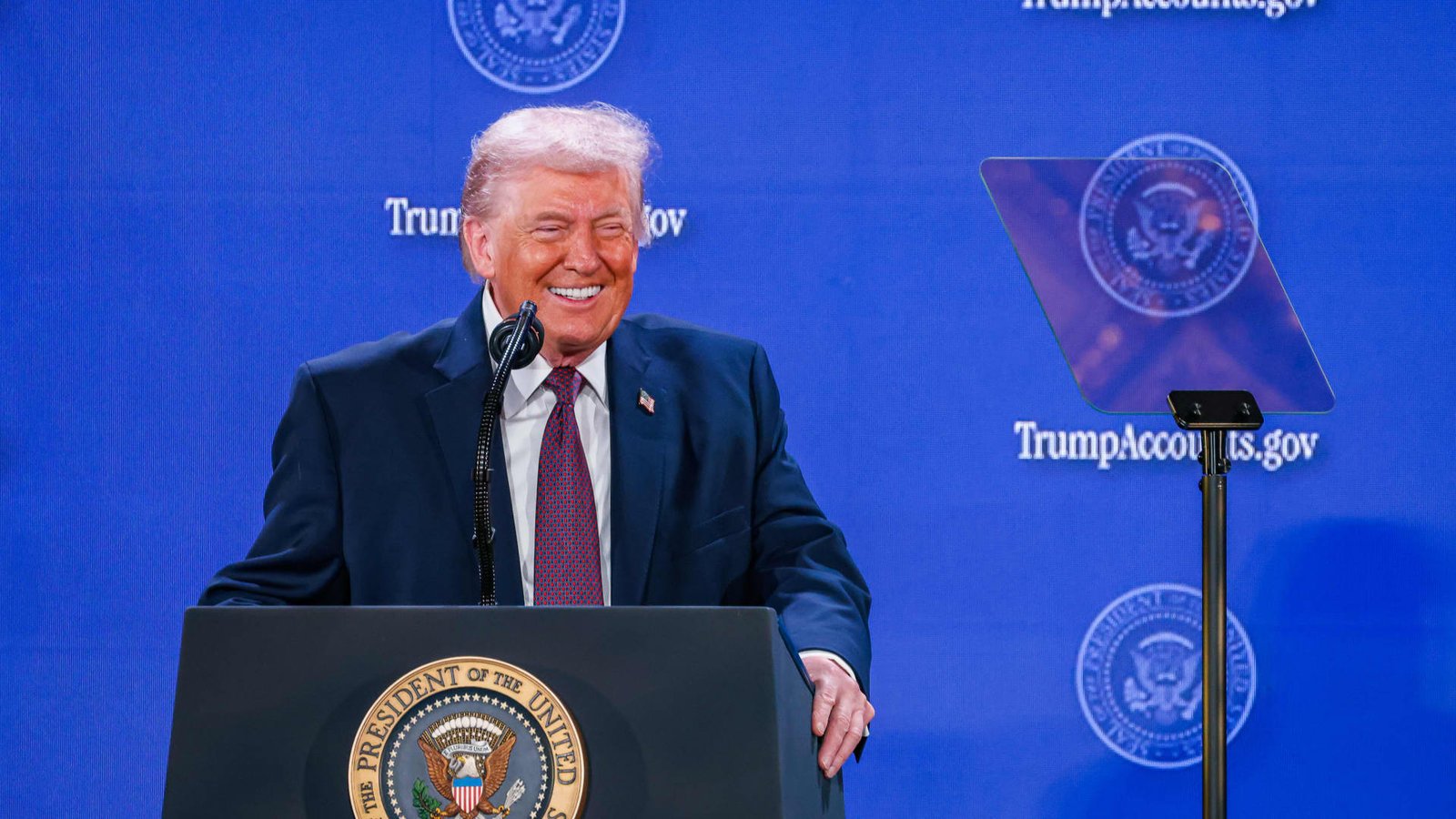
Trump Accounts Auto-Enrollment Set to Enroll Millions of Children Starting October 2026
The Department of the Treasury announced on Tuesday that temporary regulations will trigger automatic enrollment in Trump Accounts for millions of children as early as October 1, 2026. The move aims to lift participation from the current 7 million–8 million sign‑ups to an estimated 70 million within the first month of auto‑enrollment, with further growth projected at roughly two million new accounts per year thereafter.
Auto-enrollment Set to Boost Participation
Under the existing system, families must actively opt in by filing IRS Form 4547 with their tax return or registering via TrumpAccounts.gov. This opt‑in requirement has kept overall participation low, especially among low‑income households. The new temporary rule shifts the process to automatic enrollment, leveraging the Social Security Administration’s newborn registration workflow.
Projected Enrollment Numbers
The Treasury guidance estimates that auto‑enrollment could increase the number of children enrolled in Trump Accounts in 2026 by more than 60 million. In subsequent years, the regulations are expected to add about two million accounts annually. Treasury Secretary Scott Bessent told the House Financial Services Committee on September 15 that “we anticipate within a month we will have 70 million because we will go to auto‑enroll.”
Impact on Low-Income Families
Research from the Commonwealth nonprofit shows that only 5 % of low‑ and moderate‑income families—those earning up to $80,000 annually—have opened a Trump Account. Experts say auto‑enrollment removes a major barrier for these households.
Barriers to Access
Omeed Firouzi, a practice professor and director of the low‑income taxpayer clinic at Temple University’s Beasley School of Law, noted that the current sign‑up process involves “so many different strange ways” to enroll. He added that auto‑enrollment could be “positive for lower‑income folks,” who often face obstacles accessing tax‑advantaged programs.
Implementation Challenges and Expert Concerns
While auto‑enrollment promises higher uptake, questions remain about the federal government’s capacity to execute the change. Recent IRS cuts to funding, staffing, and resources have led some analysts to doubt whether the agency can manage the surge in new accounts without additional support.
Coordination Between Agencies
Firouzi suggested that improved coordination between the Social Security Administration and the IRS could ease implementation, especially if the same leader oversees both agencies. In July, the Treasury announced that IRS chief executive and Social Security Administration commissioner Frank Bisignano would head the Trump Account expansion. A subsequent IRS hire on Friday—Joseph Velli, former Bank of New York and Convergex Group executive—will serve as senior adviser to Bisignano specifically for the program.
Madeline Brown, senior policy associate at the Urban Institute, warned that even after enrollment is automatic, “there is still a lot of work to be done to build engagement and awareness.” She stressed that outreach and education will be crucial to ensure families understand how to use the accounts effectively.
As of September 26, 2025, no further developments beyond the Treasury’s temporary regulation announcement have been reported. The auto‑enrollment mechanism is slated to take effect on October 1, 2026, pending any future regulatory or legislative adjustments.
Finance, Government, Business, News, Trump Accounts, Auto-enrollment, Treasury Department, Internal Revenue Service, Social Security Administration, Urban Institute, Temple University, Commonwealth

