

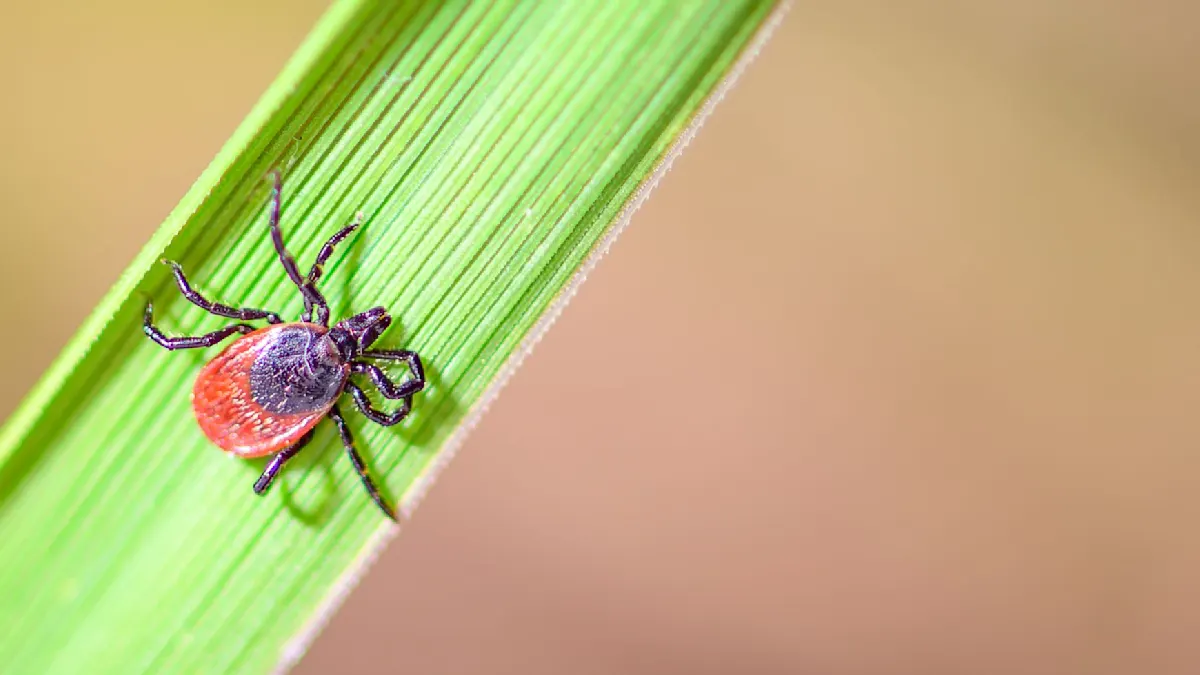
Whether in the forest, in the park or in your own garden: in the north, ticks are spreading more and more widely. “Ticks are increasingly found throughout Lower Saxony – both in the open air and in parks and gardens,” says Holger Scharlach, spokesman for the Lower Saxony State Health Authority (NLGA). Contact usually occurs in everyday life – not just on excursions.
Is the number of ticks on the rise in Lower Saxony?
“We are also seeing that tick-borne encephalitis, or TBE for short, is spreading further and further north from the southern and southeastern federal states,” explains Masyar Monazakhian, a virologist at the NLGA. The TBE virus can now be detected in ticks throughout Germany.
According to Monazakhian, in recent years new risk areas for TBE have also been identified in North Rhine-Westphalia and Saxony-Anhalt, whereas previously they were known mainly in southern Germany. “This shows that the trend is mainly northward, but an accurate forecast of how the regional situation will change in the coming years is not possible.”
Where is the risk particularly high?
In Lower Saxony, Emsland (from 2019) and Celle (from 2025) are recognized as TBE risk areas. The state health department has been closely monitoring the development of TBE for years and has been selectively testing ticks for the presence of these viruses, Monazakhian said. TBE virus has been detected in ticks in various locations, including the districts of Emsland, Cuxhaven, Nienburg and the Hannover region.
Ticks can be found in their immediate habitat, i.e. on the doorstep of a house, in their own garden or park – and not just deep in the forest. Animals are ubiquitous. “Contact occurs in everyday life, and not just on excursions,” the virologist emphasizes.
When is the season in Lower Saxony?
“The typical tick season from March to September virtually no longer exists,” explains Monazakhian. Due to climate change, ticks are now active year-round and pose a health risk at any time of year.
How many TBE diseases are there?
According to the Robert Koch Institute, this year, as of mid-July, five cases of TBE had been reported in Lower Saxony. Eleven cases were reported last year, and 13 cases in 2024. It is important to note that not every reported case can be linked to an infection in Lower Saxony.
The most well-known symptom of TBE disease is meningitis. Under certain circumstances, fever, headache or vomiting, and even bowel problems can indicate an infection.
What is the situation in Bremen?
As of mid-July, no cases of TBE had been reported in the state of Bremen, according to the senator’s health spokeswoman, Christine Wiesens. There were also no cases of TBE infection last year, so the disease was reported in 2024.
Should I get vaccinated?
You can protect yourself from TBE by getting vaccinated. For Lower Saxony, as for the whole of Germany, there is a vaccination recommendation from the Standing Vaccination Commission (STIKO): “Vaccination is recommended for all adults who live in a risk area and spend more time outdoors – and therefore have a higher risk of tick bites,” says Thomas Buck, deputy president of the Lower Saxony Medical Association. This is also recommended for travelers visiting risk areas within or outside Germany. “The general rule of vaccination is that it is usually very well tolerated and provides a very high level of protection,” the doctor emphasizes.
Vaccination may also be useful in regions where ticks have been found to have TBE. “This is something to consider, especially for people who spend a lot of time outdoors and have already been bitten by ticks,” Buck says.
Are children at greater risk?
Children especially spend more time outdoors and therefore have a higher risk of being bitten by a tick, Buck said. Parents should always monitor children for ticks after they spend long periods of time outdoors.
How common is Lyme disease?
In addition to TBE, ticks can also transmit Lyme disease. “It’s not a reportable disease, so there’s no data available,” Monazakhian says. However, throughout the country there is a risk of contracting Lyme disease after a tick bite. Depending on the region and stage of development of ticks, up to 35 percent are infected with Borrelia.
A typical sign of Lyme disease is a red ring of skin around the puncture site. There is no vaccine against this disease; it can be treated with antibiotics, especially in the early stages. “A tick that has bitten and firmly attached to the skin should always be removed as quickly as possible, because it takes several hours for the causative agents of Lyme disease to be transmitted to a person,” explains the virologist.
What is the effect of climate change?
“In Germany as a whole we are seeing a steady increase in TBE risk areas,” explains Buck. As a result, it is possible that in the future it should be assumed that the risk is generally high and that vaccination recommendations will even be generally enforced at some point.